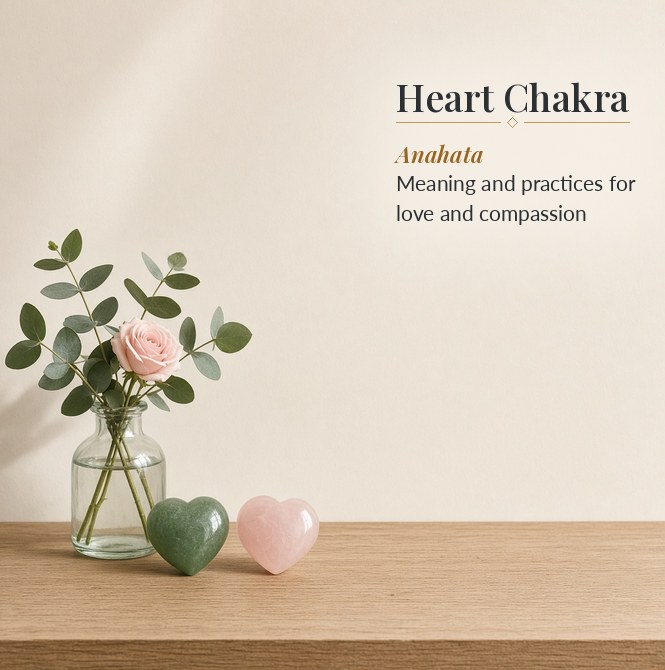
The heart chakra, called Anahata in Sanskrit, is the fourth of the seven main chakras. It is pictured at the centre of the chest and is traditionally linked with the air element, the colour green and the seed sound YAM. In modern wellness practice it is associated with love, compassion, forgiveness and connection with others.
Last updated: 4 November 2026
Reading time: about 17 minutes
How we wrote this guide: this guide was written by Saj Ali. It describes how the chakras are understood in yoga and tantric traditions and in modern wellness practice around the world, and every research claim links to its source.
Heart chakra in brief
- Name. Anahata, Sanskrit for “unstruck”, after the inner sound said to be heard in deep meditation.
- Where. The centre of the chest, level with the heart.
- Linked with. Air, the colour green (often pink too), the sense of touch and the seed sound YAM.
- Themes. Love for yourself and others, compassion, forgiveness, gratitude and openness.
- Practices. Loving-kindness meditation, heart-opening yoga poses, gratitude, forgiveness journaling and chanting YAM.
Chakra series: The 7 Chakras Explained · Chakra Meditation · Root Chakra (Muladhara) · Third Eye Chakra (Ajna) · Chakra Healing guide
Contents
- What Is the Heart Chakra?
- Heart Chakra at a Glance
- Where the Idea Comes From
- Signs of Balance and Imbalance People Describe
- Practices for Love and Compassion
- A 10-Minute Heart Chakra Practice
- Journal Prompts
- The Heart Chakra in Relationships
- Around the World
- What the Research Says About Chakra Practices
- Frequently Asked Questions
- Key Takeaways
- Explore More on Self Help Supermarket
- Sources
What Is the Heart Chakra?
The heart chakra sits in the middle of the seven main chakras, with three below it and three above. In the yoga and tantric traditions of India, the chakras are described as energy centres along the central channel of the subtle body (Encyclopaedia Britannica, chakra), and the heart chakra is often described as the bridge between them: between the physical, everyday concerns of the lower chakras and the more reflective, spiritual themes of the upper ones.
In modern practice, the heart chakra is the centre of love in all its forms: romantic love, friendship, family, kindness to strangers and, just as important, kindness to yourself. It is also linked with compassion, forgiveness, gratitude and the ability to give and receive care. When people describe an open heart chakra, they usually mean feeling warm, connected and at ease with others.
Heart chakra practice is gentle and practical. Most of it involves cultivating warm feelings on purpose, through loving-kindness meditation, gratitude, forgiveness and simple acts of care. For the bigger picture, see The 7 Chakras Explained, and for how chakra healing works as a whole, see our Chakra Healing guide.
Heart Chakra at a Glance
| Sanskrit name | Anahata (anāhata): “unstruck” or “unhurt”, referring to a sound that arises without two things striking |
| Position | Fourth of the seven main chakras, the midpoint of the system |
| Location | Centre of the chest, level with the heart |
| Colour | Green in the modern system, often with pink; older texts describe a red lotus around a smoke-coloured six-pointed star |
| Element | Air |
| Seed sound (bija mantra) | YAM |
| Lotus petals | Twelve |
| Sense | Touch |
| Core themes | Love, compassion, forgiveness, gratitude, empathy, connection, self-acceptance |
| Affirmation people use | “I give and receive love freely. I am kind to myself and others.” |
| Yoga poses often used | Camel, Cobra, Bridge, Fish, Cat-Cow, Cow Face arms |
| Hand gesture (mudra) | Anjali mudra (palms together at the heart) or Padma mudra (the lotus gesture) |
| Crystals commonly linked | Rose quartz, green aventurine, jade, rhodonite, malachite |
| Foods often linked | Leafy greens, green tea, herbs and other green foods |
The twelve petals, the air element and the seed sound YAM come from the older tantric texts. Green and pink, the crystals and the food links come from modern wellness teaching. Practitioners differ on the details, so treat the table as a starting point.
Where the Idea Comes From
The word chakra means “wheel” in Sanskrit. In certain forms of Hinduism and Tantric Buddhism, the chakras are centres of subtle energy, each traditionally linked with a colour, a shape, a sense organ, an element, a deity and a mantra (Encyclopaedia Britannica, chakra).
The name Anahata refers to the anahata nada, the “unstruck sound”: a subtle inner sound that yogis describe hearing in deep meditation, which is not made by any two things striking together. The 16th-century Ṣaṭ-cakra-nirūpaṇa, translated in 1919 by Sir John Woodroffe as Arthur Avalon in The Serpent Power, describes Anahata as a twelve-petalled lotus with a six-pointed star of two interlaced triangles at its centre, the symbol of air, and the seed syllable YAM (Avalon, The Serpent Power, 1919).
The heart has also long been seen as the seat of the self in Indian thought. Many traditions describe the “cave of the heart” as the place where the deepest self is found in meditation. In Buddhism, the heart is central to the practice of metta, or loving-kindness, one of the four “boundless” qualities alongside compassion, sympathetic joy and equanimity.
In the 20th century, Western teachers linked the heart chakra with green, the middle colour of the rainbow, and with the psychology of love and relationships. Today it is one of the most widely practised chakras, because its themes, love, kindness and connection, matter to almost everyone.
Signs of Balance and Imbalance People Describe
Chakra teachers often describe a chakra as balanced, under-active or over-active. These descriptions are reflective rather than diagnostic: they are prompts to notice how you feel. Here is how the heart chakra is commonly described:
| Area | Often described when balanced | Often described when out of balance |
|---|---|---|
| Love | Giving and receiving love with ease | Feeling closed off, or giving so much that your own needs are forgotten |
| Self-love | Being kind and patient with yourself | Harsh self-criticism or finding it hard to accept care |
| Forgiveness | Able to let go of old hurts over time | Holding on to resentment, or excusing behaviour that is not acceptable |
| Connection | Feeling close to others and part of something larger | Loneliness, or depending on others for your sense of worth |
| Boundaries | Warm and open, with healthy limits | Walls that keep everyone out, or no limits at all |
| Gratitude | Noticing what is good in life | Focusing mainly on what is missing |
Many people notice heart chakra themes after a breakup or loss, during family tension, or when they have been giving a lot without receiving much back. The practices below are a gentle way to reconnect with warmth, for yourself as well as others.
Practices for Love and Compassion
Heart chakra practices are about cultivating warm feelings on purpose. Choose one or two that suit you and come back to them regularly.
Loving-kindness meditation (metta)
Loving-kindness meditation is the classic heart chakra practice. Sit comfortably, rest a hand on your chest and silently repeat kind wishes, first for yourself, then for someone you love, someone neutral, someone you find difficult and finally all beings. A common set of phrases is: “May you be happy. May you be healthy. May you be safe. May you live with ease.”
In a study of 139 working adults, loving-kindness meditation increased daily positive emotions, which in turn built resources such as social support and a sense of purpose and predicted greater life satisfaction (Fredrickson et al., 2008). Even a few minutes of the practice increased feelings of connection towards strangers (Hutcherson, Seppala and Gross, 2008).
Heart-opening yoga poses
Heart-opening poses gently stretch the chest and shoulders. Try Cat-Cow to warm up, then Cobra or Sphinx, a supported Bridge, and Fish pose over a cushion. Camel is a deeper backbend for experienced practitioners. Move slowly and breathe into the chest. Our Yoga guide covers how to start safely.
Chanting the seed sound YAM
The seed sound for the heart chakra is YAM, pronounced “yahm”. Breathe in, and on the out-breath chant “yahm” softly, feeling the vibration in the chest. Continue for three to five minutes, perhaps with your hands in Anjali mudra at the heart. See our Sound Healing guide for more on sound practices.
Gratitude practice
Gratitude is closely linked with the heart chakra. Each evening, write down three things you are grateful for, or tell someone why you appreciate them. NIH notes that taking time to feel gratitude may improve emotional wellbeing by helping people cope with stress (NIH News in Health, 2019).
Self-love and self-compassion
Many teachers say the heart chakra opens from the inside out. Speak to yourself as you would to a close friend, especially after a mistake. Place a hand on your heart and say, “This is hard, and I am doing my best.” Our guide to self-love practices has many more ideas.
Forgiveness journaling
Forgiveness is a central heart chakra theme. It does not mean excusing harm; it means loosening the hold an old hurt has on you. Write about a situation that still stings: what happened, how it affected you, and what you would like to feel instead. Writing about thoughts and feelings has been linked with benefits for emotional and physical health (Baikie and Wilhelm, 2005). Our guides to forgiveness in relationships and letting go of the past go further.
Heart-centred breathing
Breathe slowly in for five and out for five, imagining the breath flowing in and out through the centre of your chest. As you breathe, bring to mind someone or something you appreciate and let the warm feeling grow. Slow breathing of this kind has been linked with calmer, more relaxed states (Zaccaro et al., 2018). See our Breathwork guide.
Acts of kindness and connection
Many people find the most practical heart chakra work happens off the mat: calling a friend, helping a neighbour, listening without rushing to fix, or spending time with an animal. Small, regular acts of care keep the heart’s themes alive in daily life.
A 10-Minute Heart Chakra Practice
This short routine combines breath, movement, sound and loving-kindness. It works well in the morning or before seeing someone you care about.
- Settle and place a hand on your heart. Sit comfortably with your spine tall. Rest one hand on the centre of your chest and feel it rise and fall for a few breaths.
- Breathe into the chest. Breathe in for five and out for five, picturing the breath moving through the centre of your chest. Continue for two minutes.
- Open the chest. Do five rounds of Cat-Cow, then rest in Sphinx or a gentle Cobra for five breaths, letting the front of the body soften.
- Visualise a green light. Sit again and imagine a soft green or pink light at the centre of your chest, growing a little with each breath.
- Chant YAM. Chant “yahm” on each out-breath for about two minutes, feeling the sound in your chest.
- Offer loving-kindness. Silently wish yourself, someone you love and someone you find difficult: “May you be happy. May you be safe. May you live with ease.”
- Close with gratitude. Name three things you are grateful for today, and one small act of kindness you could offer someone.
Doing this practice a few times a week is a simple way to keep heart chakra themes alive. Many people find the loving-kindness step alone changes the tone of their day.
Journal Prompts
These prompts are a good way to explore heart chakra themes. Write freely for ten minutes on one at a time:
- When do I feel most loved and most loving?
- How easy do I find it to receive care, compliments or help?
- What would I say to myself today if I were my own best friend?
- Is there someone I am ready to forgive, even a little? What would that free up in me?
- Who could I show appreciation to this week, and how?
- Where do I need kinder boundaries, so that I can stay open without feeling drained?
The Heart Chakra in Relationships
Romantic relationships. The heart chakra is often described as the centre of intimacy and trust. Practices such as loving-kindness and gratitude can bring warmth to a partnership, and honest, caring conversation keeps it strong. Our guide to improving communication in relationships has practical steps.
After heartbreak. Many people turn to heart chakra practices after a breakup or loss, to help them grieve and slowly reopen. Our guides to heartbreak and breakups and grief and loss offer support.
Friendship and community. The heart chakra is not only about romance. Feeling connected to friends, neighbours and community is just as central. If connection feels thin, see our guide to loneliness and making friends.
Your relationship with yourself. Teachers often say that self-love is the foundation of every other relationship. Kindness towards yourself makes it easier to offer kindness to others. See self-love practices and self-esteem.
Within the chakra system. The heart chakra sits between the grounding of the root chakra and the insight of the third eye chakra, and many people see it as the place where the two meet.
Around the World
India. In yoga and tantra, Anahata is the seat of the unstruck sound and of devotion, or bhakti. Many devotional practices focus attention at the heart.
Buddhism. Loving-kindness (metta) and compassion (karuna) are among the best-known Buddhist meditations, practised across Asia and now around the world. Buddhist tantric traditions describe four main energy centres (Encyclopaedia Britannica, chakra), and the heart is one of them.
China. In Chinese medicine and qi gong, the middle dantian in the chest is linked with emotions and the heart-mind, or xin. Our Qi Gong guide explains how people work with it.
Christianity and Sufism. Many contemplative traditions focus prayer and attention at the heart, such as the “prayer of the heart” in Eastern Orthodox Christianity and practices of remembrance in Sufism.
Modern wellness. Heart-opening yoga, compassion practices and gratitude journaling are now common worldwide, often taught with a heart chakra focus.
What the Research Says About Chakra Practices
Chakras belong to a spiritual and yogic framework, so research does not measure the heart chakra directly. What researchers have studied are the practices people use to work with the chakras: yoga, meditation, slow breathing, chanting, loving-kindness, time in nature and reflective writing. These practices have encouraging research behind them.
| Practice | What the research found | Source |
|---|---|---|
| Loving-kindness meditation | In a study of 139 working adults, loving-kindness meditation increased daily positive emotions, which went on to build personal resources such as social support and purpose, and greater life satisfaction. | (Fredrickson et al., 2008) |
| A few minutes of loving-kindness | Even a few minutes of loving-kindness meditation increased feelings of social connection and positivity towards strangers. | (Hutcherson, Seppala and Gross, 2008) |
| Gratitude | NIH notes that taking time to feel gratitude may improve emotional wellbeing by helping people cope with stress. | (NIH News in Health, 2019) |
| Slow breathing | A systematic review of 15 studies found that slow breathing (under 10 breaths a minute) was linked with changes in the nervous system and with greater comfort, relaxation and alertness. | (Zaccaro et al., 2018) |
| Yoga | US adult yoga use rose from 5.0% in 2002 to 15.8% in 2022. NIH reports research suggesting yoga may help relieve stress and support mental and emotional health, sleep and balance. | (NCCIH, National Institutes of Health, 2023) |
| Expressive writing | Writing about thoughts and feelings for 15 to 20 minutes on a few occasions has been linked with benefits for emotional and physical health. | (Baikie and Wilhelm, 2005) |
In other words, practices for the heart chakra draw on some of the best-studied wellbeing habits there are, especially loving-kindness and gratitude. Many people find that is where much of their value lies.
Frequently Asked Questions
What is the heart chakra?
The heart chakra, or Anahata, is the fourth of the seven main chakras. It is pictured at the centre of the chest and is linked with the air element, the colour green, the seed sound YAM and themes of love, compassion, forgiveness and connection.
What does Anahata mean?
Anahata is Sanskrit for “unstruck” or “unhurt”. It refers to the unstruck sound, a subtle inner sound yogis describe hearing in deep meditation.
What colour is the heart chakra?
Green is the colour used in the modern chakra system, and pink is also widely used. Older tantric texts describe a red lotus with a smoke-coloured six-pointed star at its centre.
What are signs of a blocked heart chakra?
People often describe feeling closed off, lonely, holding on to resentment, harsh self-criticism or difficulty accepting care. These descriptions are prompts for reflection rather than a diagnosis.
How do I open my heart chakra?
Popular practices include loving-kindness meditation, heart-opening yoga poses, gratitude, self-compassion, forgiveness journaling, heart-centred breathing and chanting YAM.
What is the mantra for the heart chakra?
The seed sound is YAM, pronounced “yahm”. Many people also use loving-kindness phrases such as “May you be happy. May you be safe. May you live with ease.”
What crystals are used for the heart chakra?
Rose quartz and green aventurine are the most popular, along with jade, rhodonite and malachite.
How is the heart chakra linked with relationships?
The heart chakra is seen as the centre of love, trust and connection, so many people use heart chakra practices to bring warmth, patience and forgiveness to their relationships, including their relationship with themselves.
Key Takeaways
- The heart chakra, Anahata, is the fourth of seven main chakras, at the centre of the chest.
- It is traditionally linked with air, twelve petals, the sense of touch and the seed sound YAM; green and pink are its modern colours.
- It is the centre of love, compassion, forgiveness, gratitude and connection, including love for yourself.
- Signs of imbalance are best read as gentle prompts to check in with your relationships and how you treat yourself.
- Loving-kindness meditation, heart-opening yoga, gratitude and forgiveness journaling are the most popular practices.
- Loving-kindness and gratitude have encouraging research behind them, including increases in positive emotion and social connection.
Explore More on Self Help Supermarket
Use these guides alongside this one:
- Chakra Healing: The Complete Guide – how chakra healing works and how to get started
- Chakra Healing hub – videos, books, apps and resources we have checked
- The 7 Chakras Explained – the full chart
- Chakra Meditation – a step-by-step practice
- Root Chakra (Muladhara) – grounding and safety
- Third Eye Chakra (Ajna) – intuition and insight
- Self-Love Practices – everyday ways to be kinder to yourself
- Improving Communication in Relationships – practical steps for closer connection
- Meditation – styles and how to begin
- Crystal Healing hub – resources on rose quartz and other heart stones
- Browse all self-help techniques – compare every method on Self Help Supermarket.
Sources
- The Editors of Encyclopaedia Britannica. Chakra. Encyclopaedia Britannica. https://www.britannica.com/topic/chakra
- Avalon, A. (Woodroffe, J.) (1919). The Serpent Power, including a translation of the Ṣaṭ-cakra-nirūpaṇa. London: Luzac and Co. Internet Archive. https://archive.org/details/TheSerpentPowerByArthurAvalon
- Fredrickson, B. L., Cohn, M. A., Coffey, K. A., Pek, J., and Finkel, S. M. (2008). Open hearts build lives: Positive emotions, induced through loving-kindness meditation, build consequential personal resources. Journal of Personality and Social Psychology, 95(5), 1045–1062. https://doi.org/10.1037/a0013262
- Hutcherson, C. A., Seppala, E. M., and Gross, J. J. (2008). Loving-kindness meditation increases social connectedness. Emotion, 8(5), 720–724. https://doi.org/10.1037/a0013237
- NIH News in Health. (2019, March). Practicing Gratitude: Ways to Improve Positivity. National Institutes of Health. https://newsinhealth.nih.gov/2019/03/practicing-gratitude
- Zaccaro, A., Piarulli, A., Laurino, M., Garbella, E., Menicucci, D., Neri, B., and Gemignani, A. (2018). How breath-control can change your life: A systematic review on psycho-physiological correlates of slow breathing. Frontiers in Human Neuroscience, 12, 353. https://doi.org/10.3389/fnhum.2018.00353
- National Center for Complementary and Integrative Health (NCCIH), National Institutes of Health. (2023). Yoga: Effectiveness and Safety. https://www.nccih.nih.gov/health/yoga-effectiveness-and-safety
- Baikie, K. A., & Wilhelm, K. (2005). Emotional and physical health benefits of expressive writing. Advances in Psychiatric Treatment, 11(5), 338–346. https://doi.org/10.1192/apt.11.5.338
Self Help Supermarket guides are for general information and are not a substitute for professional medical or psychological advice.