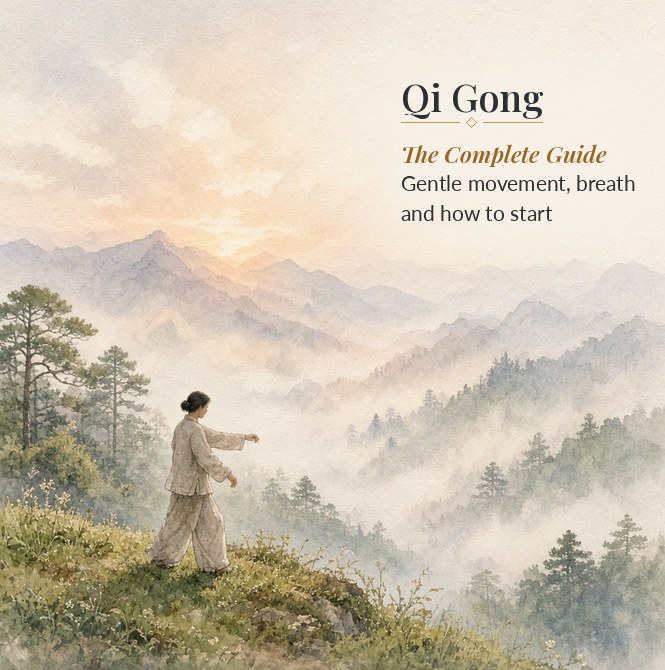
Qi gong (also written qigong and pronounced “chee gung”) is a gentle Chinese mind-body practice that combines slow flowing movement, relaxed breathing and focused attention. It developed in China thousands of years ago as part of traditional Chinese medicine, and today millions of people practise it for relaxation, energy, balance and wellbeing.
Last updated: 30 October 2026
Reading time: about 16 minutes
How we wrote this guide: this guide was written by Saj Ali. Every research claim below links to the original study, its DOI or an official record.
Quick answer: does qi gong work?
- A large review found consistent benefits. A review of 77 randomised controlled trials of qigong and tai chi found consistent, significant results for several health outcomes, including physical function, balance and falls, quality of life and psychological symptoms (Jahnke et al., 2010).
- It may lift mood and ease anxiety. A meta-analysis found qigong may reduce depression and anxiety, with notable results in people with type 2 diabetes (Wang et al., 2013).
- It may help you sleep and feel less tired. Qigong improved sleep quality in older adults (Xiong et al., 2025) and reduced fatigue in people with chronic fatigue (Ho et al., 2012).
- It is gentle and free to start. The US National Center for Complementary and Integrative Health says qigong appears to be a safe form of activity (NCCIH). You can begin with a free 10-minute video.
Contents
- What Is Qi Gong?
- Where Qi Gong Came From
- How Qi Gong Works
- Popular Qi Gong Forms
- A 10-Minute Qi Gong Routine for Beginners
- What Is Qi Gong Used For?
- What the Research Shows
- Qi Gong vs Tai Chi vs Yoga
- Finding a Qi Gong Teacher or Class
- Watch, Listen and Follow
- Frequently Asked Questions About Qi Gong
- Key Takeaways
- Explore More on Self Help Supermarket
- Sources
What Is Qi Gong?
Qi gong is a family of gentle exercises from China that combine three things: posture and movement, breathing and mind focus. The name joins two Chinese words. Qi (sometimes written chi) means vital energy or breath, and gong means skill or cultivation. So qi gong means, roughly, “cultivating energy” or “breath work”.
According to the US National Center for Complementary and Integrative Health (NCCIH), qigong was developed in China thousands of years ago as part of traditional Chinese medicine, and involves exercises that aim to optimise energy within the body, mind and spirit (NCCIH). Movements are typically gentle and smooth, and breathing ranges from simple belly breathing to breathing combined with sounds.
What makes qi gong special is how accessible it is. You do not need to be fit or flexible. Most forms can be done standing, many can be done sitting, and a short session takes only a few minutes. That is why it is popular with everyone from office workers to older adults, athletes and people recovering from illness.
Qi Gong at a Glance
| Origin | China, thousands of years ago, as part of traditional Chinese medicine |
| What you do | Slow movement or still postures, relaxed breathing and focused attention |
| Popular forms | Baduanjin (Eight Brocades), Liuzijue (Six Healing Sounds), Yijin Jing, medical qigong; tai chi for health is also considered a form of qigong (NCCIH) |
| Equipment | None: comfortable clothes and a little space |
| Session length | 5 to 60 minutes; 10 to 20 minutes daily is a good start |
| Cost to start | Free, with online videos; classes and courses are optional |
| Suitable for | Most ages and fitness levels; many routines can be done seated |
Where Qi Gong Came From
Qi gong has deep roots in Chinese culture. Exercises for health and long life appear in early Chinese medical and philosophical traditions, and over many centuries practices developed within medicine, Taoist and Buddhist traditions and the martial arts. Each lineage added its own movements, breathing methods and meditations, which is why there are hundreds of styles today.
The modern term “qigong” became widely used in the 20th century, when practices from different traditions were gathered under one name and taught for health in China. In recent decades, several traditional routines, such as Baduanjin and Yijin Jing, have been standardised in China as “Health Qigong” forms, so they can be taught and studied consistently. Many of the routines you see in parks across China, and increasingly worldwide, follow these standard forms.
Over the past few decades, qi gong has spread to Europe, North America and beyond through teachers, books and video. Today you will find it in community centres, hospitals, gyms, workplaces and countless online classes. Western teachers such as Lee Holden, Kenneth Cohen, Roger Jahnke and Mimi Kuo-Deemer have helped make it easy for beginners to learn.
Qi and the meridians
In traditional Chinese medicine, qi is thought to flow through channels called meridians. Good health is linked with smooth, balanced flow, and qi gong movements are designed to encourage it. You do not need to adopt these ideas to benefit. Many people simply enjoy qi gong as relaxing, mindful movement, and researchers study its effects in the same way they study other gentle exercise.
How Qi Gong Works
Qi gong works on body and mind at the same time. Teachers often describe “three regulations”: regulating the body (posture and movement), regulating the breath and regulating the mind. NCCIH describes the same three elements (NCCIH).
Regulating the body
Qi gong postures are upright, relaxed and balanced. Knees are soft, shoulders drop and the spine lengthens. Movements are slow, smooth and continuous, which builds strength, flexibility and balance without strain. Weight shifts from one leg to the other gently train stability.
Regulating the breath
Breathing is usually slow, deep and through the nose, with the belly rising and falling. Movements often follow the breath: rising with the in-breath and sinking with the out-breath. Slow breathing like this is a simple way to help the body relax.
Regulating the mind
Your attention rests on the movement, the breath or a point such as the lower belly. Some styles use imagery, such as moving through water or gathering light. This focus gives qi gong a meditative quality, similar to mindfulness in motion.
Dynamic and meditative qi gong
NCCIH explains that dynamic (active) qigong focuses on movements of the whole body or the arms and legs, while meditative (passive) qigong can be practised in any comfortable posture and uses breath and mind exercises with almost no body movement (NCCIH). Most beginners start with dynamic forms and add standing or seated meditation later.
Popular Qi Gong Forms
There are hundreds of qi gong styles. These are some of the most widely taught.
Baduanjin (Eight Brocades)
The Eight Brocades is one of the best-known routines in the world. It has eight movements, such as “Two hands hold up the heavens” and “Drawing the bow to shoot the hawk”. It takes about 10 to 15 minutes and is a favourite in research studies, which makes it a great first form to learn.
Liuzijue (Six Healing Sounds)
Liuzijue pairs gentle movements with six breathing sounds, each linked with an organ in traditional Chinese medicine. It is calm, simple and often taught for breathing and relaxation.
Yijin Jing (Muscle-Tendon Changing Classic)
Yijin Jing is a stretching and strengthening routine traditionally associated with the Shaolin Temple. It is slightly more demanding and is popular with people who want a fuller workout.
Tai chi for health
Tai chi began as a martial art. When it is practised for health, NCCIH considers it a form of qigong (NCCIH). Tai chi forms are longer and more choreographed, so many people learn qi gong first.
Standing meditation (Zhan Zhuang)
In “standing like a tree”, you hold a relaxed standing posture with the arms rounded as if hugging a tree. It looks simple but builds deep relaxation, leg strength and focus.
Medical qigong
Medical qigong is taught by practitioners who adapt exercises to a person’s health goals. Some practitioners also offer hands-off energy work, similar in spirit to Reiki.
A 10-Minute Qi Gong Routine for Beginners
This short routine uses movements common to many beginner qi gong classes. Wear comfortable clothes, stand on a flat surface and move slowly. Keep every movement within a comfortable range. If you need to, you can do most of it seated.
- Stand in a relaxed posture. Stand with your feet hip-width apart, knees soft, shoulders relaxed and arms by your sides. Imagine a thread gently lifting the crown of your head. Take three slow breaths into your belly.
- Shake out tension (1 minute). Gently bounce on your knees and let your arms, shoulders and hands shake loosely. Let tension fall away. Slow down and come to stillness.
- Belly breathing (1 minute). Place your hands on your lower belly, just below the navel. Breathe in slowly through your nose so the belly expands, and breathe out gently. This area is called the dantian in Chinese tradition.
- Lift the sky (2 minutes). Interlace your fingers in front of your belly. As you breathe in, raise your hands up in front of you and over your head, palms turning to the sky. As you breathe out, separate the hands and float them down to your sides. Repeat six to eight times. This is the first movement of the Eight Brocades (Baduanjin).
- Open and close the chest (2 minutes). Bring your hands in front of your chest as if holding a ball. Breathing in, open your arms wide to the sides. Breathing out, bring them back together. Feel the space between your palms.
- Turn the waist (1 minute). Let your arms hang loosely and gently turn your waist left and right, letting the arms swing and tap the body lightly. Keep the knees soft and the movement easy.
- Gather the energy (1 minute). Sweep your arms out and up in a big circle, then bring your palms down in front of your face and chest towards your belly, as if gathering fresh air and energy into your centre. Repeat three times.
- Rest and notice (1 minute). Rest your hands on your belly and stand quietly. Notice how your body feels: warmth, tingling, calm or lightness. Smile gently, then finish.
Try this routine once a day for two weeks. Many people like to practise first thing in the morning or as a break from screens. The videos below will guide you through fuller routines, including the complete Eight Brocades.
What Is Qi Gong Used For?
People practise qi gong for many everyday goals. Research is strongest for wellbeing, balance, quality of life and mood, and it is growing in other areas.
- Stress and relaxation. Slow breathing and gentle movement help you unwind. See our guide to stress management.
- Anxiety and mood. A meta-analysis found qigong may reduce anxiety and depression (Wang et al., 2013). See our guides to anxiety and burnout.
- Energy and fatigue. In a randomised trial, qigong reduced fatigue in people with chronic fatigue (Ho et al., 2012). Read more in energy and fatigue.
- Sleep. A 2025 meta-analysis found qigong improved sleep quality in older adults (Xiong et al., 2025). See our sleep guide.
- Back and neck tension. Reviews suggest qigong may help decrease neck pain and musculoskeletal pain, though results vary between studies (NCCIH). See back and neck pain.
- Fibromyalgia. NCCIH notes that frequent, consistent qigong practice may help people with fibromyalgia with pain, sleep and physical and mental function, based on early research (NCCIH). See our fibromyalgia guide.
- Headaches and tension. Many people use relaxed breathing and shoulder release to ease everyday tension. See headaches and migraines.
- Balance and healthy ageing. The large Jahnke review found benefits for physical function, balance and falls (Jahnke et al., 2010).
What the Research Shows
Qi gong has a substantial research base, much of it from China, Hong Kong, the USA and Europe. Here are some of the key findings.
The big review: 77 trials
Jahnke and colleagues examined 77 randomised controlled trials of qigong and tai chi. They found consistent, significant results across a range of outcomes, including bone health, heart and lung fitness, physical function, falls and balance, quality of life, self-efficacy, psychological symptoms and immune markers (Jahnke et al., 2010). The authors concluded that these gentle practices have many demonstrated health benefits.
Mood and anxiety
A systematic review and meta-analysis by Wang and colleagues looked at qigong’s effects on anxiety, depression and psychological wellbeing. It found that qigong may reduce depression and anxiety, with notable results in people with type 2 diabetes (Wang et al., 2013).
Fatigue
In a randomised controlled trial in Hong Kong, people with chronic fatigue or chronic fatigue syndrome took part in a qigong programme. Compared with a waiting-list group, they had less fatigue and better mental functioning. Interestingly, activity of telomerase, an enzyme linked to cell health, also rose in the qigong group (Ho et al., 2012).
Sleep in older adults
A 2025 meta-analysis of 15 randomised trials with 1,074 older adults found that qigong improved sleep quality scores, with Baduanjin showing a significant effect. The authors rated the certainty of evidence as low and called for more high-quality trials (Xiong et al., 2025).
The studies at a glance
| Study | Type | Main finding |
|---|---|---|
| Jahnke et al., 2010 | Review of 77 RCTs | Consistent benefits for function, balance, quality of life and psychological symptoms |
| Wang et al., 2013 | Meta-analysis | May reduce depression and anxiety |
| Ho et al., 2012 | RCT, chronic fatigue | Less fatigue, better mental functioning |
| Xiong et al., 2025 | Meta-analysis, 15 RCTs, 1,074 older adults | Better sleep quality |
On safety, NCCIH says qigong appears to be a safe form of activity, and many studies report no negative side effects, including in people with chronic diseases (NCCIH). If you have a health condition or injury, a quick chat with your doctor and an experienced teacher will help you choose suitable movements.
Qi Gong vs Tai Chi vs Yoga
| Qi gong | Tai chi | Yoga | |
|---|---|---|---|
| Origin | China | China (martial art) | India |
| Style | Short, repeated flowing movements and still postures | Longer choreographed sequences | Held postures, flows and breathing |
| Learning curve | Very easy; you can follow along on day one | Moderate; forms take weeks or months | Easy to hard, depending on style |
| Floor work | Rarely | No | Often |
| Best for | Quick daily practice, relaxation, energy | Balance, coordination, longer practice | Flexibility, strength, relaxation |
All three combine movement, breath and attention, and many people enjoy more than one. Explore our guides to yoga, meditation and the Wim Hof Method for other breath-and-body practices.
Finding a Qi Gong Teacher or Class
Qi gong is easy to learn from videos, but a live teacher can help with posture, pace and motivation. Look for classes at community centres, martial arts schools, leisure centres and wellbeing studios, or join an online class.
What to look for
- A teacher who explains clearly and offers options for different bodies
- A calm, unhurried pace, with time to practise
- Experience in the style you want, such as Baduanjin or tai chi for health
- Seated options if you need them
Costs
You can practise free with online videos such as those below. Community classes are often low-cost, and online membership sites charge monthly or yearly fees. Check the current price with the teacher or provider before you sign up. For example, Holden QiGong offers on-demand routines, live online classes and courses with Lee Holden (Holden QiGong).
Watch, Listen and Follow
Follow along with these free videos. Start with a 10-minute routine, then learn the full Eight Brocades.
Videos
- 10 Minute Morning Qi Gong For Beginners – Holden QiGong. A friendly first routine from Lee Holden.
- 6-Minute Qi Gong for Stress Relief – Holden QiGong. A short routine for busy days.
- 20-Min Beginner’s Qi Gong Routine for a Healthy Heart – Holden QiGong. A longer class with Lee Holden.
- Health QiGong Ba Duan Jin (Eight Brocades), English – TCM SHUNSHUN. The standard Baduanjin routine with English instruction.
- Eight Brocades Qigong Practice with English instruction – Qigong Tai Chi Centre | Yogalily Studio. Step-by-step teaching of each brocade.
- 8 Brocades Qigong Practice – Mimi Kuo-Deemer. A graceful follow-along practice.
- Beginner Qigong | Feel Great in 10 Min – QiYoga With LuChin. A gentle, upbeat beginner session.
- 5-Min Qigong for Beginners: Cleansing Breath – Qigong Meditation. A quick breathing practice for stress.
- Daily Qigong Routine – Easy and Effective! – Qigong For Vitality. A simple routine to practise every day.
Books
- The Way of Qigong: The Art and Science of Chinese Energy Healing – Kenneth S. Cohen (Ballantine, 1997). A classic, thorough introduction.
- The Healing Promise of Qi – Roger Jahnke (Contemporary Books/McGraw-Hill, 2002). Practical routines from one of the authors of the large research review.
- Qigong and the Tai Chi Axis – Mimi Kuo-Deemer (2018). A beautifully illustrated guide to daily practice.
Free resources
- NCCIH: Qigong – What You Need To Know – a clear, research-based overview from the US National Institutes of Health.
- Holden QiGong – free videos plus optional paid classes with Lee Holden.
Frequently Asked Questions About Qi Gong
What is qi gong good for?
People use qi gong for relaxation, energy, sleep, balance and mood. Research links it with better physical function, balance, quality of life and psychological wellbeing, and with less fatigue and better sleep in some groups.
Is qi gong the same as tai chi?
They are closely related. Tai chi began as a martial art, and when it is practised for health it is considered a form of qigong. Qi gong routines are usually shorter and simpler, so they are easier to learn.
How often should I practise qi gong?
A short daily practice of 10 to 20 minutes works well for most people. Studies often use sessions several times a week over a few months.
Can beginners do qi gong?
Yes. Qi gong is one of the most beginner-friendly practices. Movements are slow and gentle, there is no equipment, and many routines can be done seated.
Is qi gong safe?
NCCIH says qigong appears to be a safe form of activity, and many studies report no negative side effects. If you have an injury or health condition, choose gentle movements and check with your doctor.
What is the Eight Brocades?
The Eight Brocades, or Baduanjin, is a popular qi gong routine of eight movements. It takes about 10 to 15 minutes and is widely used in research and classes worldwide.
Does qi gong help with sleep?
A 2025 meta-analysis of 15 trials in older adults found qigong improved sleep quality, with Baduanjin showing a significant effect. Gentle evening practice can be a calming part of a bedtime routine.
Key Takeaways
- Qi gong is a gentle Chinese practice combining movement, breathing and focused attention.
- It developed in China thousands of years ago as part of traditional Chinese medicine.
- A review of 77 trials found consistent benefits for function, balance, quality of life and psychological symptoms.
- Studies also link qigong with less anxiety, less fatigue and better sleep.
- It appears to be a safe form of activity and is free to start with online videos.
- The Eight Brocades (Baduanjin) is a great first routine.
Explore More on Self Help Supermarket
Use these guides alongside this one:
- Stress management – calm body and mind
- Energy and fatigue – boost your daily energy
- Back and neck pain – gentle ways to ease tension
- Sleep – build a calming bedtime routine
- Anxiety – tools to feel calmer
- Headaches and migraines – ease everyday tension
- Fibromyalgia – gentle movement and self-care
- Burnout – recover and recharge
- Yoga – another breath-and-movement practice
- Meditation – still the mind
- Reiki – gentle energy work
- Browse all self-help techniques – compare every method on Self Help Supermarket.
Sources
- Jahnke, R., Larkey, L., Rogers, C., Etnier, J., & Lin, F. (2010). A comprehensive review of health benefits of qigong and tai chi. American Journal of Health Promotion, 24(6), e1–e25. https://doi.org/10.4278/ajhp.081013-LIT-248
- Wang, F., Man, J. K. M., Lee, E.-K. O., et al. (2013). The effects of qigong on anxiety, depression, and psychological well-being: A systematic review and meta-analysis. Evidence-Based Complementary and Alternative Medicine, 2013, 1–16. https://doi.org/10.1155/2013/152738
- Ho, R. T. H., Chan, J. S. M., Wang, C.-W., et al. (2012). A randomized controlled trial of qigong exercise on fatigue symptoms, functioning, and telomerase activity in persons with chronic fatigue or chronic fatigue syndrome. Annals of Behavioral Medicine, 44(2), 160–170. https://doi.org/10.1007/s12160-012-9381-6
- Xiong, X., Zhang, L., & Zhang, E. (2025). The effects of qigong exercise on sleep quality in older adults: A systematic review and meta-analysis. Frontiers in Public Health, 13. https://doi.org/10.3389/fpubh.2025.1664055
- National Center for Complementary and Integrative Health. Qigong: What you need to know. https://www.nccih.nih.gov/health/qigong-what-you-need-to-know
- Holden QiGong. https://www.holdenqigong.com/
Self Help Supermarket guides are for general information and are not a substitute for professional medical or psychological advice.