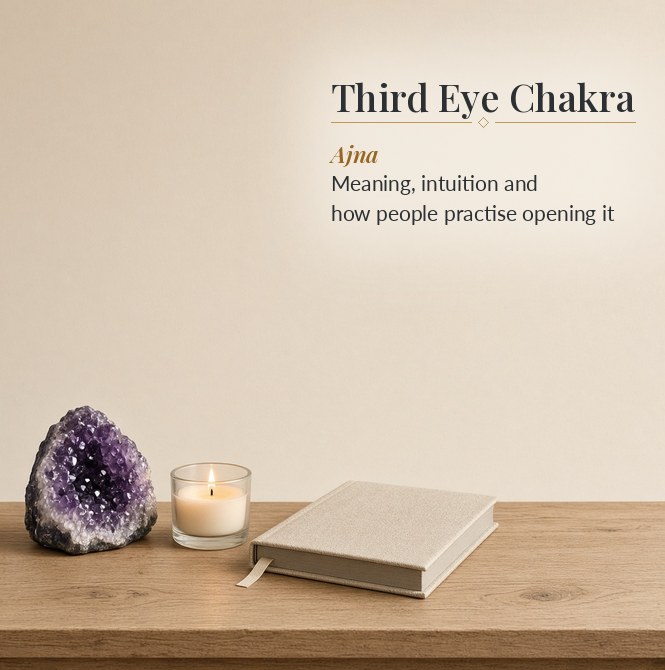
The third eye chakra, called Ajna in Sanskrit, is the sixth of the seven main chakras. It is pictured between the eyebrows and is traditionally linked with the mind, the colour indigo and the seed sound OM. In modern wellness practice it is associated with intuition, insight, imagination and clear seeing.
Last updated: 4 November 2026
Reading time: about 17 minutes
How we wrote this guide: this guide was written by Saj Ali. It describes how the chakras are understood in yoga and tantric traditions and in modern wellness practice around the world, and every research claim links to its source.
Third eye chakra in brief
- Name. Ajna, from the Sanskrit for “command” or “perceive”.
- Where. Between the eyebrows, the spot often marked with a bindi.
- Linked with. The mind, the colour indigo, a two-petalled lotus and the seed sound OM.
- Themes. Intuition, insight, imagination, clarity and trusting your inner sense of things.
- How people practise opening it. Meditation between the brows, candle gazing (trataka), humming bee breath, chanting OM, visualisation and intuition journaling.
Chakra series: The 7 Chakras Explained · Chakra Meditation · Root Chakra (Muladhara) · Heart Chakra (Anahata) · Chakra Healing guide
Contents
- What Is the Third Eye Chakra?
- Third Eye Chakra at a Glance
- Where the Idea Comes From
- Signs of Balance and Imbalance People Describe
- How People Practise Opening the Third Eye
- A 10-Minute Third Eye Practice
- Journal Prompts
- The Third Eye in Everyday Life
- Around the World
- What the Research Says About Chakra Practices
- Frequently Asked Questions
- Key Takeaways
- Explore More on Self Help Supermarket
- Sources
What Is the Third Eye Chakra?
The third eye chakra is the sixth of the seven main chakras, just below the crown. In the yoga and tantric traditions of India, the chakras are described as energy centres along the central channel of the subtle body, and Ajna is placed between the eyebrows, the spot traditionally marked with a bindi (Encyclopaedia Britannica, chakra).
The “third eye” is an image of a different kind of sight: seeing inwardly rather than outwardly. In modern practice, the third eye chakra is linked with intuition, the quiet sense of knowing something without being able to explain how; with imagination and the ability to picture things clearly; and with insight, seeing the bigger picture and the patterns in your life.
People who talk about “opening the third eye” usually mean developing these inner qualities: becoming more intuitive, more reflective and more aware of their own thoughts. Most of the practices involve focused attention, such as meditation, gazing, breathing and visualisation. For the bigger picture, see The 7 Chakras Explained, and for how chakra healing works as a whole, see our Chakra Healing guide.
Third Eye Chakra at a Glance
| Sanskrit name | Ajna (ājñā): “command”, “authority” or “perception” |
| Position | Sixth of the seven main chakras |
| Location | Between the eyebrows, slightly above the bridge of the nose |
| Colour | Indigo in the modern system; older texts describe a white, moon-like lotus |
| Element | The mind (beyond the five physical elements); some modern teachers say light |
| Seed sound (bija mantra) | OM (AUM) |
| Lotus petals | Two |
| Sense | The mind, often called the sixth sense |
| Core themes | Intuition, insight, imagination, clarity, inner wisdom, perspective |
| Affirmation people use | “I trust my intuition. I see clearly.” |
| Yoga poses often used | Child’s pose (forehead resting), Downward Dog, Dolphin, Eagle, seated forward fold |
| Hand gesture (mudra) | Hakini mudra (fingertips of both hands touching) or Jnana mudra |
| Crystals commonly linked | Amethyst, lapis lazuli, sodalite, labradorite, fluorite |
| Foods often linked | Purple and dark blue foods such as blueberries and purple grapes |
The two petals, the link with the mind and the seed sound OM come from the older tantric texts. Indigo, the crystals and the food links come from modern wellness teaching. Practitioners differ on the details, so treat the table as a starting point.
Where the Idea Comes From
The word chakra means “wheel” in Sanskrit. In certain forms of Hinduism and Tantric Buddhism, the chakras are centres of subtle energy, each traditionally linked with a colour, a shape, a sense organ, an element, a deity and a mantra. In kundalini yoga, energy is said to rise from the root chakra through each centre in turn (Encyclopaedia Britannica, chakra).
The 16th-century Ṣaṭ-cakra-nirūpaṇa, translated in 1919 by Sir John Woodroffe as Arthur Avalon in The Serpent Power, describes Ajna as a white two-petalled lotus where the mind dwells, with OM as its sound (Avalon, The Serpent Power, 1919). The name “command” is often explained as the place where the guidance of a teacher, or of one’s own inner wisdom, is received. It is also where the three main energy channels, ida, pingala and sushumna, are said to meet.
The bindi worn between the eyebrows in South Asia marks this point (Encyclopaedia Britannica, chakra), and the image of a third eye appears in many stories: the Hindu god Shiva is often shown with a third eye on his forehead, a symbol of wisdom and insight.
In the 20th century, Western writers linked Ajna with indigo, with intuition and imagination, and with the pineal gland, a small gland deep in the brain that produces the sleep hormone melatonin. The 17th-century philosopher René Descartes famously described the pineal gland as the place where the soul and body meet, and many modern writers see it as a physical counterpart to the third eye. This link is a modern interpretation rather than part of the original tradition, but it has become one of the most popular ways people talk about the third eye.
Signs of Balance and Imbalance People Describe
Chakra teachers often describe a chakra as balanced, under-active or over-active. These descriptions are reflective rather than diagnostic: they are prompts to notice how you feel. Here is how the third eye chakra is commonly described:
| Area | Often described when balanced | Often described when out of balance |
|---|---|---|
| Intuition | Trusting your gut feelings while weighing the facts | Ignoring inner signals, or acting on every hunch without reflection |
| Clarity | Seeing situations and patterns clearly | Feeling foggy, indecisive or unable to see the bigger picture |
| Imagination | Vivid, creative and able to picture goals | Finding it hard to imagine, or getting lost in daydreams |
| Thinking | Reflective and open-minded | Overthinking, or holding on rigidly to one point of view |
| Sleep and dreams | Restful sleep and memorable dreams | Poor sleep or a busy, racing mind at night |
| Perspective | Able to step back and learn from experience | Repeating the same patterns without noticing them |
Many people notice third eye themes when facing a big decision, feeling creatively blocked or caught in overthinking. The practices below are a gentle way to quieten the mind and listen inwardly.
How People Practise Opening the Third Eye
“Opening the third eye” is usually a slow, steady practice of attention rather than a single event. These are the methods people use most often. Choose one or two and practise them regularly.
Meditation focused between the brows
Sit with your spine upright and eyes closed. Gently bring your attention to the point between your eyebrows without straining the eyes. Rest there, breathing slowly, and when thoughts arise, notice them and return. Start with five minutes and build up. Meditation was the most popular of seven complementary practices tracked among US adults in 2022, used by 17.3% (NCCIH, National Institutes of Health, 2022). Our Meditation guide covers the basics.
Candle gazing (trataka)
Trataka is a traditional yoga practice described in the medieval Hatha Yoga Pradipika. Place a candle at arm’s length at eye level in a dim room. Gaze softly at the flame for a minute or two, blinking when you need to, then close your eyes and watch the after-image at the point between the brows until it fades. Repeat two or three times. Many people find it settles a busy mind quickly.
Humming bee breath (bhramari)
Bhramari, the “bee breath”, is another classic practice. Close your eyes, place your index fingers gently on the cartilage of your ears, breathe in, and hum softly like a bee as you breathe out. Feel the vibration in your head. Repeat five to ten times. Slow breathing practices like this have been linked with calmer, more relaxed and more alert states (Zaccaro et al., 2018). See our Breathwork guide.
Chanting OM
OM is the seed sound of the third eye. Breathe in deeply and chant “aaa-ooo-mmm” slowly on the out-breath, letting the final “m” hum. Repeat for three to five minutes. A small pilot brain-imaging study found that chanting OM was linked with quieter activity in emotion-related areas of the brain (Kalyani et al., 2011). Our Sound Healing guide has more on sound practices.
Alternate nostril breathing (nadi shodhana)
Because Ajna is where the left and right energy channels are said to meet, alternate nostril breathing is a favourite third eye practice. Close the right nostril with your thumb and breathe in through the left; close the left and breathe out through the right; breathe in through the right; close it and breathe out through the left. Continue for three to five minutes.
Visualisation
The third eye is linked with the imagination, so visualisation is a natural practice. With eyes closed, picture an indigo light between your brows, or imagine a calm, detailed scene and explore it with all your senses. Many people also use visualisation to picture their goals. See our Visualisation guide.
Intuition and dream journaling
Keep a notebook for hunches, gut feelings and dreams. Write down an intuition when it comes, and later note what happened. Over time, many people notice patterns in how their intuition speaks to them. Writing about thoughts and feelings has been linked with benefits for emotional and physical health (Baikie and Wilhelm, 2005). Our guide to intuitive development goes further.
Rest, darkness and screen breaks
Many teachers suggest giving the eyes and mind a rest: regular sleep, time away from screens, and a few minutes of sitting in a dim, quiet room. Resting the forehead on the floor in Child’s pose is a gentle way to finish any third eye session. Our sleep guide has practical tips.
A 10-Minute Third Eye Practice
This routine combines the main practices people use to open the third eye. It works well in the morning or before journaling.
- Sit comfortably. Sit with your spine upright, shoulders relaxed and eyes closed. Take a few slow breaths.
- Balance the breath. Do two minutes of alternate nostril breathing to settle the mind.
- Hum like a bee. Do five rounds of bhramari breath, feeling the vibration in your head.
- Focus between the brows. Rest your attention gently at the point between your eyebrows and imagine a soft indigo light there.
- Chant OM. Chant OM slowly on each out-breath for about two minutes, then sit in silence for a minute.
- Ask a question. Silently ask a question you are thinking about, and notice any image, word or feeling that comes, without judging it.
- Write it down. Open your eyes and note what came up in your journal. Finish by resting your forehead on the floor in Child’s pose for a few breaths.
Practising a few times a week is often more helpful than long sessions now and then. Many people find that, over weeks, they become more aware of their gut feelings and more able to step back from busy thoughts.
Journal Prompts
These prompts are a good way to explore third eye themes. Write freely for ten minutes on one at a time:
- When has my intuition been right, and what did it feel like at the time?
- What is my gut telling me about a decision I am facing?
- What patterns keep repeating in my life, and what might they be showing me?
- What did I dream about recently, and what feelings did the dream leave?
- If I could see my situation from far above, what would I notice?
- What do I imagine my life looking like a year from now?
The Third Eye in Everyday Life
Decisions. Many people use third eye practices to make decisions with both head and heart: weighing the facts, then checking in with their gut feeling. Journaling both side by side is a simple way to do this.
Creativity. Because Ajna is linked with imagination, artists, writers and designers often use visualisation and quiet reflection to spark ideas. See our guide to creativity.
Overthinking. Third eye practices aim at clarity, not more thinking. Focused attention and breathing can help quieten a racing mind. Our guide to overthinking has more ideas.
Intuitive and psychic practices. Some people connect the third eye with intuitive abilities and practices such as remote viewing. Our guide to intuitive development explains how people approach this.
Within the chakra system. Teachers often suggest balancing the lower chakras, such as the root chakra, alongside third eye work, so that insight stays grounded, and the heart chakra, so that it stays kind.
Around the World
India. The bindi and tilaka marks worn on the forehead honour the point of Ajna, and Shiva’s third eye is a symbol of wisdom. Many Hindu and yogic practices focus the gaze or attention here.
Buddhism. Images of the Buddha often show a small dot or curl between the brows, the urna, traditionally a sign of insight and spiritual vision.
China. In Daoist practice, the upper dantian, between and behind the eyebrows, is linked with spirit and insight. Our Qi Gong guide explains how people work with the dantians.
Ancient Egypt. The Eye of Horus is often compared with the third eye in modern writing as a symbol of protection and insight.
Modern wellness. Around the world, “opening the third eye” has become a popular way of describing the search for intuition and clarity, taught in yoga classes, meditation apps and online courses.
What the Research Says About Chakra Practices
Chakras belong to a spiritual and yogic framework, so research does not measure the third eye chakra directly. What researchers have studied are the practices people use to work with the chakras: yoga, meditation, slow breathing, chanting, loving-kindness, time in nature and reflective writing. These practices have encouraging research behind them.
| Practice | What the research found | Source |
|---|---|---|
| Meditation | Meditation was the most popular of seven complementary practices tracked among US adults in 2022, used by 17.3%, up from 7.5% in 2002. | (NCCIH, National Institutes of Health, 2022) |
| Slow breathing | A systematic review of 15 studies found that slow breathing (under 10 breaths a minute) was linked with changes in the nervous system and with greater comfort, relaxation and alertness. | (Zaccaro et al., 2018) |
| Chanting OM | A small pilot brain-imaging study (12 people) found that chanting OM was linked with quieter activity in emotion-related brain areas, which a simple “ssss” sound did not show. | (Kalyani et al., 2011) |
| Yoga | US adult yoga use rose from 5.0% in 2002 to 15.8% in 2022. NIH reports research suggesting yoga may help relieve stress and support mental and emotional health, sleep and balance. | (NCCIH, National Institutes of Health, 2023) |
| Expressive writing | Writing about thoughts and feelings for 15 to 20 minutes on a few occasions has been linked with benefits for emotional and physical health. | (Baikie and Wilhelm, 2005) |
| Time in nature | A 90-minute walk in a natural setting reduced repetitive negative thinking and activity in a related brain area; a city walk did not. | (Bratman et al., 2015) |
In other words, the practices people use to open the third eye draw on well-studied building blocks: focused attention, slow breathing, chanting and reflective writing. Many people find that is where much of their value lies.
Frequently Asked Questions
What is the third eye chakra?
The third eye chakra, or Ajna, is the sixth of the seven main chakras. It is pictured between the eyebrows and is linked with the mind, the colour indigo, the seed sound OM and themes of intuition, insight and imagination.
How do you open your third eye?
People usually practise opening the third eye through regular meditation focused between the brows, candle gazing (trataka), humming bee breath (bhramari), chanting OM, alternate nostril breathing, visualisation and intuition journaling.
What does Ajna mean?
Ajna is Sanskrit for “command”, “authority” or “perception”. It is often explained as the centre where inner guidance is received.
What colour is the third eye chakra?
Indigo is the colour used in the modern chakra system. Older tantric texts describe a white, moon-like two-petalled lotus.
Is the third eye the pineal gland?
Many modern writers link the third eye with the pineal gland, a small gland in the brain that produces melatonin. This is a modern interpretation; the traditional texts describe Ajna as an energy centre between the eyebrows.
What does it feel like when your third eye opens?
People describe it in different ways: a sense of calm clarity, stronger gut feelings, more vivid dreams or imagination, or a gentle pressure or warmth between the brows during meditation. Experiences vary widely.
What is the mantra for the third eye chakra?
The seed sound is OM (AUM). Many people also use affirmations such as “I trust my intuition. I see clearly.”
What crystals are used for the third eye?
Amethyst, lapis lazuli, sodalite, labradorite and fluorite are the stones most often linked with the third eye in modern practice.
Key Takeaways
- The third eye chakra, Ajna, is the sixth of seven main chakras, between the eyebrows.
- It is traditionally linked with the mind, two petals and the seed sound OM; indigo is its modern colour.
- It stands for intuition, insight, imagination and clarity.
- Opening the third eye is usually a slow practice of attention: meditation, trataka, bhramari, chanting OM, visualisation and journaling.
- The link with the pineal gland is a popular modern interpretation.
- These practices draw on habits with encouraging research behind them, such as meditation, slow breathing and reflective writing.
Explore More on Self Help Supermarket
Use these guides alongside this one:
- Chakra Healing: The Complete Guide – how chakra healing works and how to get started
- Chakra Healing hub – videos, books, apps and resources we have checked
- The 7 Chakras Explained – the full chart
- Chakra Meditation – a step-by-step practice
- Root Chakra (Muladhara) – grounding and safety
- Heart Chakra (Anahata) – love and compassion
- Intuitive Development – how people build and trust their intuition
- Remote Viewing – an intuitive practice some link with the third eye
- Visualisation – using the imagination with purpose
- Meditation hub – meditation videos, apps and resources
- Browse all self-help techniques – compare every method on Self Help Supermarket.
Sources
- The Editors of Encyclopaedia Britannica. Chakra. Encyclopaedia Britannica. https://www.britannica.com/topic/chakra
- Avalon, A. (Woodroffe, J.) (1919). The Serpent Power, including a translation of the Ṣaṭ-cakra-nirūpaṇa. London: Luzac and Co. Internet Archive. https://archive.org/details/TheSerpentPowerByArthurAvalon
- National Center for Complementary and Integrative Health (NCCIH), National Institutes of Health. (2022). Meditation and Mindfulness: Effectiveness and Safety. https://www.nccih.nih.gov/health/meditation-and-mindfulness-effectiveness-and-safety
- Zaccaro, A., Piarulli, A., Laurino, M., Garbella, E., Menicucci, D., Neri, B., and Gemignani, A. (2018). How breath-control can change your life: A systematic review on psycho-physiological correlates of slow breathing. Frontiers in Human Neuroscience, 12, 353. https://doi.org/10.3389/fnhum.2018.00353
- Kalyani, B. G., Venkatasubramanian, G., Arasappa, R., Rao, N. P., Kalmady, S. V., Behere, R. V., Rao, H., Vasudev, M. K., and Gangadhar, B. N. (2011). Neurohemodynamic correlates of OM chanting: A pilot functional magnetic resonance imaging study. International Journal of Yoga, 4(1), 3–6. https://doi.org/10.4103/0973-6131.78171
- National Center for Complementary and Integrative Health (NCCIH), National Institutes of Health. (2023). Yoga: Effectiveness and Safety. https://www.nccih.nih.gov/health/yoga-effectiveness-and-safety
- Baikie, K. A., & Wilhelm, K. (2005). Emotional and physical health benefits of expressive writing. Advances in Psychiatric Treatment, 11(5), 338–346. https://doi.org/10.1192/apt.11.5.338
- Bratman, G. N., Hamilton, J. P., Hahn, K. S., Daily, G. C., and Gross, J. J. (2015). Nature experience reduces rumination and subgenual prefrontal cortex activation. Proceedings of the National Academy of Sciences, 112(28), 8567–8572. https://doi.org/10.1073/pnas.1510459112
Self Help Supermarket guides are for general information and are not a substitute for professional medical or psychological advice.