
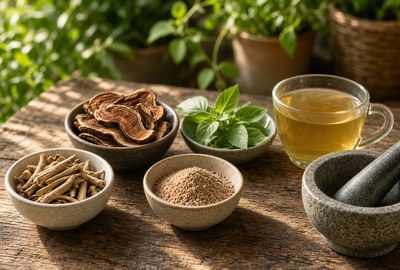
Adaptogens are herbs and mushrooms that people around the world use to help the body handle stress, keep energy steady and bounce back more easily. Many come from long traditions: ashwagandha and tulsi from Ayurveda in India, ginseng and reishi from China and Korea, rhodiola and eleuthero from Siberia and the mountains of northern Europe, and maca from the Peruvian Andes. Today they are taken as teas, powders, capsules and tinctures in kitchens everywhere, and a growing body of research has studied several of them. Pick what’s going on for you and we’ll show you where to start.
What’s going on for you?
For when stress has been running the show.
- Step 1 · Start with the basics
Rest, food and movement
Adaptogens work best alongside sleep, regular meals and some daily movement.
- Step 2 · Learn the main herbs
Ashwagandha and rhodiola
The two most studied adaptogens for everyday stress. There are short explainers in Videos.
- Step 3 · Calm the system
Stress management
Simple daily tools to help you feel more in control.
Not quite right? See every method for adaptogens
For winding down and resting well.
- Step 1 · Evening ritual
A calming cup
Many people enjoy tulsi tea or ashwagandha in warm milk in the evening.
- Step 2 · Look at the research
Ashwagandha and sleep
Studies have looked at ashwagandha for sleep quality. See What the research shows.
- Step 3 · Build better nights
Sleep
More ways to fall asleep and stay asleep.
Not quite right? See every method for adaptogens
For steady energy and a clear head.
- Step 1 · Daytime support
Rhodiola and ginseng
Traditionally taken in the morning for stamina and mental energy.
- Step 2 · Try a mushroom
Lion’s mane and cordyceps
Functional mushrooms many people add to coffee or smoothies.
- Step 3 · Upgrade your habits
Human Upgrade System
A whole-life approach to energy and performance.
Not quite right? See every method for adaptogens
For learning the traditions behind the herbs.
- Step 1 · Ayurveda
India’s system of health
Where ashwagandha and tulsi come from.
- Step 2 · Chinese tradition
Ginseng, reishi and schisandra
Tonic herbs used for centuries in China, Korea and Japan.
- Step 3 · Move the energy
Qi Gong
Gentle movement from the same tradition as many tonic herbs.
Not quite right? See every method for adaptogens
Every method for adaptogens
The best-studied adaptogens
-
Ashwagandha
An Ayurvedic root. In a 60-day trial, adults with chronic stress had lower stress scores and lower cortisol than a placebo group. [1]
Herb
-
Rhodiola
A golden root from cold mountain regions. In one trial it reduced fatigue and improved attention in people with stress-related fatigue. [2]
Herb
-
Asian ginseng
The classic tonic root of China and Korea. Single doses improved performance on demanding mental tasks in one study. [3]
Herb
-
Tulsi (holy basil)
Known in India as the Queen of Herbs and drunk daily as a tea. [4]
Herb
Mushrooms and other favourites
-
Lion’s mane
A shaggy white mushroom. In a Japanese trial, older adults with mild memory problems improved their cognitive scores while taking it. [5]
Mushroom
-
Reishi and cordyceps
Two prized mushrooms in Chinese tradition, used for calm and for stamina.
Mushroom
-
Eleuthero, schisandra and maca
Siberian ginseng, the Chinese five-flavour berry and the Andean root used for energy.
Herb
Methods that pair well
-
Meditation
A daily calming practice that suits a relaxing evening cup of tulsi. Full guide
-
Yoga
From the same Indian tradition as Ayurveda, and a lovely partner to adaptogens. Full guide
-
Qi Gong
Gentle movement from the Chinese tradition of tonic herbs. Full guide
-
Human Upgrade System
An approach to energy and performance that includes supplements and daily habits. Full guide
More methods with their own hub and guide
-
Relaxation
People use it to switch off the stress response. Full guide
-
Mindfulness
Helps you notice stress early so you can respond. Full guide
-
Vedic Meditation
A mantra meditation from the Vedic tradition of India. Full guide
-
Energy Healing
Approaches that work with the body’s energy. Full guide
Expert guidance
-
Pharmacist
A pharmacist can help you choose a product that suits you and anything else you take.
Support option
-
Qualified herbalist or Ayurvedic practitioner
They can tailor a blend to you.
Support option
Learn more
About adaptogens
What it is, why it happens and what helps. Contents:
- What adaptogens are
- Where the idea came from
- How adaptogens work
- What the research shows
- Ashwagandha
- Rhodiola
- Ginseng and eleuthero
- Tulsi (holy basil)
- Functional mushrooms
- Schisandra, maca and more
- Adaptogens around the world
- Choosing an adaptogen
- Teas, powders, capsules and tinctures
- Buying good-quality products
- A simple adaptogen routine
- Adaptogens and everyday habits
- How self-help methods fit in
- FAQs
What adaptogens are
An adaptogen is a plant or mushroom that is thought to help your body adapt to stress and return to balance. The idea is not that an adaptogen pushes your body in one direction, like a stimulant or a sedative, but that it helps you cope more smoothly with whatever the day brings, whether that is a busy week at work, a long journey or a run of poor sleep. Classic adaptogens include ashwagandha, rhodiola, Asian ginseng, eleuthero and schisandra, and many people also include tulsi, reishi, cordyceps, lion’s mane and maca. They are usually taken regularly over weeks rather than once, and they are often blended together in teas, powders and capsules. You can explore related topics in our Health hub.
Where the idea came from
Many of these plants have been used for centuries in Ayurveda, traditional Chinese medicine and the folk medicine of Siberia and Scandinavia. The word adaptogen itself is more recent. It was coined in 1947 by the Soviet scientist Nikolai Lazarev, and in 1969 the researchers Israel Brekhman and Igor Dardymov described what an adaptogen should do: help the body resist a wide range of stresses, have a normalising effect, and be gentle enough to take regularly. [6] Soviet scientists studied plants such as eleuthero and rhodiola to support the stamina of athletes, workers and even cosmonauts. Since then, research has spread to India, Europe, the United States, Australia and beyond, and adaptogens have become a familiar part of wellness shelves around the world. The World Health Organization notes that traditional and herbal medicine is an important part of health care in many countries. [7]
How adaptogens work
When you are under stress, your body releases stress hormones such as cortisol through a system known as the HPA axis, which links your brain and your adrenal glands. This is helpful in short bursts, but when stress goes on and on you may feel tired, wired, foggy or flat. Researchers Alexander Panossian and Georg Wikman reviewed the science and concluded that adaptogens appear to work on the central nervous system and the HPA axis, helping to regulate key stress mediators and supporting the body’s ability to stay steady under pressure. [8] In simple terms, many people describe the effect as feeling more even: still able to rise to a challenge, but recovering more easily afterwards.
What the research shows
Ashwagandha is the most studied adaptogen. In a 60-day randomised trial in India, 64 adults with a history of chronic stress took a full-spectrum ashwagandha root extract or a placebo. Those taking ashwagandha had lower stress scores and lower levels of the stress hormone cortisol. [1] In an Australian trial, 60 adults took ashwagandha or a placebo for 60 days, and the ashwagandha group had lower anxiety scores and lower morning cortisol. [9] An eight-week trial in India found that ashwagandha lowered perceived stress and cortisol and improved sleep quality. [10] And in a ten-week study of people with insomnia and anxiety, ashwagandha improved how quickly people fell asleep and how well they slept. [11]
Rhodiola has also been studied for stress and tiredness. In a Swedish trial, people with stress-related fatigue who took rhodiola for four weeks had less fatigue, better attention and a lower cortisol response on waking than a placebo group. [2] In an earlier study, young doctors on night duty who took a low dose of rhodiola for two weeks had less mental fatigue and better performance on mental tasks. [12] Ginseng, tulsi and lion’s mane have their own studies too, which you will find in their sections below.
Ashwagandha
Ashwagandha (Withania somnifera) is a small shrub whose root has been used in Ayurveda for more than 3,000 years. Its Sanskrit name refers to the smell of a horse, a nod both to its earthy scent and to the strength it was said to give. In Ayurveda it is known as a rasayana, a rejuvenating tonic, and it is traditionally taken in warm milk with a little honey or spice in the evening. Today it is one of the best-selling herbs in the world, used for stress, calm, sleep and energy. The research above makes it a natural first choice for many people. Most studies used a root extract once or twice a day for about two months, so give it time. The BBC has a short explainer in Videos.
Rhodiola
Rhodiola rosea, also called golden root or Arctic root, grows in cold, high places across Siberia, Scandinavia, the Alps and North America. Vikings are said to have used it for strength, and it has a long history in Russian and Scandinavian folk medicine. It is usually taken in the morning or early afternoon, because many people find it gently energising and clarifying. It is a popular choice for students around exam time, shift workers and anyone who feels mentally drained. [2] [12] Naturopath Jessica Norton gives a short overview in Videos.
Ginseng and eleuthero
Asian ginseng (Panax ginseng) is perhaps the most famous tonic herb in the world. It has been treasured in China and Korea for thousands of years, and Korean red ginseng, made by steaming and drying the root, is still given as a gift. The name Panax comes from the same Greek root as panacea. In a UK study, single doses of ginseng improved performance on demanding mental tasks and reduced mental fatigue. [3] American ginseng (Panax quinquefolius), which grows in eastern North America, is often described as more cooling and calming. Eleuthero, sometimes called Siberian ginseng, is a different plant that was widely studied in the Soviet Union for stamina and resilience. [6]
Tulsi (holy basil)
Tulsi (Ocimum sanctum or Ocimum tenuiflorum) is a sacred plant in India, where many homes grow it in a courtyard and drink it daily as a tea. In Ayurveda it is called the Queen of Herbs, and it is valued as an adaptogen that supports calm and clear thinking. A review of human studies described tulsi as a herb for all reasons, with benefits reported for stress, metabolism and general well-being. [4] It is one of the easiest adaptogens to enjoy: a cup of tulsi tea has a warm, peppery, slightly sweet flavour, and it blends well with ginger, lemon or green tea.
Functional mushrooms
Mushrooms have become one of the most popular parts of the adaptogen world. Reishi (Ganoderma lucidum), known in China as lingzhi, has been revered for over 2,000 years and is often taken in the evening for calm. Cordyceps, from the high Himalayas and Tibetan plateau, is traditionally used for stamina and breath. Chaga grows on birch trees in Siberia, Scandinavia and Canada and is brewed as a tea. Lion’s mane (Hericium erinaceus), called yamabushitake in Japan, is used for focus and memory. In a 16-week Japanese trial, older adults with mild cognitive impairment who took lion’s mane improved their cognitive scores compared with a placebo group. [5] Mushroom coffees, hot chocolates and powders make these easy to fit into your day. FreshCap Mushrooms has a beginner’s guide in Videos.
Schisandra, maca and more
Schisandra (Schisandra chinensis) is called the five-flavour berry in Chinese, because it tastes sweet, sour, salty, bitter and pungent all at once. It is used as a tonic for energy and focus, and it was studied in the Soviet Union alongside rhodiola and eleuthero. Maca (Lepidium meyenii) is a root vegetable that has been grown high in the Peruvian Andes for around 2,000 years and is eaten as a food for energy, stamina and vitality. It has a malty, nutty taste and is often added to smoothies and porridge. Other plants often grouped with adaptogens include shatavari from Ayurveda, astragalus from Chinese tradition, and licorice root, which appears in many herbal blends.
Adaptogens around the world
One of the joys of adaptogens is how international they are. In India, the Ministry of AYUSH supports Ayurveda, yoga and other traditional systems, and herbs such as ashwagandha and tulsi are part of daily life. In China, Korea and Japan, tonic herbs and mushrooms are sold in markets and pharmacies and added to soups and teas. In Russia and Scandinavia, rhodiola has a long folk history. In Peru, maca is a staple food. And in North America, Europe, Australia and beyond, adaptogens are now sold in health shops, supermarkets, cafés and online, often in modern forms such as gummies, lattes and drink powders. Many traditions see adaptogens as part of a bigger picture of daily rhythms, food and rest, which is a helpful way to think about them wherever you live.
Choosing an adaptogen
A simple way to choose is to match the herb to what you want help with:
- Everyday stress and feeling frazzled: ashwagandha or tulsi.
- Mental tiredness and focus: rhodiola, Asian ginseng or lion’s mane.
- Winding down in the evening: ashwagandha, tulsi or reishi.
- Stamina and physical energy: eleuthero, cordyceps, schisandra or maca.
Start with one herb at a time so you can notice how it suits you, and keep a simple note of your energy, mood and sleep for a few weeks. A pharmacist can help you choose a product that suits you and anything else you take, and a qualified herbalist or Ayurvedic practitioner can tailor a blend to you.
Teas, powders, capsules and tinctures
Adaptogens come in many forms, and the best one is the one you will enjoy using regularly.
- Teas: tulsi, ginseng and reishi teas make a gentle daily ritual.
- Powders: ashwagandha, maca and mushroom powders can be stirred into warm milk, smoothies or porridge.
- Capsules and tablets: standardised extracts, which are what most research studies used.
- Tinctures: liquid extracts taken in a little water, popular with herbalists.
- Drinks and blends: mushroom coffees, adaptogen lattes and ready-made blends.
If you want to match the research, look for products that name the plant part (for example ashwagandha root) and the extract, and follow the label.
Buying good-quality products
Quality can vary from one brand to another, so it pays to choose carefully. Look for brands that tell you the Latin name of the plant, the part used, how much is in each dose and where it comes from. Independent testing seals, organic certification and clear batch numbers are good signs. Organisations such as the American Botanical Council publish free information on herbs, and the About Herbs database at Memorial Sloan Kettering gives plain-language summaries of many plants. A good herb shop, pharmacy or qualified herbalist can recommend trusted brands in your country.
A simple adaptogen routine
Here is an easy way to start, which you can adjust to suit you:
- Morning: rhodiola or ginseng with breakfast, or a mushroom coffee with lion’s mane or cordyceps.
- Afternoon: a cup of tulsi tea instead of a third coffee.
- Evening: ashwagandha in warm milk, or a reishi tea, as part of a wind-down routine.
- Weekly check-in: jot down how your energy, mood and sleep feel.
Most studies lasted between four weeks and two months, so give a new herb a fair trial before deciding whether it suits you. Some people like to take a break every few months and then start again.
Adaptogens and everyday habits
Adaptogens work best as part of a healthy daily rhythm rather than instead of one. In Ayurveda and Chinese medicine, herbs always sit alongside food, sleep, movement and rest. Getting daylight in the morning, eating regular meals, moving your body and having a calming evening routine all help your stress system find its balance, and adaptogens can support that process. Our guides to sleep, energy and fatigue, gut health and healthy eating have more ideas.
How self-help methods fit in
Adaptogens pair beautifully with mind-body practices. Meditation and mindfulness help you notice stress early. Yoga comes from the same Indian tradition as Ayurveda, and qi gong from the same Chinese tradition as ginseng and reishi. Relaxation techniques help switch off the stress response, and the Human Upgrade System combines supplements with daily habits for energy and performance. If stress or tiredness is what brings you here, our guides to stress management, burnout and anxiety have many more ideas. Directories for several countries are in Get help & sources.
Frequently asked questions
What are adaptogens?
Herbs and mushrooms that are thought to help the body adapt to stress and return to balance, such as ashwagandha, rhodiola, ginseng and tulsi. [8]
Which adaptogen is best for stress?
Ashwagandha is the most studied. In a 60-day trial, adults with chronic stress had lower stress scores and cortisol than a placebo group. [1]
Which adaptogen is best for energy and focus?
Rhodiola, Asian ginseng and lion’s mane are popular choices. Rhodiola reduced fatigue and improved attention in a four-week trial. [2]
Does ashwagandha help you sleep?
Studies have found it improved sleep quality, including in people with insomnia. [11] Many people take it in the evening.
How long do adaptogens take to work?
Most studies lasted between four weeks and two months, so give a new herb several weeks before deciding whether it suits you.
Can I take more than one adaptogen?
Many products blend several. Starting with one at a time makes it easier to notice what suits you, and a pharmacist or herbalist can help with combinations.
Where do adaptogens come from?
Many come from Ayurveda in India, traditional Chinese medicine and Siberian folk medicine. The word itself was coined by Soviet scientists. [6]
The best videos on adaptogens
Hand-picked and checked one by one: an integrative doctor, herbalists, a naturopath and the BBC.
Adaptogens explained
Herb by herb
Traditions and mushrooms
Books on adaptogens
Free resources
Experts to follow
Get help
A pharmacist or herbalist can help you choose a product that suits you and anything else you take.
Find a therapist or counsellor
- US and Canada: Psychology Today (US) and (Canada) directories.
- UK: BACP therapist directory.
- Australia: APS Find a Psychologist, and Relationships Australia for couple and family services.
- Elsewhere, including Europe and India: ask your doctor or local health service for a referral, and check that anyone you see is registered or accredited where you live.
This hub is for information, not a substitute for medical or psychological care.
Sources
- Chandrasekhar, Kapoor & Anishetty (2012), A prospective, randomized double-blind, placebo-controlled study of safety and efficacy of a high-concentration full-spectrum extract of ashwagandha root in reducing stress and anxiety in adults, Indian Journal of Psychological Medicine 34(3):255-262
- Olsson, von Schéele & Panossian (2009), A randomised, double-blind, placebo-controlled, parallel-group study of the standardised extract SHR-5 of the roots of Rhodiola rosea in the treatment of subjects with stress-related fatigue, Planta Medica 75(2):105-112
- Reay, Kennedy & Scholey (2005), Single doses of Panax ginseng (G115) reduce blood glucose levels and improve cognitive performance during sustained mental activity, Journal of Psychopharmacology 19(4):357-365
- Cohen (2014), Tulsi – Ocimum sanctum: a herb for all reasons, Journal of Ayurveda and Integrative Medicine 5(4):251-259
- Mori et al. (2009), Improving effects of the mushroom Yamabushitake (Hericium erinaceus) on mild cognitive impairment: a double-blind placebo-controlled clinical trial, Phytotherapy Research 23(3):367-372
- Brekhman & Dardymov (1969), New substances of plant origin which increase nonspecific resistance, Annual Review of Pharmacology 9:419-430
- World Health Organization, WHO Traditional Medicine Strategy 2014-2023
- Panossian & Wikman (2010), Effects of adaptogens on the central nervous system and the molecular mechanisms associated with their stress-protective activity, Pharmaceuticals 3(1):188-224
- Lopresti et al. (2019), An investigation into the stress-relieving and pharmacological actions of an ashwagandha (Withania somnifera) extract, Medicine 98(37):e17186
- Salve et al. (2019), Adaptogenic and anxiolytic effects of ashwagandha root extract in healthy adults: a double-blind, randomized, placebo-controlled clinical study, Cureus 11(12):e6466
- Langade et al. (2019), Efficacy and safety of ashwagandha (Withania somnifera) root extract in insomnia and anxiety: a double-blind, randomized, placebo-controlled study, Cureus 11(9):e5797
- Darbinyan et al. (2000), Rhodiola rosea in stress induced fatigue: a double blind cross-over study of a standardized extract SHR-5 with a repeated low-dose regimen on the mental performance of healthy physicians during night duty, Phytomedicine 7(5):365-371
Written by Saj Ali. Last updated 31 October 2026. Spotted an error? Tell us and we will fix it.