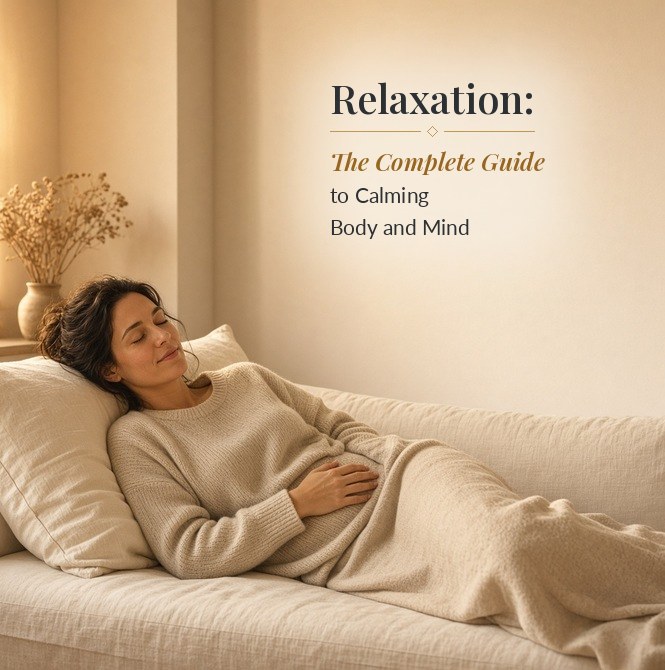
Relaxation is the state in which your body's stress response switches off and the parasympathetic nervous system takes over: your heart rate, breathing and muscle tension fall and your mind settles. Relaxation techniques are simple, learnable skills, such as slow breathing and progressive muscle relaxation, that bring this state on deliberately. Start with our complete guide.
Relaxation is the state in which your body's stress response switches off and the parasympathetic nervous system takes over: your heart rate, breathing and muscle tension fall and your mind settles. Relaxation techniques are simple, learnable skills, such as slow breathing and progressive muscle relaxation, that bring this state on deliberately.
This hub is the home on Self Help Supermarket for Relaxation. Our complete guide explains the method, the evidence and its limits. As we check them, videos, podcasts, courses, books and practitioner directories for Relaxation are added to this page.
This hub is for general information and self-education. It is not a replacement for medical or psychological care.
Start here
New to Relaxation? Our complete guide covers breathing, body-based and mind-led techniques, which technique for which situation, 2-minute and 20-minute routines, the evidence and who should take care.
Relaxation is the state in which your body’s stress response switches off and the parasympathetic nervous system takes over: your heart rate, breathing and muscle tension fall and…
Slow your breathing, especially your out-breath. Breathing at around six breaths a minute reliably shifts the nervous system towards rest (Laborde et al., 2022). A few "physiological sighs" (a double inhale through the nose, then a long exhale through the mouth) is one of the quickest ways to do it.
Release your muscles on purpose. Progressive muscle relaxation, tensing and then letting go of each muscle group, has some of the best evidence of any relaxation method for stress and anxiety (Muhammad Khir et al., 2024).
It isn't for everyone in every form. A minority of people feel more anxious when they try to relax. That is normal, well documented and usually solvable by switching technique.
You will find the full evidence, with sources, in the complete guide.
Before you start: Relaxation techniques are among the safest self-help tools, but a minority of people feel more anxious when they try to relax, so switch to a more active technique if that happens. Breath-holds can cause light-headedness: skip them if you are pregnant or have heart disease, uncontrolled high blood pressure or a lung condition. Relaxation shouldn't delay medical care.
Read our complete guide first. It explains Relaxation step by step and says plainly what the evidence does and does not show.
What is the quickest way to relax?
For most people, slow breathing with a long out-breath is quickest. Try one to three physiological sighs: breathe in through your nose, add a second short sniff, then exhale slowly through your mouth. Dropping your shoulders and unclenching your jaw at the same time adds a quick physical release.
Which relaxation technique has the best evidence?
Slow breathing, progressive muscle relaxation and autogenic training have the most research behind them. PMR and autogenic training have meta-analyses showing moderate benefits for stress and anxiety, and slow breathing consistently improves heart rate variability. Applied relaxation, a structured therapy, is recommended by NICE for generalised anxiety disorder.
Is box breathing or 4-7-8 breathing better?
There is no head-to-head evidence. Box breathing has a little more research and tends to keep you alert, which suits stressful tasks. 4-7-8 breathing has a longer out-breath and many people find it more sleep-inducing, but it has been tested in only one small study. Try both and keep the one you prefer.
What is the physiological sigh?
It is a breathing pattern of two inhales through the nose, one long and one short, followed by a long exhale through the mouth. A 2023 Stanford trial found five minutes a day of this "cyclic sighing" improved mood and lowered anxiety, slightly more than mindfulness meditation. The trial was small and needs repeating.
Why do I feel more anxious when I try to relax?
This is called relaxation-induced anxiety and is surprisingly common, especially in people who are often tense. Unfamiliar sensations, fear of losing control or letting worries surface can all play a part. Try a more active method like PMR, keep your eyes open and start with very short sessions.
Can relaxation replace medication or therapy?
No. Relaxation can reduce stress and anxiety and is part of some NICE-recommended treatments, but it isn't a substitute for treatment of moderate to severe depression, anxiety disorders, PTSD or chronic pain. Use it alongside professional care, and never stop prescribed medication without speaking to your doctor first.
Get listed
Do you teach or practise Relaxation? We are building a directory of trusted practitioners, courses and apps for every technique. Get in touch to be listed.
This hub is for general information and self-help education. It is not medical or psychological advice. External resources are selected by our editors and checked when listed; we are not responsible for third-party content.