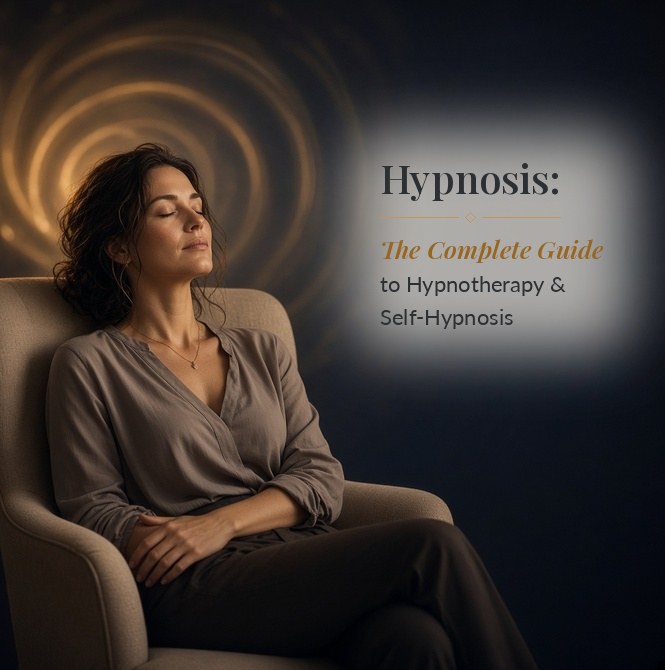
Hypnosis is a state of focused attention and reduced awareness of your surroundings in which you respond more readily to suggestion. You stay awake and in control. Used by trained clinicians, it has good evidence for irritable bowel syndrome, pain and anxiety around medical procedures, but much weaker evidence for quitting smoking or losing weight. Start with our complete guide.
Hypnosis is a state of focused attention and reduced awareness of your surroundings in which you respond more readily to suggestion. You stay awake and in control. Used by trained clinicians, it has good evidence for irritable bowel syndrome, pain and anxiety around medical procedures, but much weaker evidence for quitting smoking or losing weight.
This hub is the home on Self Help Supermarket for Hypnosis. Our complete guide explains the method, the evidence and its limits. As we check them, videos, podcasts, courses, books and practitioner directories for Hypnosis are added to this page.
This hub is for general information and self-education. It is not a replacement for medical or psychological care.
Start here
New to Hypnosis? Our complete guide covers myths versus facts, how hypnosis works, self-hypnosis step by step, what it can honestly help with, the risks and how to choose a hypnotherapist.
Hypnosis is a state of focused attention and reduced awareness of your surroundings in which you respond more readily to suggestion. You stay awake and in control. Used…
People differ a lot. About 10–15% of people respond to most hypnotic suggestions and a similar share respond to very few; most are in the middle (Montgomery et al., 2025).
The best evidence is for IBS. NICE says hypnotherapy should be considered for IBS that hasn't responded to medicines after 12 months (NICE CG61).
It also helps with pain and medical procedures, especially for people who are more hypnotisable (Thompson et al., 2019).
The evidence for stopping smoking is weak. A Cochrane review found any benefit is small at most (Barnes et al., 2019).
You will find the full evidence, with sources, in the complete guide.
Before you start: For most people, hypnosis with a properly trained practitioner is safe, but talk to your doctor or mental health team first if you have psychosis, bipolar disorder, a personality disorder, epilepsy, severe depression, PTSD or a history of trauma. Hypnosis does not unlock an accurate record of the past, and it should never replace medical treatment or be a reason to stop medication. If you are in crisis or thinking of harming yourself, contact your local emergency number or find a helpline in your country at findahelpline.com (in the US, call or text 988).
Read our complete guide first. It explains Hypnosis step by step and says plainly what the evidence does and does not show.
Can anyone be hypnotised?
Most people can respond to some degree. About 10 to 15% are highly hypnotisable, a similar share respond very little, and most are in between. Hypnotisability is a stable trait, but motivation, trust and practice help.
Can I be made to do something against my will?
No. You stay aware and can refuse any suggestion or open your eyes at any time. Stage volunteers are chosen because they are responsive and willing to play along. That said, always use a reputable practitioner and never feel pressured.
What does hypnosis feel like?
Most people feel relaxed, focused and absorbed, a bit like being lost in a good book. Your body may feel heavy or light. You usually remember the session, and many people are surprised by how "normal" it feels.
Is hypnosis the same as sleep?
No. Despite the name, which comes from the Greek word for sleep, you are awake and aware during hypnosis, and brain activity looks like that of an awake person, not someone asleep. You can hear and respond throughout.
What is hypnosis best for?
The strongest evidence is for IBS, pain and anxiety around medical procedures. NICE recognises hypnotherapy as an option for IBS that hasn't responded to medicines after 12 months. Evidence for anxiety is promising, while evidence for stopping smoking and weight loss is weak.
Can hypnosis recover lost memories?
No, and this is risky. Hypnosis makes people more confident in their memories without making them more accurate, and it can create false memories. Avoid anyone offering to "recover" repressed memories.
Get listed
Do you teach or practise Hypnosis? We are building a directory of trusted practitioners, courses and apps for every technique. Get in touch to be listed.
This hub is for general information and self-help education. It is not medical or psychological advice. External resources are selected by our editors and checked when listed; we are not responsible for third-party content.