
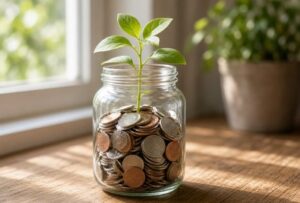
A money and abundance mindset is about the beliefs, feelings and habits you bring to money, and whether you see life mainly through scarcity or through possibility. Money touches almost everything: security, freedom, relationships, generosity and the chance to do work you love. Many of us also carry old stories about money from childhood, culture or past setbacks. The good news is that these stories can be noticed and changed, and research offers some surprising insights into how money and happiness connect. On this page you’ll find what shapes your money mindset, practical habits for a calmer and more abundant relationship with money, and self-help methods that can help. Pick what’s going on for you and we’ll show you where to start.
What’s going on for you?
For when money worries feel heavy today.
- Step 1 · Breathe and pause
Calm first
Big decisions are easier with a calm mind.
- Step 2 · Write the numbers down
Clarity
Facts on paper feel smaller than fears in your head.
- Step 3 · Take one small step
One action
Call, check or plan one thing today.
Not quite right? See every method for money and abundance mindset
For when old money stories hold you back.
- Step 1 · Spot your money script
Childhood messages
What did you learn about money growing up?
- Step 2 · Question it
Is it true?
Test a belief such as “Money is hard to come by”.
- Step 3 · Write a new story
Empowering beliefs
Choose a belief that helps you grow.
Not quite right? See every method for money and abundance mindset
For when it never feels like enough.
- Step 1 · Count what you have
Gratitude
List five things you’re thankful for.
- Step 2 · Give a little
Generosity
Spending on others boosts happiness.
- Step 3 · Buy back time
Time, not things
Paying to save time can lift wellbeing.
Not quite right? See every method for money and abundance mindset
For a lasting abundant mindset.
- Step 1 · Set a clear intention
Know what you want
Define what abundance means to you.
- Step 2 · Visualise it
See it clearly
Picture the life you’re building.
- Step 3 · Act on it
Inspired action
Pair mindset with practical steps.
Not quite right? See every method for money and abundance mindset
Every method for money and abundance mindset
Self-help practices
-
Gratitude
Counting blessings has been linked with greater wellbeing. [1]
Everyday practice
-
Generous spending
Spending money on others promoted happiness in research. [2]
Everyday practice
-
Buying time
Spending on time-saving services was linked with greater life satisfaction. [3]
Everyday practice
-
Money check-ins
A calm, regular look at your numbers replaces vague worry with clarity.
Everyday practice
Methods that pair well
-
Law of Attraction
Focusing thoughts and feelings on the abundance you want to create. Full guide
-
Abraham-Hicks
Esther Hicks’ teachings on allowing and feeling good first. Full guide
-
The Secret
Rhonda Byrne’s popular book and film on the law of attraction.
-
Reality Transurfing
Vadim Zeland’s approach to choosing your reality with less struggle. Full guide
More methods with their own hub and guide
-
Visualisation
Picturing your financial goals clearly and often. Full guide
-
The Lefkoe Method
Dissolving beliefs such as “Money is the root of all evil”. Full guide
-
Belief Coding
Rewriting limiting money beliefs. Full guide
-
EFT Tapping
Tapping on money worries and blocks. Full guide
-
Mind Movies
Creating a visual vision board video of your goals. Full guide
Expert guidance
-
Financial adviser or planner
Practical help with budgeting, saving, debt and investing.
Support option
-
Free money guidance
Many countries offer free, impartial money guidance services.
Support option
Learn more
About money and abundance mindset
What it is, why it happens and what helps. Contents:
- What is an abundance mindset?
- Scarcity versus abundance
- Your money scripts
- Does money buy happiness?
- Spending that makes you happier
- The joy of giving
- Time is wealth too
- Gratitude and enough
- Changing money beliefs
- The law of attraction and money
- Practical habits
- Easing money stress
- Money and relationships
- Self-worth and earning
- A simple 30-day plan
- How self-help methods fit in
- FAQs
What is an abundance mindset?
An abundance mindset is a way of seeing the world as full of opportunity, where there is enough to go around and your success doesn’t have to mean someone else’s loss. The phrase was popularised by Stephen Covey in The 7 Habits of Highly Effective People. Applied to money, it means approaching finances with calm, confidence and generosity rather than fear. It isn’t about pretending money doesn’t matter or ignoring bills. It’s about pairing a hopeful, open outlook with wise, practical choices. You can explore related topics in our Wellness hub, including manifestation and positivity.
Scarcity versus abundance
A scarcity mindset focuses on what’s missing: “There’s never enough”, “I can’t afford anything” or “Other people’s success leaves less for me.” It often brings tension, comparison and short-term thinking. An abundance mindset focuses on possibility: “There are ways to grow”, “I can learn” and “I’m glad for their success.” Most people move between the two depending on circumstances. Noticing which one you’re in is the first step to choosing more often.
Your money scripts
Many of our beliefs about money are learned early, from family, culture, religion and experience. Common examples include “Money doesn’t grow on trees”, “Rich people are greedy”, “We don’t talk about money” or “I’m just not good with money.” Financial psychologists call these “money scripts”. They often run quietly in the background, shaping how we earn, spend, save and give. Try writing down the messages you heard about money as a child, and ask of each: “Is this true? Is it helpful? What would I rather believe?” The Work and the Lefkoe Method offer structured ways to do this.
Does money buy happiness?
Research suggests money can help, especially when it covers needs and brings security. Matthew Killingsworth found, using real-time reports from tens of thousands of people in the US, that experienced wellbeing kept rising with income, even above $75,000 per year. [4] In a later collaboration with Daniel Kahneman and Barbara Mellers, the researchers found that for most people happiness rises steadily with income, while for the least happy group it levels off at higher incomes. [5] This suggests that money supports wellbeing for many people, and that other parts of life, such as relationships, health and meaning, matter too.
Spending that makes you happier
How you spend can matter as much as how much you have. Psychologists Elizabeth Dunn and Michael Norton, authors of Happy Money, suggest several principles: buy experiences, make spending a treat, buy time, pay now and enjoy later, and invest in others. Their TED talks are in Videos. Shared experiences, such as a meal with friends, a trip or learning something new, tend to bring lasting joy because we can look forward to them, enjoy them and remember them.
The joy of giving
In a well-known study, Elizabeth Dunn, Lara Aknin and Michael Norton found that people who spent more of their income on others were happier, and that people randomly given money to spend on someone else felt happier than those who spent it on themselves. [2] Generosity is a natural expression of abundance. Even small amounts count: buying a friend a coffee, supporting a cause you care about or giving time and skills. Many people find that giving helps them feel that they have enough.
Time is wealth too
Ashley Whillans and colleagues studied more than 6,000 people in the United States, Canada, Denmark and the Netherlands. People who spent money on time-saving services reported greater life satisfaction, and in an experiment, working adults felt happier after a time-saving purchase than after a material one. [3] Whillans’ TEDx talk is in Videos. Abundance isn’t only about money. Free time, energy, health and relationships are forms of wealth too.
Gratitude and enough
Gratitude helps shift attention from what’s missing to what’s already here. Robert Emmons and Michael McCullough found that people who regularly counted their blessings reported greater wellbeing than those who listed hassles. [1] A simple daily practice is to write three things you’re grateful for, including at least one related to money or resources, such as a warm home, a meal or a skill you can earn with. Many people find that feeling “enough” is the foundation of feeling abundant.
Changing money beliefs
Beliefs shape behaviour. If you believe you’re “bad with money”, you may avoid looking at your accounts, which makes things harder. If you believe you can learn, you’re more likely to ask questions and build skills. Try replacing old beliefs with ones that feel true and hopeful, such as “I’m learning to manage money well”, “Money can be a tool for good” or “I deserve to be paid fairly.” Repeat them, write them down and look for evidence that supports them. Belief Coding and EFT tapping are popular ways to work on deeper money blocks.
The law of attraction and money
Many people use the law of attraction to support an abundance mindset. The idea is that focusing your thoughts and feelings on what you want, rather than on what you lack, helps you notice opportunities and take inspired action. Teachers such as Esther Hicks, Rhonda Byrne, Bob Proctor and Wallace D. Wattles have written about this, and Vadim Zeland’s Reality Transurfing offers a related approach. Common practices include visualisation, affirmations, scripting and vision boards. Many readers find these work best alongside practical steps, so their mindset and actions point in the same direction. Our guide to manifestation explores this further.
Practical habits
- A weekly money date. Spend 20 minutes looking calmly at your accounts and plans.
- Pay yourself first. Set aside a small amount for savings as soon as money comes in.
- Spend on purpose. Match your spending with your values.
- Build an emergency fund. Even a small cushion brings peace of mind.
- Keep learning. Books, podcasts and free courses build confidence.
- Celebrate progress. Notice every step forward, however small.
Free, impartial money guidance services exist in many countries, including the UK, the US, Canada, Australia and India, and can help with budgeting and debt.
Easing money stress
Money worries are among the most common sources of stress. When you feel anxious, try slowing your breathing, writing down the facts and choosing one small next step. Breaking big problems into small actions makes them feel manageable. Talking to someone you trust, or to a free money guidance service, can bring relief and fresh ideas. Our guides to stress management and anxiety offer more tools.
Money and relationships
Money can be a sensitive topic for couples and families. Different money scripts often explain different habits: one person may love to save, another to spend. Talking openly, without blame, about what money means to each of you can bring you closer. Agree shared goals and give each person some freedom too. Our guides to communication and conflict resolution may help.
Self-worth and earning
Many people find it hard to ask for a pay rise, set their prices or accept generous offers. This often links with self-worth. Remember that being paid fairly is an exchange of value, not greed. Practise naming your worth out loud, gather evidence of the value you bring, and remember that confidence grows with practice. Our guides to self-esteem and imposter syndrome may help if you feel you don’t deserve success.
A simple 30-day plan
Week 1: Awareness. Write down your childhood money messages and how you feel about money today.
Week 2: Gratitude. Write three things you’re grateful for each day, including one about resources.
Week 3: New beliefs. Choose two empowering money beliefs and repeat them daily. Hold a weekly money date.
Week 4: Abundance in action. Do one generous act, buy back a little time and take one practical step towards a money goal.
How self-help methods fit in
The law of attraction, Abraham Hicks, The Secret and Reality Transurfing offer different ways to focus your mind on abundance. The Lefkoe Method and Belief Coding help change limiting money beliefs, and visualisation helps you see your goals clearly. You can see every method we cover in the full list above.
Frequently asked questions
What is an abundance mindset?
A way of seeing the world as full of opportunity, where there is enough to go around, and approaching money with calm and generosity rather than fear.
What is a scarcity mindset?
A focus on what’s missing, such as “There’s never enough”, which often brings tension and short-term thinking.
Does money buy happiness?
Research suggests wellbeing rises with income for most people, though relationships, health and meaning matter too. [5]
What kind of spending makes people happier?
Spending on others, on experiences and on saving time have all been linked with greater happiness. [2] [3]
How do I change my money mindset?
Notice your childhood money messages, question them, choose new beliefs, practise gratitude and pair mindset with practical habits.
Can the law of attraction help with money?
Many people use it to build an abundant mindset and notice opportunities, ideally alongside practical financial steps.
What are money scripts?
Beliefs about money learned early in life, such as “Money doesn’t grow on trees”, that shape how we earn, spend, save and give.
The best videos on money and abundance mindset
Hand-picked and checked one by one: TED, TED-Ed and TEDx.
Money and happiness
Time and giving
Abundance mindset
Books on money and abundance mindset
Free resources
Experts to follow
Get help
If money worries feel overwhelming, a free money guidance service or your doctor can help.
Find a therapist or counsellor
- US and Canada: Psychology Today (US) and (Canada) directories.
- UK: BACP therapist directory.
- Australia: APS Find a Psychologist, and Relationships Australia for couple and family services.
- Elsewhere, including Europe and India: ask your doctor or local health service for a referral, and check that anyone you see is registered or accredited where you live.
This hub is for information, not a substitute for medical or psychological care.
Sources
- Emmons & McCullough (2003), Counting blessings versus burdens: an experimental investigation of gratitude and subjective well-being in daily life, Journal of Personality and Social Psychology 84(2):377-389
- Dunn, Aknin & Norton (2008), Spending money on others promotes happiness, Science 319(5870):1687-1688
- Whillans et al. (2017), Buying time promotes happiness, PNAS 114(32):8523-8527
- Killingsworth (2021), Experienced well-being rises with income, even above $75,000 per year, PNAS 118(4):e2016976118
- Killingsworth, Kahneman & Mellers (2023), Income and emotional well-being: a conflict resolved, PNAS 120(10):e2208661120
Written by Saj Ali. Last updated 3 November 2026. Spotted an error? Tell us and we will fix it.