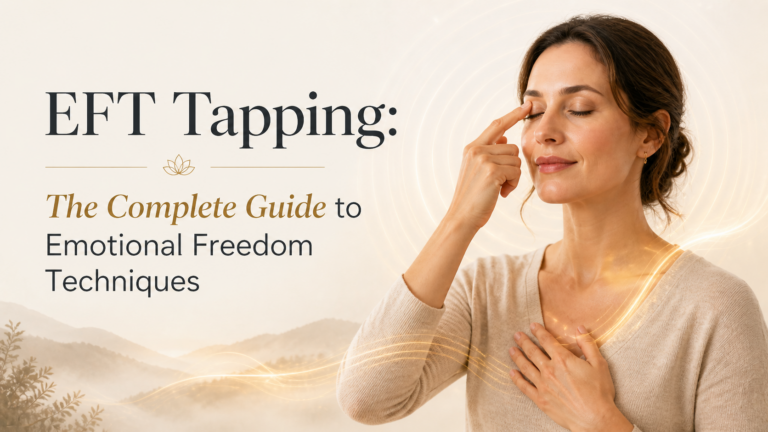
Emotional Freedom Techniques (EFT), often called tapping, is a self-help method developed by Gary Craig in the 1990s. You tap with your fingertips on acupressure points on the face and upper body while focusing on a problem and repeating a short phrase. People use it for stress, anxiety and difficult memories; research is growing but mixed in quality.
EFT tapping helped war veterans with severe PTSD reduce their symptoms by 63% in just six sessions. That single statistic, drawn from a 2013 study published in the Journal of Nervous and Mental Disease, represents something remarkable: a technique you can learn in ten minutes that produces results clinical psychologists spend years trying to achieve.
Emotional Freedom Techniques (EFT), commonly known as “tapping,” is a therapeutic method that combines elements of cognitive behavioural therapy with acupressure. Practitioners tap on specific meridian points on the body while focusing on a distressing thought, memory, or emotion. The process is designed to reduce the emotional charge attached to negative experiences, lower cortisol levels, and restore the body’s energy balance.
If that sounds too good to be true, you are not alone. EFT was dismissed by mainstream psychology for years. But a growing body of peer-reviewed research, including over 100 published studies, has forced the scientific community to take notice. Whether you are dealing with anxiety, chronic pain, traumatic memories, or simply the low-grade stress of everyday life, EFT tapping offers a practical, accessible tool you can use anywhere, at any time, without a therapist, a prescription, or a penny.
What Is EFT Tapping?
EFT (Emotional Freedom Techniques) is a mind-body healing method that involves tapping with your fingertips on specific acupressure points while verbalising a setup statement and focusing on a particular issue. It was developed by Gary Craig in 1995 and is rooted in the principles of Traditional Chinese Medicine and modern psychology.
Craig, a Stanford-trained engineer and personal performance coach, simplified an earlier technique called Thought Field Therapy (TFT), created by psychologist Dr Roger Callahan in the 1980s. Callahan discovered that tapping on meridian endpoints while thinking about a specific fear could eliminate the emotional disturbance almost instantly. Craig took Callahan’s complex diagnostic approach and distilled it into a single, universal tapping sequence that anyone could learn.
The core philosophy of EFT rests on one central premise: unresolved negative emotions are caused by disruptions in the body’s energy system. By tapping on the endpoints of major energy meridians while mentally engaging with the problem, you send a calming signal to the amygdala (the brain’s stress centre), effectively telling your nervous system that it is safe to relax.
EFT is sometimes described as “psychological acupuncture without the needles.” The technique targets the same meridian points used in acupuncture for thousands of years, but uses gentle fingertip tapping instead of needles. This makes it entirely self-administered and non-invasive.
How Does EFT Tapping Work?
Think of your brain’s stress response like a car alarm. When a genuine threat appears, the alarm goes off and you respond appropriately. But sometimes the alarm gets stuck. A bad memory, a phobia, or chronic anxiety keeps triggering the alarm even when there is no real danger. Your body floods with cortisol and adrenaline. Your muscles tighten. Your thinking narrows.
EFT tapping works by simultaneously activating the stress response (by focusing on the negative emotion) and sending a physical calming signal (through the tapping) to the amygdala. This combination appears to “reset” the alarm system.
Research supports this mechanism. A landmark 2012 study by Dawson Church, PhD, and colleagues, published in the Journal of Nervous and Mental Disease, measured cortisol levels in 83 participants. The group that received an hour of EFT tapping showed a 24% decrease in cortisol, compared to just 14% in the talk therapy group and 12% in the resting control group.
Functional MRI studies have added further evidence. Research conducted at Harvard Medical School demonstrated that stimulating acupressure points decreases activity in the amygdala and other parts of the limbic system. When the amygdala calms down, the fight-or-flight response deactivates, and the body can return to a state of equilibrium.
The process also appears to work through a mechanism called “memory reconsolidation.” Every time you recall a memory, your brain briefly makes it malleable. By tapping while recalling a distressing memory, you are essentially rewriting the emotional tag attached to that memory. The factual memory remains, but the emotional sting diminishes or disappears.
What Are the 9 EFT Tapping Points?
The standard EFT tapping sequence uses nine specific points on the body. Each point corresponds to an endpoint of a major energy meridian. Here is the complete sequence:
1. The Karate Chop Point (KC) Located on the outer edge of your hand, below the little finger. This is where you tap while saying the setup statement. It corresponds to the small intestine meridian.
2. Top of the Head (TH) The crown of the head, directly in the centre. This point sits at the intersection of several meridian lines, known in acupuncture as the “governing vessel.”
3. Eyebrow Point (EB) The inner edge of the eyebrow, just above the bridge of the nose. This corresponds to the bladder meridian.
4. Side of the Eye (SE) The bone on the outer edge of the eye socket. This corresponds to the gallbladder meridian.
5. Under the Eye (UE) The bone directly beneath the centre of the eye, roughly one inch below the pupil. This corresponds to the stomach meridian.
6. Under the Nose (UN) The small area between the bottom of the nose and the top of the upper lip. This corresponds to the governing vessel meridian.
7. Chin Point (CH) The crease between the bottom lip and the chin, sometimes called the “mental crease.” This corresponds to the central vessel meridian.
8. Collarbone Point (CB) The junction where the collarbone, the first rib, and the breastbone meet. Feel for the bony bumps just below and slightly to the side of your throat notch. This corresponds to the kidney meridian.
9. Under the Arm (UA) About four inches below the armpit, roughly in line with the nipple for men or the middle of the bra strap for women. This corresponds to the spleen meridian.
You can tap on either side of the body. Most practitioners use two or three fingers and tap approximately five to seven times on each point. The tapping should be firm but gentle, using just enough pressure to feel it without causing discomfort.
What Are the Benefits of EFT Tapping?
The documented benefits of EFT span physical, psychological, and emotional health. Unlike vague self-help promises, many of these outcomes are backed by peer-reviewed research.
Anxiety Reduction
A 2016 meta-analysis published in the Journal of Nervous and Mental Disease reviewed 14 randomised controlled trials and found that EFT produced significant reductions in anxiety symptoms. The effect size was large (Cohen’s d = 1.23), meaning it outperformed many conventional treatments.
PTSD and Trauma Recovery
EFT has shown particularly strong results for post-traumatic stress disorder. A study of military veterans by Church et al. (2013) found that 86% of participants no longer met clinical PTSD criteria after six sessions. This compares favourably with traditional trauma therapies, which typically require 12 or more sessions.
Pain Management
A 2013 review in the journal Energy Psychology found that EFT tapping reduced pain intensity in chronic pain sufferers. Practitioners report that the technique works especially well for tension headaches, fibromyalgia symptoms, and stress-related pain conditions.
Cortisol and Stress Reduction
As noted earlier, Church’s 2012 cortisol study demonstrated a 24% reduction after a single hour of EFT. Reduced cortisol brings cascading benefits: better sleep, improved immune function, clearer thinking, and reduced inflammation.
Food Cravings and Weight Management
A 2014 study by Stapleton et al., published in Psychotherapy and Psychosomatics, found that participants who used EFT experienced significant reductions in food cravings and maintained those improvements at 12-month follow-up. Participants also lost a measurable amount of weight without any dietary intervention.
Phobia Treatment
EFT’s origins trace back to treating phobias, and this remains one of its strongest applications. Practitioners commonly report that specific phobias, including fear of public speaking, needles, spiders, and flying, can be reduced or eliminated in one to three sessions.
Emotional Resilience
Regular EFT practice appears to build broader emotional resilience over time. A 2020 study in the Journal of Evidence-Based Integrative Medicine found that participants who used EFT daily for 30 days reported significant improvements in overall psychological wellbeing, including reduced depression, anxiety, and somatic symptoms.
Who Is EFT Tapping Best For?
EFT tapping is remarkably versatile. Here is how it connects to the three pillars of health, wellness, and relationships.
Health
People dealing with chronic pain, autoimmune conditions, insomnia, or stress-related health issues often find EFT helpful as a complementary tool. It is not a replacement for medical treatment, but it can address the emotional components that frequently accompany physical illness. Cancer patients have used EFT to manage treatment anxiety and emotional distress.
Wellness
Anyone seeking better emotional regulation, stress management, or personal development can benefit from EFT. It is particularly effective for people who feel “stuck” emotionally; those carrying old resentments, childhood memories, or limiting beliefs that conventional approaches have not shifted.
Relationships
Relationship conflicts often have deep emotional roots. EFT can help individuals process the anger, hurt, or fear that drives destructive relationship patterns. Couples therapists increasingly incorporate tapping to help partners release emotional charge before attempting productive conversations.
EFT is suitable for adults and children. It requires no special equipment, costs nothing to practise, and can be learned in minutes. However, people with severe trauma or complex PTSD should work with a qualified EFT practitioner or mental health professional rather than attempting to address deep trauma alone.
How to Get Started with EFT Tapping
You can learn the basic EFT tapping technique in under ten minutes. Here is a step-by-step guide you can follow right now.
Step 1: Identify the Issue
Choose one specific problem to work on. This could be an emotion (anxiety about a presentation), a physical sensation (tension in your shoulders), a memory (an argument that still bothers you), or a belief (I am not good enough). Be as specific as possible. “I feel anxious” is less effective than “I feel anxious about my performance review on Thursday.”
Step 2: Rate the Intensity
On a scale of 0 to 10, rate how intense the issue feels right now. 10 is the worst it could possibly feel; 0 means it does not bother you at all. This is called the SUDS rating (Subjective Units of Distress Scale). Write this number down. You will use it to measure your progress.
Step 3: Create Your Setup Statement
The setup statement has a specific formula: “Even though I [state the problem], I deeply and completely accept myself.”
For example: “Even though I feel this anxiety about my performance review, I deeply and completely accept myself.”
If “I deeply and completely accept myself” feels too strong, try alternatives such as “I am open to letting this go” or “I choose to accept how I feel right now.”
Step 4: The Setup Round
Tap on the Karate Chop point continuously while repeating the setup statement three times. Say it out loud if possible.
Step 5: The Tapping Sequence
Now tap through each of the remaining eight points (top of head, eyebrow, side of eye, under eye, under nose, chin, collarbone, under arm), tapping five to seven times on each point. As you tap each point, say a shorter “reminder phrase” that keeps you focused on the issue. For example: “this anxiety about my review” or “this tightness in my chest.”
Step 6: Reassess
After completing one full round, take a breath and rate the intensity again. If it started at an 8 and is now at a 5, you are making progress. Repeat the sequence, adjusting your language as the intensity shifts. You might move from “this remaining anxiety” to “this last bit of tension.”
Step 7: Continue Until the Intensity Drops
Keep tapping rounds until the intensity reaches a 2 or below. This typically takes 5 to 20 minutes for a specific issue. Some issues resolve in one session; others require multiple sessions spread over days or weeks.
Time commitment: Most people see results with 10 to 20 minutes of daily practice. A single session can address a specific issue. Building EFT into a daily routine takes about the same time as brushing your teeth.
Resources needed: Nothing. Your fingers and your voice.
Expected timeline: Immediate relief is common for surface-level stress. Deeper issues such as childhood trauma or long-standing beliefs may take weeks of consistent practice.
EFT Tapping vs EMDR: How Do They Compare?
EFT and EMDR (Eye Movement Desensitisation and Reprocessing) are both used to treat trauma, anxiety, and emotional disturbances. They share some philosophical ground but differ significantly in practice.
EMDR, developed by Francine Shapiro in 1987, uses bilateral stimulation (typically guided eye movements) while a patient recalls distressing memories. It requires a trained therapist and typically involves 6 to 12 structured sessions.
EFT uses physical tapping on meridian points combined with verbal statements. It can be self-administered and learned without professional training for everyday issues.
Both techniques operate on the principle of processing distressing memories while the body receives a calming physical input. Research supports both methods for PTSD and anxiety.
The key difference is accessibility. EMDR requires a trained professional and clinical setting. EFT can be practised at home, at work, or anywhere you have five minutes of privacy. For severe trauma, EMDR’s clinical structure may be more appropriate. For everyday stress, anxiety, and emotional regulation, EFT offers a practical self-help option.
Many practitioners recommend using both: EMDR with a therapist for deep trauma work, and EFT as a daily self-regulation tool.
Does EFT Tapping Really Work? Common Misconceptions
Misconception 1: “EFT is just the placebo effect”
This is the most common criticism, and it has been directly addressed by research. The Church et al. (2012) cortisol study included both a placebo control (supportive interview) and a no-treatment control (rest). EFT significantly outperformed both. If EFT were purely placebo, the supportive interview group would have shown similar results.
Misconception 2: “There is no scientific evidence”
As of 2023, over 100 peer-reviewed studies have been published on EFT, including more than 40 randomised controlled trials. EFT meets the criteria established by the American Psychological Association’s Division 12 as an “evidence-based treatment” for anxiety, depression, phobias, and PTSD. The research base continues to grow annually.
Misconception 3: “You need to believe in it for it to work”
EFT has been shown to work with sceptical participants and in studies where participants had no prior belief in the technique. It has also been used successfully with children and animals, neither of whom can hold a belief about the method’s efficacy.
Misconception 4: “Tapping on your face cannot possibly affect your brain”
Functional MRI research from Harvard Medical School has demonstrated that stimulating specific acupoints produces measurable changes in brain activity, particularly in the amygdala and prefrontal cortex. The physical mechanism is well-documented.
Misconception 5: “EFT is a replacement for professional therapy”
No responsible EFT practitioner makes this claim. EFT is a complementary technique. For complex mental health conditions, it works best alongside professional support, not as a substitute. Many licensed therapists now incorporate EFT into their clinical practice.
Expert Practitioners and Resources
Key Figures in EFT
Gary Craig is the founder of EFT and author of The EFT Manual. His website, emofree.com, remains one of the most comprehensive free resources for learning the technique.
Dawson Church, PhD is a leading researcher in the field and author of The Genie in Your Genes and Mind to Matter. His research has been instrumental in establishing the evidence base for EFT.
Nick Ortner is the author of the bestselling book The Tapping Solution and founder of The Tapping Solution app, which has introduced EFT to millions of people. His annual Tapping World Summit is the largest online event in the field.
Peta Stapleton, PhD is a clinical psychologist and professor at Bond University, Australia. Her research, particularly on EFT for food cravings and weight management, has been published in leading psychology journals. She is the author of The Science Behind Tapping.
Related: self-help experts directory
Recommended Books
- The EFT Manual by Gary Craig
- The Tapping Solution by Nick Ortner
- The Science Behind Tapping by Peta Stapleton
- Mind to Matter by Dawson Church
Suggested External Authority Links
- National Center for Biotechnology Information (NCBI): EFT research database (.gov)
- Association for Comprehensive Energy Psychology (ACEP)
- Harvard Medical School: research on acupoint stimulation
- Bond University: Peta Stapleton’s research lab (.edu.au)
- American Psychological Association: Division 12 evidence-based treatments (.org)
Frequently Asked Questions About EFT Tapping
What is EFT tapping? EFT (Emotional Freedom Techniques) is a mind-body therapy that involves tapping on acupressure meridian points while focusing on a specific emotional issue. Developed by Gary Craig in 1995, it combines principles from cognitive therapy and acupressure to reduce emotional distress and restore energy balance.
How long does EFT tapping take to work? Many people feel relief within a single session of 10 to 20 minutes, especially for surface-level stress and anxiety. Deeper issues such as trauma or long-standing phobias may require multiple sessions over several weeks. Consistent daily practice produces the strongest results.
Is EFT tapping scientifically proven? Over 100 peer-reviewed studies support EFT’s effectiveness, including more than 40 randomised controlled trials. Research published in journals such as the Journal of Nervous and Mental Disease demonstrates measurable reductions in cortisol, anxiety, PTSD symptoms, and pain. EFT meets APA Division 12 criteria as evidence-based.
Can I do EFT tapping on my own? Yes. EFT was designed as a self-help tool. The basic technique can be learned in minutes and practised anywhere without equipment or professional guidance. For complex trauma or severe mental health conditions, working with a certified EFT practitioner is recommended.
Does EFT tapping work for anxiety? Research strongly supports EFT for anxiety. A 2016 meta-analysis of 14 randomised controlled trials found a large treatment effect for anxiety reduction. Many practitioners and users report significant anxiety relief after just one or two sessions.
What are the side effects of EFT tapping? EFT is generally considered safe with minimal side effects. Some people experience temporary emotional intensity as suppressed feelings surface during tapping. Fatigue, yawning, or light-headedness after a session are also occasionally reported. These effects typically pass quickly.
Can children use EFT tapping? Yes. EFT is safe for children and has been used successfully in schools and paediatric settings. Children often respond quickly to tapping because they tend to have less resistance to the process. Simpler language and shorter sessions work best for younger children.
How is EFT different from acupuncture? Both EFT and acupuncture target the body’s meridian system, but EFT uses fingertip tapping instead of needles. EFT also incorporates a cognitive component (focusing on specific thoughts and emotions) that acupuncture does not. EFT can be self-administered; acupuncture requires a trained practitioner.
Is EFT tapping covered by insurance? Coverage varies by country and provider. In the UK and many other countries, EFT is not typically covered by standard health insurance. However, some therapists who use EFT are licensed mental health professionals whose services may be covered. Check with your specific provider.
Where can I learn EFT tapping? Free resources include Gary Craig’s emofree.com and numerous instructional videos on YouTube. Nick Ortner’s The Tapping Solution app offers guided sessions. For professional training, the Association for Comprehensive Energy Psychology (ACEP) and EFT International offer accredited certification programmes.
Start Tapping Today
EFT tapping is one of the most accessible, well-researched, and genuinely useful self-help techniques available. It costs nothing, takes minutes to learn, and has a growing evidence base that spans anxiety, trauma, pain, cravings, and emotional resilience.
The best way to understand EFT is to experience it. Pick one small issue, follow the seven steps outlined above, and notice what shifts. You might be surprised.
Explore more evidence-based self-help techniques, expert profiles, and wellness resources at selfhelpsupermarket.com.
Related: browse all self-help techniques