
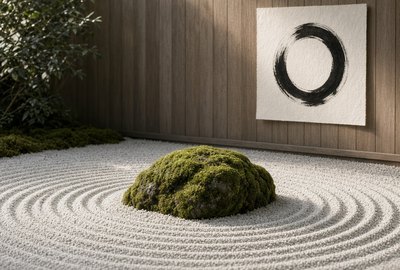
Satori is the Japanese Zen Buddhist term for the experience of awakening or enlightenment: a sudden, direct insight into the true nature of reality and of oneself. It is closely related to kensho, ‘seeing one’s true nature’, which usually names an initial awakening. In Zen, satori is reached through meditation (zazen), and in some schools through koan practice, rather than through study alone.
Last updated: 10 November 2026
Reading time: about 9 minutes
How we wrote this article: this article was written by Saj Ali. It defines satori and related terms using Zen centre glossaries and Tricycle, explains the Rinzai and Soto approaches, and links research on Zen meditation and the neuroscience of insight to its sources.
Satori in brief
- Meaning. Awakening; a sudden, direct insight into your true nature.
- Kensho. ‘Seeing one’s true nature’, often an initial awakening.
- Method. Seated meditation (zazen), and koan practice in the Rinzai school.
- After satori. Practice continues to deepen and express the insight in daily life.
- For everyone. Beginner’s mind: meeting each moment fresh.
Contents
- What Is Satori?
- Satori and Kensho
- Where Satori Comes From: A Short History of Zen
- Zazen: Seated Meditation
- Koans: Questions That Open the Mind
- What Research Shows
- Beginner’s Mind: Bringing Zen Into Daily Life
- Satori Compared With Other Awakening Experiences
- Frequently Asked Questions
- Key Takeaways
- Explore More on Self Help Supermarket
- Sources
What Is Satori?
Satori comes from the Japanese verb satoru, “to understand” or “to know”. In Zen it means the experience of awakening, or enlightenment (Mount Baldy Zen Center glossary).
Satori is described as a direct, often sudden insight that cannot be fully captured in words. The usual sense of a separate self falls away, and the world is seen as it is, without the filter of habitual thinking. Those who report it often describe a sense of freedom, clarity and deep connection.
The Zen scholar D. T. Suzuki, who did much to introduce Zen to the West, wrote that “Satori is the raison d’être of Zen, without which Zen is no Zen” (An Introduction to Zen Buddhism, 1934).
| Term | Language | Meaning |
|---|---|---|
| Satori | Japanese | Awakening, enlightenment |
| Kensho | Japanese | Seeing one’s true nature |
| Wu | Chinese | Awakening (the Chinese term behind satori) |
| Bodhi | Sanskrit, Pali | Awakening, as in the Buddha’s enlightenment |
| Zazen | Japanese | Seated meditation |
| Koan | Japanese | A teaching story or question used in meditation |
Satori and Kensho
Kensho means “to see self nature” or “seeing one’s own true nature; an experience of awakening” (Mount Baldy Zen Center glossary). The two words are often used interchangeably. Where a distinction is made, kensho usually names a first glimpse, and satori a deeper or fuller awakening.
Zen teachers stress that a first awakening is a beginning rather than an end. Writing in Tricycle, one Zen teacher describes an early kensho as “an initial awakening” that “provided the basis for faith to continue the Zen Way”. The same article quotes Philip Kapleau Roshi: awakening “doesn’t transform us overnight, but it establishes the basis by which we can go on endlessly transforming ourselves.”
The continued practice after awakening is sometimes called post-kensho training.
Where Satori Comes From: A Short History of Zen
Zen grew out of Mahayana Buddhism in China, where it was known as Chan, from around the 6th century CE. Tradition traces it to Bodhidharma, an Indian monk, and it later spread to Korea (Seon), Vietnam (Thien) and Japan (Zen).
Zen emphasises direct experience over scripture. A traditional verse describes it as “a special transmission outside the scriptures, not depending on words and letters, pointing directly to the human mind, seeing into one’s nature and attaining Buddhahood.”
Two main schools of Japanese Zen approach awakening in different ways:
| School | Founder in Japan | Approach to awakening |
|---|---|---|
| Rinzai | Eisai (12th century) | Koan practice and intense effort; satori often sudden |
| Soto | Dogen (13th century) | Shikantaza, “just sitting”; practice itself is seen as awakening |
Dogen taught that sitting in zazen is not a means to awakening but an expression of it. Rinzai teachers, such as the 18th-century master Hakuin, emphasised breakthrough experiences through koans.
Zazen: Seated Meditation
Zazen is “seated meditation; sitting practice of Zen; upright sitting with no mental fabrication” (Mount Baldy Zen Center glossary). It is the heart of Zen practice in every school.
How zazen is usually practised:
- Sit on a cushion (zafu) in a cross-legged position, or on a bench or chair. Keep the back upright.
- Rest the hands in the cosmic mudra: left hand on top of right, palms up, thumb tips lightly touching to form an oval.
- Keep the eyes half-open, gazing softly at the floor about a metre ahead.
- Breathe naturally through the nose. Beginners often count breaths from one to ten, then start again.
- When thoughts arise, let them come and go without following them.
In shikantaza, “just sitting”, there is no object at all: “a state of attention that is free from thoughts, directed to no object, and attached to no particular content.”
Our meditation guide covers more techniques for beginners.
Koans: Questions That Open the Mind
A koan, literally a “public case”, is a short story, dialogue or question from the lives of Zen masters. Koans are not riddles with clever answers. They are used in meditation to exhaust ordinary, logical thinking so that direct insight can break through.
Well-known koans include:
- Mu. A monk asked Master Zhaozhou (Joshu in Japanese), “Does a dog have Buddha nature?” Zhaozhou answered, “Mu” (“No” or “Not”). This is the first case in the 13th-century collection The Gateless Gate (Mumonkan) and is often given to beginners.
- The sound of one hand. “Two hands clap and there is a sound. What is the sound of one hand?” This koan was created by Hakuin.
- Original face. “What was your original face before your parents were born?”
In Rinzai practice, students work with a koan in meditation and present their understanding in a private meeting with the teacher (sanzen or dokusan). The teacher confirms when a student has seen through it.
What Research Shows
Researchers have studied Zen meditation for decades, and the wider science of sudden insight helps explain the “aha” quality of satori.
| Study | Finding |
|---|---|
| Kasamatsu and Hirai, 1966 | One of the first EEG studies of Zen monks found alpha brain waves increased during zazen, and rhythmic theta waves appeared in the most experienced monks |
| Pagnoni et al., 2008 | In regular Zen practitioners, the brain’s response to words faded faster in the default network, suggesting greater ability to let go of passing thoughts |
| Kounios and Beeman, 2014 | Sudden “aha” insight is linked with right-hemisphere processing and with internally focused attention before and during problem solving |
| Goyal et al., 2014 | A review of 47 trials found meditation programmes improved anxiety, depression and pain |
Research on everyday insight shows that a calm, open, inward-focused mind makes sudden understanding more likely, which matches how Zen teachers describe the conditions for awakening.
Beginner’s Mind: Bringing Zen Into Daily Life
You don’t need to live in a monastery to benefit from Zen. The Soto Zen teacher Shunryu Suzuki, founder of the San Francisco Zen Center, wrote in Zen Mind, Beginner’s Mind (1970): “In the beginner’s mind there are many possibilities, but in the expert’s there are few.”
Beginner’s mind (shoshin) means meeting each moment with openness and curiosity, without assuming you already know.
Ways to practise it:
- Do one thing at a time. Eat, walk or wash dishes with full attention. Zen sees everyday tasks as practice.
- Sit daily. Five to ten minutes of zazen each morning builds the habit.
- Ask a ‘don’t know’ question. When you feel certain, ask: “What if I’m missing something?”
- Let go of outcomes. Zen teachers often warn against chasing satori. Practise for its own sake.
- Find a sangha. Many Zen centres offer free introductions to zazen, online and in person.
For related practices, see our guides to meditation vs mindfulness, overthinking and letting go of the past.
Satori Compared With Other Awakening Experiences
| Concept | Tradition | Key feature |
|---|---|---|
| Satori | Zen Buddhism | Sudden, direct insight into true nature |
| Nirvana | Buddhism | The end of suffering and craving |
| Samadhi | Yoga, Buddhism | Deep meditative absorption |
| Moksha | Hinduism | Liberation from the cycle of rebirth |
| Peak experience | Humanistic psychology (Abraham Maslow) | Moments of intense joy, meaning and unity |
Satori differs from samadhi in that samadhi is a state of absorption during meditation, while satori is an insight that changes how you see everything afterwards. Read more in our guide to samadhi.
Frequently Asked Questions
What is satori in Zen?
Satori is the Zen term for awakening or enlightenment: a sudden, direct insight into the true nature of reality and of oneself.
What is the difference between satori and kensho?
Kensho means ‘seeing one’s true nature’ and often names a first awakening. Satori is often used for a deeper or fuller awakening, though the terms are frequently used interchangeably.
How do you reach satori?
Zen teaches that awakening comes through dedicated practice of zazen (seated meditation), and in the Rinzai school through koan practice with a teacher, rather than through study alone.
What is a koan?
A koan is a short story, dialogue or question from Zen tradition, such as ‘What is the sound of one hand?’, used in meditation to go beyond logical thinking.
Who said ‘In the beginner’s mind there are many possibilities’?
Shunryu Suzuki, in his 1970 book Zen Mind, Beginner’s Mind.
Is satori permanent?
Zen teachers describe a first awakening as a beginning. Continued practice deepens it and helps express it in daily life.
Key Takeaways
- Satori is the Zen experience of awakening, a direct insight into true nature.
- Kensho, ‘seeing one’s true nature’, often names an initial awakening.
- Zazen is the core practice; Rinzai Zen also uses koans.
- Research links Zen practice to an easier letting go of passing thoughts.
- Beginner’s mind brings the spirit of Zen into everyday life.
Explore More on Self Help Supermarket
Use these pages alongside this one:
- Samadhi – deep meditative absorption explained
- Meditation – techniques for every level
- Meditation vs Mindfulness – how the approaches differ
- Inner Peace and Spiritual Growth – spiritual approaches to growth
- Overthinking – quietening a busy mind
- Hindu Scriptures and Self-Improvement – lessons from the Gita and Upanishads
- The Satori Method – a moving meditation routine drawing on qigong and Zen
- Browse all self-help techniques – compare every method on Self Help Supermarket.
- Microcosmic Orbit – the Taoist inner alchemy meditation
Sources
- Mount Baldy Zen Center. Glossary of Zen Terminology. https://www.mbzc.org/glossary-of-zen-terminology/
- Tricycle. The Possibility and Importance of Awakening in Zen Buddhism. https://tricycle.org/article/zen-awakening/
- Suzuki, D. T. (1934). An Introduction to Zen Buddhism. Kyoto: Eastern Buddhist Society.
- Suzuki, S. (1970). Zen Mind, Beginner’s Mind. New York: Weatherhill.
- Wumen Huikai. The Gateless Gate (Mumonkan), case 1.
- Kasamatsu, A., and Hirai, T. (1966). An electroencephalographic study on the Zen meditation (zazen). Folia Psychiatrica et Neurologica Japonica, 20(4), 315–336. https://doi.org/10.1111/j.1440-1819.1966.tb02646.x
- Pagnoni, G., Cekic, M., and Guo, Y. (2008). ‘Thinking about not-thinking’: Neural correlates of conceptual processing during Zen meditation. PLoS ONE, 3(9), e3083. https://doi.org/10.1371/journal.pone.0003083
- Kounios, J., and Beeman, M. (2014). The cognitive neuroscience of insight. Annual Review of Psychology, 65, 71–93. https://doi.org/10.1146/annurev-psych-010213-115154
- Goyal, M., et al. (2014). Meditation programs for psychological stress and well-being: A systematic review and meta-analysis. JAMA Internal Medicine, 174(3), 357–368. https://doi.org/10.1001/jamainternmed.2013.13018
Self Help Supermarket guides are for general information and are not a substitute for professional medical or psychological advice.