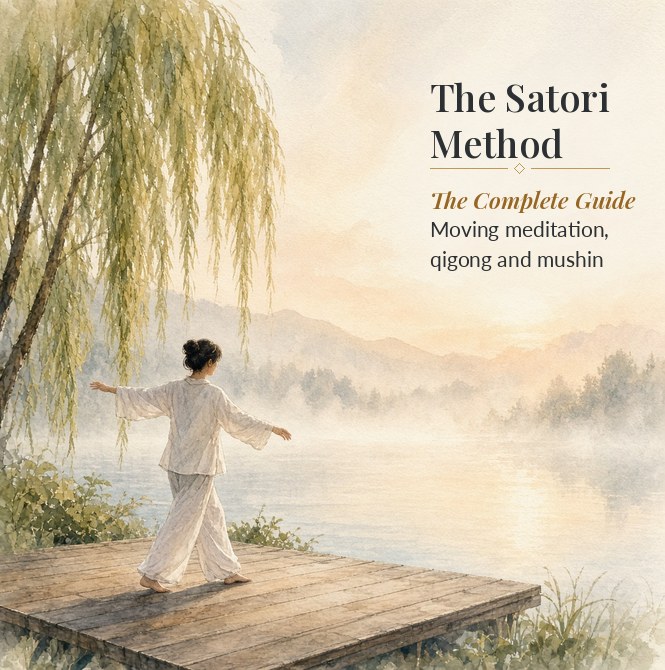
The Satori Method is a mind–body wellness system created by Tristan and Sabrina Truscott that blends qigong, tai chi, yoga and Zen meditation into short daily “moving meditation” routines. Named after satori, the Zen word for a sudden moment of awakening, it aims to help people raise their energy, release stress and tension, and experience calm, present-moment awareness.
Last updated: 30 October 2026
Reading time: about 15 minutes
How we wrote this guide: this guide was written by Saj Ali. Every research claim below links to the original study, its DOI or an official record.
Quick answer: what is the Satori Method?
- It blends ancient energy arts. The Satori Method combines qigong, tai chi, yoga and meditation with modern fitness ideas into what it calls “moving meditation” (Satori Method).
- It was created by Tristan and Sabrina Truscott. Tristan, a martial arts sensei, turned to qigong after a serious back injury, and he and Sabrina built the method from that experience (Satori Method).
- The core routine takes 10 minutes. A six-step “Energy Blueprint” is split into a morning routine (awaken, build, store) and an evening routine (cleanse, calm, accumulate) (Satori Method qigong programme).
- It includes a meditation for “no-mind”. The Art of Mushin programme teaches a state of focused, calm awareness through focusing the mind, correct breathing and letting go (Art of Mushin).
- Qigong and meditation are well researched. A review of 77 randomised trials found benefits of qigong and tai chi for physical function, quality of life and psychological symptoms (Jahnke et al., 2010).
Contents
- What Is the Satori Method?
- Where the Satori Method Came From
- How the Satori Method Works
- How to Try a Satori-Style Daily Routine
- What People Use the Satori Method For
- What the Research Shows
- A Simple Mushin-Style Meditation
- Who the Satori Method Is For
- Getting the Most from the Satori Method
- Watch, Listen and Follow
- Frequently Asked Questions About The Satori Method
- Key Takeaways
- Explore More on Self Help Supermarket
- Sources
What Is the Satori Method?
The Satori Method is a holistic wellbeing system that works through the body. Rather than treating body, mind and spirit separately, it uses movement, breath and meditation to awaken what it calls your vital life-force energy, so you can feel stronger, calmer and more whole (Satori Method).
Its founders describe it as blending “ancient energy healing arts such as Qigong, Tai Chi, Yoga and meditation with contemporary breakthroughs in neuroscience and today’s best fitness modalities” (Satori Method). The routines are short, designed for busy people and suitable for beginners.
What “satori” means
Satori is a Japanese Zen Buddhist word for awakening, often described as a sudden flash of insight into your true nature. The Satori Method draws on this tradition, alongside the related Zen idea of mushin, or “no-mind”, a state in which you are totally present, focused, clear-headed, aware, centred and calm (Art of Mushin).
The Satori Method at a Glance
| Created by | Tristan Truscott (martial arts sensei and qigong teacher) and Sabrina Truscott (dancer and mind–body fitness teacher) |
| Draws on | Qigong, tai chi, yoga, Zen meditation and modern fitness |
| Core practice | A six-step Energy Blueprint in two 10-minute routines |
| Other programmes | The Flow Form (15-minute qigong form) and the Art of Mushin meditation |
| How it is taught | Home-study programmes, virtual live classes, challenges and teacher training |
Details are from Satori Method, Satori Method qigong programme and Flow Form.
Where the Satori Method Came From
Tristan Truscott spent around 20 years in the martial arts and ran his own dojo as a sensei. In 2000 he suffered a severe back injury while teaching a self-defence clinic at his dojo, which ended his martial arts career. Over the next five years he tried many treatments, including massage, chiropractic, physical therapy, hydrotherapy, hypnotherapy and surgery, without the recovery he hoped for (Flow Form; Satori Method).
He then came across a qigong workshop. Although he was unsure at first, he began to heal, and he went on to study with many teachers. He found the practice hard to learn at first, so he spent years distilling the movements, breathwork and energy principles into simple, Western-friendly routines (Flow Form).
Sabrina Truscott, a competitive ballroom dancer and mind–body fitness teacher, joined him in building a complete healing and wellbeing system from these experiences, and the Satori Method was born (Satori Method). The couple now teach through online programmes, live virtual classes and retreats, and train Satori teachers.
From martial arts to meditation
Before his injury, Tristan was a black belt running a busy dojo with over 300 students (Satori Method qigong programme). He has written that martial arts alone did not free him from nervousness and fear, which led him to a long path of yoga meditation. He says he later distilled more than 25,000 hours of meditation practice and his own discoveries into the simple five-step process taught in the Art of Mushin (Art of Mushin). This blend of martial arts focus, flowing qigong and quiet Zen awareness gives the Satori Method its distinctive character.
How the Satori Method Works
Moving meditation
At the heart of the Satori Method is moving meditation: slow, flowing movements combined with breath and focused attention. The aim is to quiet the mind through the body, rather than by sitting still and fighting your thoughts (Satori Method).
The six-step Energy Blueprint
The method’s core qigong programme is built around a six-step Energy Blueprint, divided into two short practices of about 10 minutes each (Satori Method qigong programme):
| Routine | Step | Purpose |
|---|---|---|
| Morning | 1. Awaken | Gently transition from sleep and loosen stiff joints |
| 2. Build | Raise your energy and vitality for the day | |
| 3. Store | Store energy so you can draw on it through the day | |
| Evening | 4. Cleanse | Wash away worry and the tension of the day |
| 5. Calm | Relax the body and settle the nervous system | |
| 6. Accumulate | Wind down and prepare for deep, restorative sleep |
The Flow Form
The Flow Form is a 15-minute qigong routine that Tristan developed to bring together his favourite movements in a fun, fluid, easy-to-follow format (Flow Form).
The Art of Mushin
The Art of Mushin is the method’s meditation programme. It brings together Tristan’s favourite aspects of qigong, yoga and Zen meditation in a simple five-step process. Tristan describes the core as three simple elements: focusing the mind, breathing correctly and letting go (Art of Mushin).
How to Try a Satori-Style Daily Routine
The Satori Method’s full routines are taught in its own programmes (Satori Method qigong programme). This simple practice is inspired by its six-step structure and uses common, gentle qigong movements. Wear comfortable clothes and move within a range that feels easy.
- Awaken (morning). Stand with feet hip-width apart and knees soft. Gently shake out your hands, arms and legs for a minute, then lightly tap your arms, chest and legs with loose fists to wake up the body.
- Build (morning). Breathe in slowly as you float your arms up in front of you and overhead, palms facing up, as if lifting the sky. Breathe out as you lower them down the sides. Repeat eight times.
- Store (morning). Rest both hands on your lower belly, just below the navel. Take ten slow breaths, imagining the energy you have built settling there like a battery charging.
- Cleanse (evening). Raise your arms overhead and slowly sweep them down in front of your body, as if parting clouds and brushing away the day. Repeat eight times with slow breaths.
- Calm (evening). Stand or sit comfortably. Breathe in for a count of four and out for a count of six for two minutes, letting your shoulders, jaw and belly soften.
- Accumulate (evening). Return your hands to your lower belly. Rest your attention there for a few minutes. If thoughts arise, notice them and let them go, coming back to the breath.
- Pause in stillness. Finish either routine with a minute of stillness. Notice how your body feels before you continue your day or go to sleep.
Practise each routine once a day for a couple of weeks and notice changes in your energy, mood and sleep. If you have an injury or health condition, move gently and check with your doctor before starting new exercise.
What People Use the Satori Method For
- Stress and a busy mind. Moving meditation and Mushin are designed to quiet looping thoughts. See stress management, anxiety and overthinking.
- Energy. The morning routine aims to lift energy and focus for the day. See energy and fatigue.
- Sleep. The evening routine prepares the body for rest. See sleep.
- Stiffness and mobility. Gentle movements help loosen joints. See back and neck pain and pain relief.
- Self-awareness and spiritual growth. The Zen roots of satori and mushin invite deeper presence and insight. See mindfulness.
- Feeling at home in your body. Many people use the practice to reconnect with themselves. See self-love practices.
What the Research Shows
The Satori Method is built on qigong, tai chi and meditation, practices with a substantial research base.
Qigong and tai chi
Jahnke and colleagues examined 77 randomised controlled trials of qigong and tai chi. They found consistent, significant results across many outcomes, including bone health, heart and lung fitness, physical function, falls and balance, quality of life, self-efficacy, psychological symptoms and immune markers (Jahnke et al., 2010).
Mood and wellbeing
A systematic review and meta-analysis found that qigong may reduce depression and anxiety and support psychological wellbeing (Wang et al., 2013). A separate review in Psychiatric Clinics of North America looked at tai chi and qigong for the treatment and prevention of mental health conditions (Abbott & Lavretsky, 2013).
Sleep
A 2025 meta-analysis of 15 randomised trials with 1,074 older adults found that qigong improved sleep quality scores (Xiong et al., 2025).
Meditation
A large review of randomised trials with active control groups, published in JAMA Internal Medicine, found that mindfulness meditation programmes improved anxiety, depression and pain (Goyal et al., 2014).
The studies at a glance
| Study | Focus | Main finding |
|---|---|---|
| Jahnke et al., 2010 | 77 trials of qigong and tai chi | Benefits for function, balance, quality of life and mood |
| Wang et al., 2013 | Qigong and mood | May reduce depression and anxiety |
| Abbott & Lavretsky, 2013 | Tai chi and qigong for mental health | A review of mental health applications |
| Xiong et al., 2025 | Qigong and sleep | Better sleep quality in older adults |
| Goyal et al., 2014 | Meditation programmes | Improved anxiety, depression and pain |
A Simple Mushin-Style Meditation
This short sitting practice is inspired by the three elements the Art of Mushin is built on: focus, breath and letting go (Art of Mushin). It takes about five minutes.
1. Focus
Sit upright and comfortably, with your hands resting on your thighs or lower belly. Choose a single point of attention, such as the feeling of your breath at your nostrils or the rise and fall of your belly.
2. Breathe
Breathe slowly through your nose, letting the belly expand as you breathe in and soften as you breathe out. Let the out-breath be a little longer than the in-breath.
3. Let go
Each time you breathe out, let go of a little tension, in your forehead, jaw, shoulders, hands and belly. When thoughts arise, simply notice them and let them drift away like clouds, without following them.
4. Rest in awareness
For the last minute or two, let go of the technique altogether and simply rest in open, relaxed awareness. This quiet, present state is a small taste of what Zen calls mushin.
You can use this meditation after your evening routine, before a challenging task or whenever you want to return to centre. For more sitting practices, see our meditation guide and Vedic Meditation.
Who the Satori Method Is For
The Satori Method is designed to be accessible. Its founders describe the routines as easy, fun and not strenuous, and say most people begin to notice results within the first few days of practising for 10 minutes a day (Satori Method qigong programme). It may suit you if you:
- want a short daily practice that fits around work and family life;
- find sitting meditation difficult and prefer to start with movement;
- would like gentle exercise that builds strength, flexibility, coordination and balance;
- are looking for natural ways to manage stress and calm looping thoughts;
- are curious about qigong but have found traditional teaching hard to follow;
- enjoy a warm, playful approach rather than a strict or serious one.
The method stresses that ancient wisdom does not have to be boring or serious. Its community encourages laughing often and staying playful as part of vibrant health (Satori Method).
How to get started
- Try a free class. The Satori Method offers a free qigong for beginners course and many short follow-along videos (Satori Method).
- Choose one routine. Start with either the morning or the evening routine, rather than both at once.
- Pick a regular time and place. Linking practice to an existing habit, such as after waking or before bed, makes it easier to keep up.
- Add meditation when you are ready. Once the movements feel familiar, add a few minutes of sitting meditation afterwards.
- Explore further. If you enjoy the practice, the method offers home-study programmes, live virtual classes, retreats and teacher training.
If you are recovering from an injury or managing a health condition, check with your doctor before starting a new movement practice, and adapt the movements to suit you.
Getting the Most from the Satori Method
- Keep it short and regular. Ten minutes morning and evening is easier to keep up than an occasional long session.
- Move gently. The routines are designed to be easy and not strenuous (Satori Method qigong programme). Stay within a comfortable range.
- Link movement and breath. Slow, coordinated breathing is what turns exercise into moving meditation.
- Keep it playful. The founders emphasise that laughter and fun are part of healing (Satori Method).
- Follow along with video. The Satori Method’s free videos make it easy to learn the movements.
- Combine practices. Many people pair qigong with yoga, EFT tapping or relaxation.
- Notice the changes. Keep brief notes about your energy, mood and sleep over the first few weeks.
Satori Method vs Traditional Qigong vs Yoga
| Satori Method | Traditional qigong | Yoga | |
|---|---|---|---|
| Roots | Qigong, tai chi, yoga and Zen combined | Chinese energy arts | Indian tradition |
| Style | Short, Western-friendly moving meditation | Flowing movement, breath and focus | Postures, breath and meditation |
| Daily time | About 10 minutes per routine | Varies | Varies |
| Learn more | Satori Method | NCCIH qigong overview | Yoga guide |
Watch, Listen and Follow
Follow along with short qigong routines from the Satori Method, and hear Tristan Truscott talk about moving meditation and the mind–body connection.
Videos
- Satori Method Montage Trailer – Tristan Truscott. An introduction to the Satori Method.
- Morning Qigong Routine – Satori Method. A Satori Method morning qigong routine to follow.
- Qigong for Beginners: 7 minutes to Clear Negative Energies (Parting Clouds) – Satori Method. A seven-minute beginner’s practice, Parting Clouds.
- 7 Simple Qigong Moves (everyone should know) – Satori Method. Seven simple qigong moves.
- 🌀 Qigong For Morning Stiffness, Takes Just 3 Minutes! – Satori Method. A three-minute routine for morning stiffness.
- 🔥 3 Simple Qigong Moves (Pain, Stiffness, Fatigue) – Satori Method. Three simple qigong moves for everyday tension.
- ONE Minute Exercise to reduce stress and boost energy! – Satori Method. A one-minute exercise for stress and energy.
- Easy way to manage stress or fatigue using Qigong – Satori Method. Qigong for stress and tiredness.
- The Mind-Body Healing Connection And The Power Of Movement Meditations – With Tristan Truscott – Shawn Stevenson. Tristan Truscott on the mind–body healing connection.
Satori Method programmes
- Satori Method qigong programme – the six-step Energy Blueprint morning and evening routines.
- Flow Form – a 15-minute qigong form.
- Art of Mushin – the Mushin meditation programme.
Books on the roots of the method
- Zen Mind, Beginner’s Mind – Shunryu Suzuki (1970). A classic, gentle introduction to Zen practice.
- The Way of Qigong: The Art and Science of Chinese Energy Healing – Kenneth S. Cohen (Ballantine, 1997). A thorough guide to qigong.
Frequently Asked Questions About The Satori Method
What is the Satori Method?
The Satori Method is a mind–body wellness system created by Tristan and Sabrina Truscott. It blends qigong, tai chi, yoga and Zen meditation into short “moving meditation” routines for energy, calm and wellbeing.
What does satori mean?
Satori is a Japanese Zen Buddhist word for awakening, often described as a sudden moment of insight into your true nature.
Who created the Satori Method?
Tristan Truscott, a former martial arts sensei who turned to qigong after a serious back injury, created the method with his wife Sabrina Truscott, a dancer and mind–body fitness teacher.
How long does the Satori Method take each day?
The core six-step Energy Blueprint is split into two routines of about 10 minutes each, one in the morning and one in the evening.
What is Mushin?
Mushin is a Zen term meaning “no-mind”. The Satori Method’s Art of Mushin meditation aims to bring you into a calm, focused, present state through focus, breathing and letting go.
Is the Satori Method good for beginners?
Yes. The routines are designed to be simple, gentle and easy to follow, and the method offers free videos to learn from.
Is there research on the Satori Method?
Yes. The Satori Method is built on qigong, tai chi and meditation, which have a large research base showing benefits for physical function, mood, sleep and stress.
Key Takeaways
- The Satori Method was created by Tristan and Sabrina Truscott.
- It blends qigong, tai chi, yoga and Zen meditation into moving meditation.
- Its six-step Energy Blueprint uses a 10-minute morning and a 10-minute evening routine.
- The Art of Mushin meditation teaches focus, breath and letting go.
- Satori is the Zen word for a sudden moment of awakening.
- Research on qigong, tai chi and meditation supports benefits for function, mood, sleep and stress.
Explore More on Self Help Supermarket
Use these guides alongside this one:
- Meditation – calm the mind
- Mindfulness – present-moment awareness
- Yoga – postures and breath
- Vedic Meditation – effortless meditation
- Big Mind – a Zen-based process
- Relaxation – release tension
- Flow state – effortless focus
- Spiritual healing – heal body and spirit
- Stress management – reduce stress
- Anxiety – feel calmer
- Sleep – rest better
- Energy and fatigue – restore your energy
- Browse all self-help techniques – compare every method on Self Help Supermarket.
Sources
- Satori Method. Home. https://satorimethod.com/
- Satori Method. Comprehensive qigong program. https://satorimethod.com/qigong-program/
- Satori Method. Flow Form program. https://satorimethod.com/flow-form-program/
- Satori Method. Meditation program: The Art of Mushin. https://satorimethod.com/meditation-program/
- Jahnke, R., Larkey, L., Rogers, C., Etnier, J., & Lin, F. (2010). A comprehensive review of health benefits of qigong and tai chi. American Journal of Health Promotion, 24(6), e1–e25. https://doi.org/10.4278/ajhp.081013-LIT-248
- Wang, F., Man, J. K. M., Lee, E.-K. O., et al. (2013). The effects of qigong on anxiety, depression, and psychological well-being: A systematic review and meta-analysis. Evidence-Based Complementary and Alternative Medicine, 2013. https://doi.org/10.1155/2013/152738
- Abbott, R., & Lavretsky, H. (2013). Tai chi and qigong for the treatment and prevention of mental disorders. Psychiatric Clinics of North America, 36(1), 109–119. https://doi.org/10.1016/j.psc.2013.01.011
- Xiong, X., Zhang, L., & Zhang, E. (2025). The effects of qigong exercise on sleep quality in older adults: A systematic review and meta-analysis. Frontiers in Public Health, 13. https://doi.org/10.3389/fpubh.2025.1664055
- Goyal, M., Singh, S., Sibinga, E. M. S., et al. (2014). Meditation programs for psychological stress and well-being: A systematic review and meta-analysis. JAMA Internal Medicine, 174(3), 357–368. https://doi.org/10.1001/jamainternmed.2013.13018
Self Help Supermarket guides are for general information and are not a substitute for professional medical or psychological advice.