
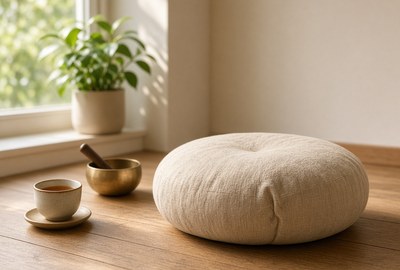
Meditation is a family of practices for training attention and awareness, usually done for a set time, such as sitting quietly for 10 or 20 minutes. Mindfulness is a quality of attention: noticing what is happening in the present moment, on purpose and without judgement. Mindfulness can be practised as a type of meditation, but it can also be brought into everyday activities such as eating, walking or listening.
Last updated: 5 November 2026
Reading time: about 12 minutes
How we wrote this article: this article was written by Saj Ali. It compares meditation and mindfulness using published definitions and research, and every research claim links to its source.
Meditation vs mindfulness in brief
- Meditation is a set of formal practices, done for a set time, that train attention.
- Mindfulness is a way of paying attention to the present moment, which you can bring to anything you do.
- The overlap. Mindfulness meditation is one type of meditation; there are many others, such as mantra and loving-kindness meditation.
- Which first? Many people start with short mindful moments in daily life, then add a few minutes of formal meditation.
- Our guides. See our meditation guide and mindfulness guide.
Contents
- The Short Answer
- What Is Meditation?
- What Is Mindfulness?
- Meditation vs Mindfulness: Key Differences
- Where They Overlap
- Popular Types of Each
- What the Research Says
- Which Should You Start With?
- Getting Started Today
- Frequently Asked Questions
- Key Takeaways
- Explore More on Self Help Supermarket
- Sources
The Short Answer
Meditation and mindfulness are often used as if they mean the same thing, and they do overlap. The simplest way to see the difference is this: meditation is something you do, while mindfulness is a way of being aware.
Meditation describes formal practices in which you set time aside to train your mind, for example by focusing on your breath, repeating a mantra or sending kind wishes to others. Mindfulness describes a quality of attention: noticing your thoughts, feelings, body and surroundings as they are, right now, with curiosity rather than judgement. You can practise mindfulness during meditation, but you can also be mindful while washing the dishes or walking to work.
The US National Center for Complementary and Integrative Health (NCCIH) puts it in a similar way: meditation has a long history in many traditions and covers many different practices, while mindfulness is about paying attention to the present moment, and mindfulness practices can be part of meditation or part of daily life (NCCIH, National Institutes of Health, 2022).
What Is Meditation?
Meditation is an umbrella term for practices that train attention and awareness. Most involve sitting, lying or walking quietly for a set time, and many come from spiritual traditions in India, China, Tibet, Japan and beyond, although they are now widely taught in a secular way.
Researchers Fred Travis and Jonathan Shear suggested a helpful way of grouping the many styles into three broad families (Travis and Shear, 2010):
- Focused attention. You hold your attention on one thing, such as the breath, a candle flame or a word, and gently bring it back when it wanders.
- Open monitoring. You notice whatever arises, such as sounds, sensations, thoughts and feelings, without holding on to any of it. Mindfulness meditation sits mainly here.
- Automatic self-transcending. You use a technique, such as a quietly repeated mantra, that lets the mind settle effortlessly beyond active thinking. Vedic Meditation and Transcendental Meditation are described this way.
Other well-known styles include loving-kindness meditation, which cultivates warmth towards yourself and others, body scan meditation, which moves attention slowly through the body, and movement-based practices such as walking meditation, qigong and yoga nidra. You can read about many of them in our complete meditation guide and find apps, courses and teachers in our meditation hub.
What Is Mindfulness?
The most widely quoted definition comes from Jon Kabat-Zinn, who founded Mindfulness-Based Stress Reduction (MBSR) at the University of Massachusetts. He describes mindfulness as the awareness that emerges through paying attention on purpose, in the present moment, and non-judgementally to the unfolding of experience (Kabat-Zinn, 2003).
A team of clinical psychologists later proposed a two-part working definition: mindfulness involves directing your attention to what is happening now, and relating to it with curiosity, openness and acceptance (Bishop et al., 2004). In other words, it is not only about noticing, but about how you notice.
The Oxford Mindfulness Foundation describes mindfulness as a natural human capacity that can be strengthened with practice, so that you can see your experience more clearly and respond rather than react (Oxford Mindfulness). This is why mindfulness is often taught both as formal meditation and as a set of small everyday habits.
Mindfulness has roots in Buddhist practice, especially the Pali term sati, but most mindfulness courses today are secular. Our mindfulness guide covers its history, the main programmes and how to begin, and our mindfulness hub lists courses, apps and teachers.
Meditation vs Mindfulness: Key Differences
Here is a side-by-side view of how the two compare:
| Meditation | Mindfulness | |
|---|---|---|
| What it is | A family of formal practices for training the mind | A quality of present-moment, non-judgemental attention |
| When you do it | Usually at a set time, such as 10 to 20 minutes a day | At any time, during any activity, as well as in formal practice |
| Main aim | Varies by style: calm, focus, insight, compassion or deep rest | Clear, kind awareness of what is happening right now |
| Techniques | Breath focus, mantra, visualisation, loving-kindness, body scan, movement | Mindful breathing, body scan, mindful eating, walking and listening |
| Roots | Many traditions, including Hindu, Buddhist, Taoist, Christian and secular | Mainly Buddhist roots, now widely taught in a secular way |
| Structured courses | Varies by style; for example, mantra-based courses taught one to one | Eight-week programmes such as MBSR and MBCT |
| Good first step | Five minutes of guided breath meditation | One mindful cup of tea or a mindful walk |
The two are best seen as overlapping circles. All mindfulness meditation is meditation, but not all meditation is mindfulness: a mantra meditation, for example, does not ask you to observe each thought, and loving-kindness meditation focuses on cultivating warmth rather than simply noticing. Equally, not all mindfulness is meditation, because you can be mindful without sitting down to meditate.
Where They Overlap
In practice, many people use both. A typical daily routine might include 10 minutes of seated meditation in the morning and a handful of mindful moments through the day, such as pausing for three breaths before opening email or noticing the taste of the first sip of coffee.
Both share some common ground:
- Attention training. Both build the skill of noticing when your mind has wandered and gently bringing it back.
- A kinder relationship with your thoughts. Both encourage you to see thoughts as passing events rather than facts you must act on.
- Calm and steadiness. Many people find both help them feel calmer and less caught up in stress.
- Practice over time. Neither is something you master in a day; both tend to deepen with regular, gentle practice.
The NCCIH notes that mindfulness practices can be part of meditation or can be used in everyday life (NCCIH, National Institutes of Health, 2022), which is a good way to think about the overlap.
Popular Types of Each
Popular types of meditation
- Breath-focused meditation. Resting attention on the natural breath.
- Mantra meditation. Silently repeating a word or sound, as in Vedic Meditation and Transcendental Meditation.
- Loving-kindness (metta). Wishing yourself and others well.
- Visualisation. Holding a calming image or scene in mind.
- Zen (zazen). Sitting with an upright posture and open awareness.
- Movement meditation. Walking meditation, qigong, tai chi and yoga nidra.
Popular mindfulness practices
- Mindful breathing. Noticing each in-breath and out-breath.
- Body scan. Moving attention slowly from head to toe.
- Mindful eating. Noticing the look, smell, taste and texture of food.
- Mindful walking. Feeling each step and the contact of your feet with the ground.
- The three-step breathing space. A short check-in used in mindfulness-based cognitive therapy (MBCT).
- Mindful listening. Giving someone your full attention without planning your reply.
What the Research Says
Both meditation and mindfulness have been studied in many trials, and the findings are encouraging:
| Area | What researchers have found | Source |
|---|---|---|
| Meditation and stress | A large review in JAMA Internal Medicine found that mindfulness meditation programmes improved anxiety, depression and pain, with moderate evidence. | (Goyal et al., 2014) |
| Mindfulness in everyday adults | A review of randomised trials of mindfulness-based programmes in adults without a diagnosis found they reduced anxiety, depression and stress and improved wellbeing compared with no intervention. | (Galante et al., 2021) |
| Mantra meditation | An American Heart Association scientific statement said Transcendental Meditation may be considered as an option to help lower blood pressure. | (Brook et al., 2013) |
| Overall picture | The US National Institutes of Health summarises research suggesting meditation and mindfulness may help with anxiety, depression, stress, sleep and blood pressure. | (NCCIH, National Institutes of Health, 2022) |
Because so many styles exist, results vary from one practice to another, and most studies look at structured programmes rather than occasional practice. A practical takeaway is that regular practice, even for a few minutes, seems to matter more than which exact style you choose. In the UK, the NHS also describes mindfulness as a way to improve mental wellbeing (NHS (UK)).
Which Should You Start With?
There is no wrong answer, and many people end up using both. These pointers can help:
- If you are busy and find sitting still hard, start with mindfulness in daily life: one mindful activity a day, such as your morning shower or a short walk.
- If you want a clear routine, start with a short daily meditation of five to 10 minutes, using a guided app or recording.
- If you want deep rest and like simplicity, a mantra-based practice such as Vedic Meditation may suit you. See our Vedic Meditation hub for teachers and courses.
- If you want structured support, an eight-week mindfulness course such as MBSR or MBCT gives you a teacher, a group and a clear plan.
- If you are mainly looking for help with stress or worry, both are good options; see our guides to stress management and anxiety for more ideas.
Getting Started Today
Here is a simple way to try both in one day:
- Morning: five minutes of meditation. Sit comfortably, close your eyes and rest your attention on your breath. When your mind wanders, gently return to the breath.
- Daytime: one mindful moment. Choose an everyday activity, such as drinking tea, and give it your full attention for a minute or two.
- Evening: a short body scan. Lying in bed, move your attention slowly from your toes to the top of your head.
- Notice what you enjoyed. After a week, keep the practices you liked and build from there.
For more step-by-step help, see our meditation guide, our mindfulness guide and the apps and courses in our meditation hub and mindfulness hub.
Frequently Asked Questions
What is the main difference between meditation and mindfulness?
Meditation is a set of formal practices you do for a set time. Mindfulness is a quality of present-moment, non-judgemental attention that you can bring to anything, including meditation.
Is mindfulness a type of meditation?
Mindfulness meditation is one type of meditation. But mindfulness can also be practised informally, without meditating, during everyday activities.
Can you meditate without being mindful?
Yes. Some styles, such as mantra meditation or visualisation, focus on other things, like letting the mind settle or holding an image, rather than observing each moment.
Which is better for stress, meditation or mindfulness?
Both have been studied for stress. Reviews of mindfulness programmes and meditation programmes have found benefits, so the best choice is the one you will practise regularly.
How long should I meditate each day?
Many beginners start with five to 10 minutes. Structured programmes often suggest 20 minutes or more, but short, regular practice is a good start.
Is Vedic Meditation the same as mindfulness?
No. Vedic Meditation uses a silently repeated mantra to let the mind settle, while mindfulness involves noticing present-moment experience.
Do I need a teacher?
Not to begin. Apps, books and free recordings are fine for starting. A teacher or course can help if you want structure or a specific technique.
Key Takeaways
- Meditation is a family of formal practices; mindfulness is a quality of present-moment attention.
- Mindfulness meditation is one type of meditation, and mindfulness can also be practised in daily life.
- Meditation styles include focused attention, open monitoring and mantra-based self-transcending practices.
- Research on both is encouraging, especially for stress, anxiety and wellbeing.
- Many people use both: a short daily meditation plus mindful moments through the day.
Explore More on Self Help Supermarket
Use these pages alongside this one:
- Meditation – our complete guide
- Meditation hub – apps, courses and teachers
- Mindfulness – our complete guide
- Mindfulness hub – courses and resources
- Vedic Meditation – mantra-based meditation
- Vedic Meditation hub – teachers and courses
- Hindu Scriptures and Self-Improvement – lessons from the Gita and Upanishads
- Samadhi – the deep meditative absorption described in yoga and Buddhism
- Satori – the Zen experience of sudden awakening
- Meditation Music – choosing sounds that support your practice
- Browse all self-help techniques – compare every method on Self Help Supermarket.
- Microcosmic Orbit – a Taoist meditation that moves attention around the body
Sources
- National Center for Complementary and Integrative Health (NCCIH), National Institutes of Health. (2022). Meditation and Mindfulness: Effectiveness and Safety. https://www.nccih.nih.gov/health/meditation-and-mindfulness-effectiveness-and-safety
- Travis, F., and Shear, J. (2010). Focused attention, open monitoring and automatic self-transcending: Categories to organize meditations from Vedic, Buddhist and Chinese traditions. Consciousness and Cognition, 19(4), 1110–1118. https://doi.org/10.1016/j.concog.2010.01.007
- Kabat-Zinn, J. (2003). Mindfulness-based interventions in context: Past, present, and future. Clinical Psychology: Science and Practice, 10(2), 144–156. https://doi.org/10.1093/clipsy.bpg016
- Bishop, S. R., Lau, M., Shapiro, S., Carlson, L., et al. (2004). Mindfulness: A proposed operational definition. Clinical Psychology: Science and Practice, 11(3), 230–241. https://doi.org/10.1093/clipsy.bph077
- Oxford Mindfulness Foundation. What is mindfulness? https://oxfordmindfulness.org/what-is-mindfulness
- Goyal, M., Singh, S., Sibinga, E. M. S., Gould, N. F., et al. (2014). Meditation programs for psychological stress and well-being: A systematic review and meta-analysis. JAMA Internal Medicine, 174(3), 357–368. https://doi.org/10.1001/jamainternmed.2013.13018
- Galante, J., Friedrich, C., Dawson, A. F., Modrego-Alarcón, M., et al. (2021). Mindfulness-based programmes for mental health promotion in adults in nonclinical settings: A systematic review and meta-analysis of randomised controlled trials. PLOS Medicine, 18(1), e1003481. https://doi.org/10.1371/journal.pmed.1003481
- Brook, R. D., Appel, L. J., Rubenfire, M., Ogedegbe, G., et al. (2013). Beyond medications and diet: Alternative approaches to lowering blood pressure. A scientific statement from the American Heart Association. Hypertension, 61(6), 1360–1383. https://doi.org/10.1161/HYP.0b013e318293645f
- NHS (UK). Mindfulness. https://www.nhs.uk/mental-health/self-help/tips-and-support/mindfulness/
Self Help Supermarket guides are for general information and are not a substitute for professional medical or psychological advice.