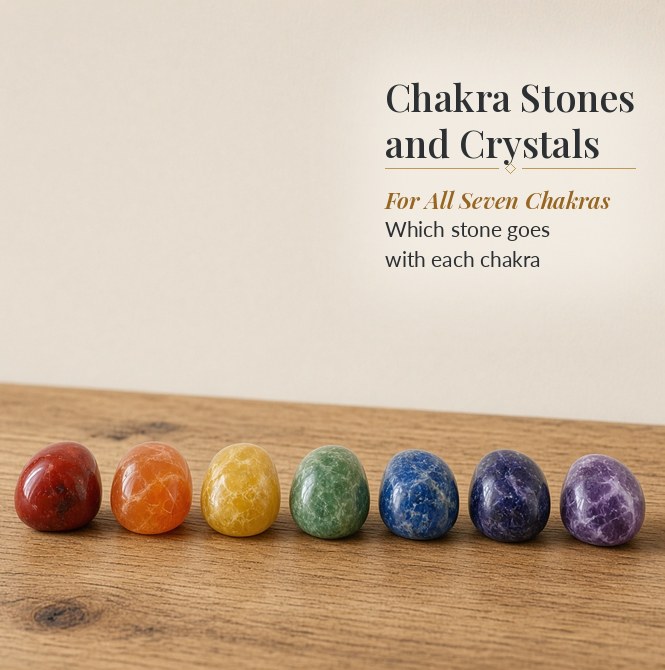
Chakra stones are crystals and gemstones that are matched with each of the seven main chakras, usually by colour. In modern wellness practice, people place them on the body during meditation, carry them, wear them or keep them nearby as reminders of the qualities each chakra stands for, from grounding at the root to inner peace at the crown.
Last updated: 5 November 2026
Reading time: about 16 minutes
How we wrote this guide: this guide was written by Saj Ali. It describes how the chakras are understood in yoga and tantric traditions and in modern wellness practice around the world, and every research claim links to its source.
Chakra stones in brief
- The basic rule. Each chakra has a colour, and its stones usually share that colour: red for the root through to violet and white for the crown.
- Most popular stones. Red jasper (root), carnelian (sacral), citrine (solar plexus), rose quartz (heart), lapis lazuli (throat), amethyst (third eye) and clear quartz (crown).
- How people use them. On the body during meditation, carried in a pocket, worn as jewellery or kept on a desk or bedside table.
- Starter set. Many people begin with a simple set of seven tumbled stones, one for each chakra.
- The key ingredient. The intention and attention you bring: most people use a stone as a focus for a practice or a reminder of a quality they want to grow.
Contents
- What Are Chakra Stones?
- Chakra Stones Chart
- Stones for Each Chakra
- How People Use Chakra Stones
- How to Choose Chakra Stones
- Caring for and Cleansing Your Stones
- A Simple 10-Minute Chakra Stone Practice
- What the Research Says About Chakra Practices
- Frequently Asked Questions
- Key Takeaways
- Explore More on Self Help Supermarket
- Sources
Chakra series: The 7 Chakras Explained · Chakra Meditation · How to Balance Your Chakras · Root Chakra (Muladhara) · Sacral Chakra (Svadhisthana) · Solar Plexus Chakra (Manipura) · Heart Chakra (Anahata) · Throat Chakra (Vishuddha) · Third Eye Chakra (Ajna) · Crown Chakra (Sahasrara) · Chakra Healing guide
What Are Chakra Stones?
In the yoga and tantric traditions of India, the chakras are described as energy centres along the central channel of the subtle body, each linked with a colour, an element and a sound (Encyclopaedia Britannica, chakra). The classic description of the chakras, translated into English by Sir John Woodroffe as The Serpent Power (Avalon, The Serpent Power, 1919), pictures each one as a lotus with its own colour and symbol.
Linking particular stones with particular chakras is a more recent idea that grew up in the 20th century, when the rainbow colour scheme for the chakras became popular in the West and crystal healing became a well-loved wellness practice. The logic is simple and memorable: each chakra has a colour, and stones of that colour are chosen to go with it. Over time, teachers added stones whose traditional meanings fit each chakra’s themes, such as rose quartz for love at the heart or clear quartz for clarity at the crown.
Today, chakra stones are one of the most popular ways people begin working with the chakras. A stone is something you can see, hold and carry, which makes an abstract idea feel tangible. For a full introduction to the chakra system, see The 7 Chakras Explained and our Chakra Healing guide. For crystals more widely, see our Crystal Healing guide.
Chakra Stones Chart
Here are the stones most often matched with each of the seven chakras, with their colours and the ways people commonly use them. Follow the links for a full guide to each chakra.
| Chakra | Colour | Traditional stones | How people use them |
|---|---|---|---|
| Root (Muladhara) | Red | Red jasper, garnet, hematite, black tourmaline, smoky quartz | Held or placed at the base of the spine during grounding meditation; carried in a pocket; kept by the front door |
| Sacral (Svadhisthana) | Orange | Carnelian, orange calcite, sunstone, moonstone | Placed on the lower belly during meditation; kept on a creative desk; worn as jewellery |
| Solar plexus (Manipura) | Yellow | Citrine, tiger’s eye, yellow jasper, pyrite, amber | Held before a meeting or decision; placed on the upper belly; kept on a work desk |
| Heart (Anahata) | Green or pink | Rose quartz, green aventurine, jade, malachite, rhodonite | Worn as a pendant near the heart; placed on the chest during loving-kindness meditation; kept by the bed |
| Throat (Vishuddha) | Blue | Aquamarine, lapis lazuli, blue lace agate, sodalite, turquoise | Worn as a necklace; held before speaking or singing; placed at the throat during humming practice |
| Third eye (Ajna) | Indigo | Amethyst, lapis lazuli, sodalite, labradorite, fluorite | Placed on the forehead while lying down; kept by the journal; held during visualisation |
| Crown (Sahasrara) | Violet or white | Clear quartz, amethyst, selenite, moonstone | Placed just above the head during a lying-down layout; kept on a meditation shelf |
You will notice that some stones appear more than once. Amethyst is linked with both the third eye and crown, and lapis lazuli and sodalite with both the throat and third eye, because their colours sit between the two. Clear quartz is often described as an all-purpose stone that can stand in for any chakra.
Stones for Each Chakra
Root chakra stones
The root chakra is linked with grounding, safety and stability. Its stones tend to be dark, heavy and earthy. Red jasper is a classic choice, and hematite, a dense metallic grey stone, is popular for its weight in the hand. Black tourmaline and smoky quartz are often described as protective and calming. Many people hold a root stone during a grounding meditation or keep one by the front door as a reminder to slow down when they come home.
Sacral chakra stones
The sacral chakra is linked with creativity, pleasure and emotional flow. Carnelian, a warm orange stone, is the best-known sacral stone. Orange calcite and sunstone are also popular, and moonstone is often chosen because of the sacral chakra’s link with the water element. People often keep a sacral stone on a creative desk or in a studio.
Solar plexus chakra stones
The solar plexus chakra is linked with confidence and personal power. Its stones are golden and sunny. Citrine is the favourite, and tiger’s eye, with its striking golden bands, is popular for focus and courage. Pyrite, yellow jasper and amber are also common. Many people hold a solar plexus stone before a meeting, an interview or a big decision.
Heart chakra stones
The heart chakra is linked with love, compassion and connection. It has two colours, green and pink. Rose quartz, often called the stone of love, is perhaps the most popular crystal of all. Green aventurine, jade, malachite and rhodonite are other favourites. Heart stones are often worn as a pendant, given as gifts, or placed on the chest during loving-kindness meditation.
Throat chakra stones
The throat chakra is linked with communication and self-expression. Its stones are blue. Aquamarine and blue lace agate are gentle, pale blues; lapis lazuli is a deep royal blue flecked with gold; sodalite and turquoise are also widely used. Throat stones are popular as necklaces, and many people hold one before speaking in public or singing.
Third eye chakra stones
The third eye chakra is linked with intuition and insight. Its stones are indigo and deep purple. Amethyst is the classic choice, alongside lapis lazuli, sodalite, labradorite with its flashes of colour, and fluorite. People often place a third eye stone on the forehead while lying down or keep one beside their journal.
Crown chakra stones
The crown chakra is linked with awareness and inner peace. Its stones are violet, white or clear. Clear quartz is the best-known crown stone and is often called a master stone. Amethyst, selenite with its soft white glow, and moonstone are also popular. Crown stones are often placed just above the head during a lying-down meditation or kept on a meditation shelf.
How People Use Chakra Stones
In meditation
The most popular use is to hold a stone, or rest it on the matching part of the body, during meditation. Many people choose the chakra they want to focus on, hold its stone, and bring their attention to the stone’s colour and weight while breathing slowly. Our Chakra Meditation guide includes a full step-by-step practice. Meditation has been linked with benefits for anxiety, stress and wellbeing (NCCIH, National Institutes of Health, 2022).
A seven-stone layout
A chakra layout is a lying-down practice in which one stone is placed on each chakra point, from the base of the spine or between the knees for the root to just above the head for the crown. You then rest for ten to twenty minutes, breathing slowly and moving your attention up through the body. Many people find this one of the most relaxing ways to use a chakra set. Slow breathing of under ten breaths a minute has been linked with calmer, more relaxed and more alert states (Zaccaro et al., 2018).
Carrying and wearing
A small tumbled stone in a pocket or a piece of jewellery acts as a gentle, portable reminder. When you touch it during the day, you can pause, take a breath and recall the quality you chose it for: steadiness, confidence, kindness or calm.
In your home and work space
People often keep stones where they want a particular quality: a rose quartz by the bed, a citrine on a work desk, an amethyst on a bedside table, or a full set of seven on a meditation shelf. Seeing them through the day keeps your intention in view.
Setting an intention
Many people “set” an intention with a new stone by holding it, taking a few breaths and naming what they would like it to remind them of. Turning that intention into a simple plan, such as “When I sit at my desk, I will hold my citrine and take three slow breaths”, can help it become a habit. Plans of this “if-then” kind help people follow through on their goals (Gollwitzer, 1999).
How to Choose Chakra Stones
There is no wrong way to choose a stone, but these are the approaches people use most often:
- By chakra. Choose the stone for the chakra whose themes you want to focus on, using the chart above.
- By colour. If you are drawn to a colour, its chakra may be a good place to start.
- By feel. Many people hold several stones and choose the one that feels right in the hand.
- A full set. A set of seven tumbled stones is an affordable way to begin and is ideal for a chakra layout.
- One versatile stone. If you want just one, clear quartz is the most common all-purpose choice, and amethyst is a popular calming stone.
When buying, it helps to look for sellers who name the stone accurately, say where it comes from and note whether it has been treated or dyed. Many people value stones that are ethically sourced. Our Crystal Healing hub lists books, shops and resources we have checked.
Caring for and Cleansing Your Stones
Many people like to “cleanse” their stones from time to time, as a way of refreshing their intention. Popular methods include:
- Moonlight. Leaving stones on a windowsill overnight, especially at the full moon.
- Sound. Ringing a singing bowl or bell near the stones. Our Sound Healing guide explains how people use bowls.
- Earth. Resting stones on soil or a plant pot for a day.
- Breath and intention. Holding the stone and breathing out slowly over it while restating your intention.
- Selenite. Placing stones on a selenite plate, a popular choice in modern practice.
Some stones are soft or fragile. Selenite, malachite, turquoise and pyrite, for example, are best kept dry, so it is worth checking how to care for a stone before using water or salt. A gentle wipe with a soft dry cloth suits almost every stone.
A Simple 10-Minute Chakra Stone Practice
Here is a simple lying-down practice using one stone for each chakra:
- Lay out your stones. Place your seven stones beside you in order, from red to violet or clear.
- Lie down comfortably. Lie on your back on a mat or bed, with a cushion under your knees if you like.
- Place the stones. Place each stone on its chakra point: between the knees or at the base of the spine, lower belly, upper belly, chest, throat, forehead and just above the head.
- Breathe slowly. Breathe in for four and out for six, letting your body settle.
- Move up through the colours. Bring your attention to each stone in turn, from root to crown, picturing its colour for three slow breaths.
- Rest. Rest for a few minutes, simply noticing how you feel.
- Close gently. Remove the stones from the crown downwards, sit up slowly and take a moment of gratitude.
Many people find that doing this once or twice a week is a calming ritual in its own right. Writing down how you felt afterwards can be a helpful habit; writing about thoughts and feelings has been linked with benefits for emotional and physical health (Baikie and Wilhelm, 2005).
What the Research Says About Chakra Practices
Chakras belong to a spiritual and yogic framework, so research does not measure chakra stones directly. What researchers have studied are the practices people use to work with the chakras: yoga, meditation, slow breathing, chanting, loving-kindness, time in nature and reflective writing. These practices have encouraging research behind them.
| Practice | What the research found | Source |
|---|---|---|
| Meditation | Meditation was the most popular of seven complementary practices tracked among US adults in 2022, used by 17.3%, up from 7.5% in 2002. | (NCCIH, National Institutes of Health, 2022) |
| Slow breathing | A systematic review of 15 studies found that slow breathing (under 10 breaths a minute) was linked with changes in the nervous system and with greater comfort, relaxation and alertness. | (Zaccaro et al., 2018) |
| If-then plans | Simple plans of the form “when X happens, I will do Y” help people follow through on their goals. | (Gollwitzer, 1999) |
| Expressive writing | Writing about thoughts and feelings for 15 to 20 minutes on a few occasions has been linked with benefits for emotional and physical health. | (Baikie and Wilhelm, 2005) |
In other words, the practices people build around chakra stones, such as meditation, slow breathing, intention-setting and journaling, are the same building blocks as well-studied wellbeing habits. Many people find a stone a lovely, tangible focus for them.
Frequently Asked Questions
What are chakra stones?
Chakra stones are crystals matched with each of the seven main chakras, usually by colour. People use them in meditation, carry or wear them, or keep them nearby as reminders of each chakra’s qualities.
Which stone goes with which chakra?
Popular pairings are red jasper or hematite for the root, carnelian for the sacral, citrine for the solar plexus, rose quartz or green aventurine for the heart, lapis lazuli or aquamarine for the throat, amethyst for the third eye and clear quartz for the crown.
How do I use chakra stones?
Hold a stone or place it on the matching chakra during meditation, lie down with a full seven-stone layout, carry one in your pocket, wear one as jewellery or keep one where you will see it.
What is the best crystal for all chakras?
Clear quartz is the stone most often described as working with every chakra, which is why it is a popular first crystal.
Where do I place chakra stones on the body?
Root: base of the spine or between the knees. Sacral: lower belly. Solar plexus: upper belly. Heart: centre of the chest. Throat: base of the throat. Third eye: forehead. Crown: just above the head.
How do I cleanse chakra stones?
Popular methods include moonlight, the sound of a singing bowl, resting them on earth, a selenite plate or simply breath and intention. Check whether a stone is soft or fragile before using water or salt.
Do I need a full set of chakra stones?
No. Many people begin with one stone for the chakra they most want to focus on. A set of seven is useful if you would like to try a full layout.
Can I wear chakra stones as jewellery?
Yes. Chakra bracelets with seven different beads are popular, as are single-stone pendants such as rose quartz for the heart or lapis lazuli for the throat.
Key Takeaways
- Chakra stones are crystals matched with each of the seven chakras, mostly by colour.
- Popular pairings run from red jasper at the root to clear quartz at the crown.
- People use them in meditation, in seven-stone layouts, as jewellery and in their home and work spaces.
- Choosing by chakra, colour or feel all work; clear quartz is a popular all-purpose stone.
- The practices around the stones, such as meditation, slow breathing and setting intentions, draw on habits with encouraging research behind them.
Explore More on Self Help Supermarket
Use these guides alongside this one:
- Chakra Healing: The Complete Guide – how chakra healing works and how to get started
- Chakra Healing hub – videos, books, apps and resources we have checked
- The 7 Chakras Explained – the full chart
- Chakra Meditation – a step-by-step practice
- How to Balance Your Chakras – 10 practices from yoga, breath and sound
- Root Chakra (Muladhara) – grounding and safety
- Sacral Chakra (Svadhisthana) – creativity and emotional flow
- Solar Plexus Chakra (Manipura) – confidence and personal power
- Heart Chakra (Anahata) – love and compassion
- Throat Chakra (Vishuddha) – communication and self-expression
- Third Eye Chakra (Ajna) – intuition and insight
- Crown Chakra (Sahasrara) – awareness and inner peace
- Crystal Healing – how people use crystals for wellbeing
- Crystal Healing hub – books, shops and resources we have checked
- Browse all self-help techniques – compare every method on Self Help Supermarket.
Sources
- The Editors of Encyclopaedia Britannica. Chakra. Encyclopaedia Britannica. https://www.britannica.com/topic/chakra
- Avalon, A. (Woodroffe, J.) (1919). The Serpent Power, including a translation of the Ṣaṭ-cakra-nirūpaṇa. London: Luzac and Co. Internet Archive. https://archive.org/details/TheSerpentPowerByArthurAvalon
- National Center for Complementary and Integrative Health (NCCIH), National Institutes of Health. (2022). Meditation and Mindfulness: Effectiveness and Safety. https://www.nccih.nih.gov/health/meditation-and-mindfulness-effectiveness-and-safety
- Zaccaro, A., Piarulli, A., Laurino, M., Garbella, E., Menicucci, D., Neri, B., and Gemignani, A. (2018). How breath-control can change your life: A systematic review on psycho-physiological correlates of slow breathing. Frontiers in Human Neuroscience, 12, 353. https://doi.org/10.3389/fnhum.2018.00353
- Gollwitzer, P. M. (1999). Implementation intentions: Strong effects of simple plans. American Psychologist, 54(7), 493–503. https://doi.org/10.1037/0003-066X.54.7.493
- Baikie, K. A., & Wilhelm, K. (2005). Emotional and physical health benefits of expressive writing. Advances in Psychiatric Treatment, 11(5), 338–346. https://doi.org/10.1192/apt.11.5.338
Self Help Supermarket guides are for general information and are not a substitute for professional medical or psychological advice.