
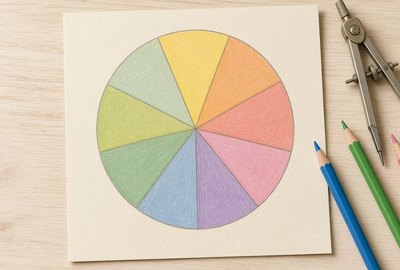
The Wheel of Life is a simple coaching tool that shows how satisfied you are with the main areas of your life at a glance. You draw a circle split into segments, such as health, career, money, relationships and fun, and score each from 0 to 10. The shape of the resulting wheel shows where life feels full and where it needs attention, so you can choose what to work on next.
Last updated: 10 November 2026
Reading time: about 8 minutes
How we wrote this article: this article was written by Saj Ali. It explains the Wheel of Life tool, its background and research on life satisfaction and goal setting, with step-by-step instructions, and every research claim links to its source.
The Wheel of Life in brief
- What it is. A circle divided into life areas, each scored from 0 (very unhappy) to 10 (fully satisfied).
- Where it came from. Usually credited to Paul J. Meyer, founder of the Success Motivation Institute, in the 1960s.
- Time needed. About 15 minutes.
- What you get. A visual snapshot of balance and a clear choice of what to improve first.
- Next step. Pick one or two low areas and set a small goal for each.
Contents
- What the Wheel of Life Is
- The Eight Classic Life Areas
- How to Do the Wheel of Life Exercise
- How to Read Your Wheel
- What the Research Says
- Turning Your Wheel Into Goals
- Popular Variations
- Tips for Getting the Most From It
- Frequently Asked Questions
- Key Takeaways
- Explore More on Self Help Supermarket
- Sources
What the Wheel of Life Is
Life rarely feels out of balance all at once. Usually, one or two areas quietly slip while others take over. The Wheel of Life makes that visible. You picture your life as a wheel. If some spokes are long and others short, the ride is bumpy.
The tool is usually credited to Paul J. Meyer, an American businessman who founded the Success Motivation Institute in 1960 and developed goal-setting and personal development programmes. Today it is one of the most widely used exercises in life coaching, workshops and personal development books worldwide.
It works well on its own, and even better as the starting point for a coaching conversation using the GROW model or for setting SMART goals.
The Eight Classic Life Areas
Most wheels use eight segments. You can rename or swap any of them so the wheel fits your life.
| Area | What it covers | Question to ask |
|---|---|---|
| Health | Energy, fitness, sleep, food, medical care | How well do I feel in my body day to day? |
| Career or work | Job satisfaction, progress, purpose at work | Do I enjoy and feel valued in my work? |
| Money | Income, savings, debt, financial security | How secure and in control do I feel about money? |
| Relationships and romance | Partner, dating, intimacy | How satisfied am I with my love life? |
| Family and friends | Connection, support, time together | Do I feel close to the people who matter? |
| Personal growth | Learning, skills, self-development | Am I growing in ways that matter to me? |
| Fun and recreation | Hobbies, play, rest, travel | Do I make time for things I enjoy? |
| Physical environment | Home, workspace, surroundings | Do my surroundings support me? |
Other popular segments include spirituality, contribution or community, creativity and life purpose.
How to Do the Wheel of Life Exercise
- Draw a circle and divide it into eight slices like a pizza. Label each slice with a life area.
- Score each area from 0 to 10. Zero sits at the centre of the circle and 10 at the outer edge. Score how satisfied you feel right now, not how you think you should feel.
- Mark each score on its slice and shade from the centre out to that point, or join the dots to make a new shape.
- Look at the shape. Is it round and large, small, or lopsided? Which spokes are shortest?
- Reflect. For each area, ask: What would a 10 look like? What one change would move this up by one point?
- Choose one or two areas to focus on. Often the lowest score, but not always. Sometimes improving one area, such as sleep, lifts several others.
- Set a small goal for each chosen area, with a time frame.
- Repeat every one to three months, and compare wheels.
How to Read Your Wheel
| Wheel shape | What it may mean | Where to start |
|---|---|---|
| Large and fairly round | Life feels balanced and satisfying | Keep habits that work; choose one area to grow further |
| Small but round | Things are steady but flat across the board | Look for one change that adds energy, such as fun or health |
| Lopsided with one or two big dips | One area needs attention | Focus on the lowest area with one small step |
| Very spiky | Lots of energy in some areas, little in others | Check whether high areas are crowding out low ones |
There is no perfect wheel. Seasons of life change it: a new baby, a career push or an illness will reshape priorities. The aim is awareness and choice, not a perfect circle.
What the Research Says
The Wheel of Life is a practical coaching tool rather than a formal psychological test, but it draws on well-researched ideas.
| Research finding | Link to the Wheel of Life |
|---|---|
| Life satisfaction can be measured reliably with short self-ratings (Diener et al., 1985) | Simple 0–10 scores can capture how life feels |
| Specific, challenging goals improve performance (Locke and Latham, 2002) | Turn low scores into specific goals |
| Goal setting changes behaviour, especially when goals are public or set with others (Epton et al., 2017) | Share your wheel and goals with a friend or coach |
| Coaching improves well-being, coping and goal-directed self-regulation (Theeboom et al., 2014) | The wheel works well as a coaching starting point |
Turning Your Wheel Into Goals
Here is how one person might move from wheel to action.
| Area | Score | What a 10 looks like | One-point step |
|---|---|---|---|
| Health | 4 | Energetic, sleeping 7–8 hours, walking daily | Lights out by 11pm on weeknights for 4 weeks |
| Fun | 3 | A hobby each week and a trip each season | Book one evening class this month |
| Money | 5 | Emergency fund of 3 months’ costs | Automatically save USD 100 (about GBP 75 or EUR 85) a month |
| Friends | 6 | Regular, easy contact with close friends | Call one friend every Sunday |
Notice that each step is small and specific. Small wins build momentum and confidence, which often spills into other areas. If you struggle to get started, our guide to procrastination can help.
Popular Variations
- Wheel of Relationships. Segments for communication, trust, fun, intimacy, shared goals and support. Useful for couples alongside the compatibility quiz.
- Wheel of Work. Segments for skills, team, manager, pay, growth, purpose and workload.
- Wellness Wheel. Physical, emotional, social, intellectual, spiritual, environmental and financial wellbeing.
- Values Wheel. Rate how well you are living each of your core values.
- Future Wheel. Score where you want each area to be in a year, then compare with today.
Tips for Getting the Most From It
- Score quickly and honestly. Your first instinct is usually accurate.
- Keep old wheels. Comparing them over time shows progress you may not otherwise notice.
- Do it with a partner, friend or coach and talk through the results.
- Celebrate high scores as well as fixing low ones.
- Pair it with journaling to explore why each area scored as it did.
- Use Six Thinking Hats if choosing between areas feels hard.
Frequently Asked Questions
What is the Wheel of Life?
A coaching tool where you score your satisfaction with eight or so life areas from 0 to 10 and plot them on a circle to see your balance.
Who created the Wheel of Life?
It is usually credited to Paul J. Meyer, founder of the Success Motivation Institute, in the 1960s.
What are the eight areas of the Wheel of Life?
A common set is health, career, money, romance, family and friends, personal growth, fun and physical environment. You can change them to suit you.
How often should I do the Wheel of Life?
Every one to three months works well, or whenever life changes.
What should I do with a low score?
Ask what one small change would raise it by a point, and set a specific goal with a time frame.
Is the Wheel of Life scientific?
It is a practical coaching tool rather than a formal test, but it draws on research on life satisfaction, goal setting and coaching.
Can couples use the Wheel of Life?
Yes. Many couples use a relationship version with segments like communication, trust and fun.
What if my wheel is very uneven?
That is common. Focus on one or two areas at a time, and remember that seasons of life naturally shift priorities.
Key Takeaways
- The Wheel of Life shows your satisfaction across key life areas at a glance.
- It is usually credited to Paul J. Meyer in the 1960s.
- Score each area from 0 to 10, plot it, and look at the shape.
- Choose one or two areas and set small, specific goals.
- Research on life satisfaction, goal setting and coaching supports the approach.
- Repeat every few months and compare wheels to see progress.
Explore More on Self Help Supermarket
Use these pages alongside this one:
- SMART Goals – turn low scores into clear goals
- The GROW Model – coach yourself through what to change
- Life Purpose and Meaning – what a 10 really means to you
- Productivity – make time for every area
- Compatibility Quiz – a relationship check-in
- Journaling for Mental Health – reflect on your scores
- Personal Values Quiz – find what matters most to you
- Actualized.org Life Purpose Course Review – a long-form course on purpose and values
- Eightify Review – an AI tool for summarising long videos
- Browse all self-help techniques – compare every method on Self Help Supermarket.
Sources
- Diener, E., Emmons, R. A., Larsen, R. J., and Griffin, S. (1985). The Satisfaction With Life Scale. Journal of Personality Assessment, 49(1), 71–75. https://doi.org/10.1207/s15327752jpa4901_13
- Locke, E. A., and Latham, G. P. (2002). Building a practically useful theory of goal setting and task motivation: A 35-year odyssey. American Psychologist, 57(9), 705–717. https://doi.org/10.1037/0003-066X.57.9.705
- Epton, T., Currie, S., and Armitage, C. J. (2017). Unique effects of setting goals on behavior change: Systematic review and meta-analysis. Journal of Consulting and Clinical Psychology, 85(12), 1182–1198. https://doi.org/10.1037/ccp0000260
- Theeboom, T., Beersma, B., and van Vianen, A. E. M. (2014). Does coaching work? A meta-analysis on the effects of coaching on individual level outcomes in an organizational context. The Journal of Positive Psychology, 9(1), 1–18. https://doi.org/10.1080/17439760.2013.837499
Self Help Supermarket guides are for general information and are not a substitute for professional medical or psychological advice.