
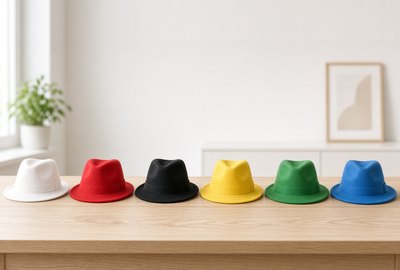
Six Thinking Hats is a thinking method created by Edward de Bono and published in 1985. It separates thinking into six modes, each linked to a coloured hat: white for facts, red for feelings, black for caution, yellow for benefits, green for new ideas and blue for managing the process. Everyone in a group wears the same hat at the same time, which de Bono called parallel thinking.
Last updated: 10 November 2026
Reading time: about 7 minutes
How we wrote this article: this article was written by Saj Ali. It explains de Bono’s method, how to run a session and what research says about its use in creativity and learning, and every research claim links to its source.
Six Thinking Hats in brief
- Who created it. Edward de Bono, the Maltese-born thinker who also coined ‘lateral thinking’, in his 1985 book Six Thinking Hats.
- The big idea. Think in one mode at a time, together, instead of arguing from fixed positions.
- The hats. White facts, red feelings, black caution, yellow benefits, green creativity, blue process.
- Where it is used. Meetings, classrooms, coaching, product design and personal decisions.
- Try it. Spend two minutes on each hat for a decision you are facing.
Contents
- What Six Thinking Hats Is
- The Six Hats Explained
- Why It Works
- How to Run a Six Thinking Hats Session
- Useful Sequences
- Using the Hats for Personal Decisions
- What the Research Says
- Six Thinking Hats and Other Tools
- Frequently Asked Questions
- Key Takeaways
- Explore More on Self Help Supermarket
- Sources
What Six Thinking Hats Is
Most discussions mix everything at once. One person shares data, another raises a worry, a third pitches a wild idea, and a fourth says how they feel. People defend positions instead of exploring the issue. Edward de Bono’s answer was to separate the types of thinking and do them one at a time.
In Six Thinking Hats (1985), de Bono assigned each type of thinking a coloured hat. When the group “puts on” a hat, everyone thinks in that mode together. He called this parallel thinking. The de Bono Group describes it as a simple, effective process that helps people be more productive, focused and involved, and highlights benefits such as shorter meetings and less conflict (de Bono Group).
De Bono (1933–2021) was a physician and author from Malta who also coined the term “lateral thinking”. His methods are taught in schools and companies in many countries.
The Six Hats Explained
| Hat | Thinking mode | Typical questions |
|---|---|---|
| ⚪ White | Facts and information | What do we know? What do we need to find out? Where can we get it? |
| 🔴 Red | Feelings, intuition, gut reactions | How do I feel about this? What does my instinct say? (No justification needed.) |
| ⚫ Black | Caution, risks, critical judgement | What could go wrong? What are the weaknesses? Does it fit our values and rules? |
| 🟡 Yellow | Benefits, optimism, value | What are the advantages? Why might this work? What is the best case? |
| 🟢 Green | Creativity, alternatives, new ideas | What else could we do? How could we improve this? What is a completely different approach? |
| 🔵 Blue | Managing the thinking process | What are we thinking about? Which hat next? What have we concluded? |
The blue hat is usually worn by the facilitator, who opens and closes the session and decides the order.
Why It Works
- It reduces ego and conflict. Criticism is not personal when everyone is wearing the black hat together.
- It gives every perspective a turn. Optimists must look at risks, and sceptics must look at benefits.
- It makes feelings legitimate. The red hat gives emotions a short, explicit slot rather than leaking into every point.
- It speeds things up. Focused, time-boxed thinking often shortens meetings.
- It boosts creativity. A dedicated green-hat slot protects new ideas from early criticism.
How to Run a Six Thinking Hats Session
- Blue hat: frame the question. “Should we launch the new wellbeing programme in January?” Agree the order of hats and time limits.
- White hat: facts. Share data, budgets, timelines and gaps in knowledge. Two to five minutes.
- Green hat: ideas. Generate options and variations. Aim for quantity.
- Yellow hat: benefits. For the main options, list the advantages.
- Black hat: risks. Identify weaknesses, risks and obstacles.
- Green hat again: fixes. Find ways to overcome the black-hat risks.
- Red hat: gut check. Each person gives a quick feeling, in a word or two, with no explanation.
- Blue hat: conclude. Summarise, decide and agree next steps.
Write each hat’s points on a separate section of a whiteboard or shared document. Stick to one hat at a time, and gently redirect anyone who switches hats mid-stream.
Useful Sequences
| Purpose | Suggested sequence |
|---|---|
| Quick decision | Blue, White, Yellow, Black, Red, Blue |
| Creative problem solving | Blue, White, Green, Yellow, Black, Green, Blue |
| Evaluating an idea | Blue, Red, Yellow, Black, Green, Red, Blue |
| Feedback on a project | Blue, White, Yellow, Black, Green, Blue |
| Personal decision | White, Red, Yellow, Black, Green, Blue |
Using the Hats for Personal Decisions
You can use the method alone in about 15 minutes with a notebook. Imagine you are deciding whether to change careers.
- White. Salary ranges, training costs, time required, job openings.
- Red. “Excited, but nervous about money.”
- Yellow. More meaningful work, new skills, better long-term prospects.
- Black. Income dip during retraining, uncertainty, starting at a junior level.
- Green. Retrain part-time, try a short course first, shadow someone in the role, negotiate a phased move.
- Blue. “I’ll do a short course over 8 weeks while working, then decide.”
Writing each hat separately helps calm overthinking, because worries get one clear slot instead of circling all day. It also pairs well with SMART goals once you decide what to do.
What the Research Says
Researchers have tested the method mainly in education and creativity. In two brainstorming experiments, Göçmen and Coşkun found that the hat people wore shaped their ideas. Participants using the green hat generated more unique ideas than those using the yellow or red hats, and an instruction to work quickly increased unique and flexible ideas further, with the green hat again on top (Göçmen and Coşkun, 2019). Other studies in design education have explored how students shift between hats and how this relates to design creativity (Hu et al., 2021).
| Research finding | What it suggests |
|---|---|
| The green hat produced the most unique ideas in brainstorming experiments (Göçmen and Coşkun, 2019) | A dedicated green-hat slot supports idea generation |
| Patterns of shifting between hats relate to design creativity (Hu et al., 2021) | Moving deliberately between modes is part of the value |
Six Thinking Hats and Other Tools
- Brainstorming focuses on ideas. Six Hats adds facts, risks, benefits and feelings in a set order.
- SWOT analysis (Strengths, Weaknesses, Opportunities, Threats) is similar to the yellow and black hats, but does not include feelings or creativity slots.
- The GROW model structures a coaching conversation. The Options stage is a natural place for green-hat thinking.
- The Johari Window focuses on self-awareness and feedback rather than decisions.
- NLP perceptual positions ask you to view a situation from your own, another person’s and an observer’s perspective, which complements the hats nicely.
Frequently Asked Questions
Who created the Six Thinking Hats?
Edward de Bono, in his 1985 book Six Thinking Hats.
What do the six hat colours mean?
White is facts, red is feelings, black is caution, yellow is benefits, green is creativity and blue is managing the process.
What is parallel thinking?
It means everyone in a group thinks in the same mode at the same time, rather than arguing from different positions.
Can I use Six Thinking Hats on my own?
Yes. Write a few lines under each hat for a decision you are facing, then use the blue hat to decide.
How long does a Six Thinking Hats session take?
A quick session can take 15 to 20 minutes. Bigger decisions might take an hour.
Which hat should come first?
Usually blue, to frame the question and choose the order. Many sessions then start with white for facts.
Is Six Thinking Hats used in schools?
Yes. It is widely used in classrooms to teach critical and creative thinking.
What is the black hat for?
Careful judgement: risks, weaknesses and whether something fits the facts, rules and values. It is useful, just not all the time.
Key Takeaways
- Six Thinking Hats was created by Edward de Bono in 1985.
- Each hat represents one mode of thinking: facts, feelings, caution, benefits, creativity and process.
- Groups think in parallel, wearing the same hat at the same time.
- It reduces conflict, shortens meetings and protects new ideas.
- In brainstorming studies, green-hat thinking produced the most unique ideas.
- It works alone for personal decisions as well as in teams.
Explore More on Self Help Supermarket
Use these pages alongside this one:
- The GROW Model – a coaching structure for decisions
- SMART Goals – turn the decision into a plan
- The Johari Window – feedback and self-awareness
- Creativity – more ways to spark new ideas
- Overthinking – calming a busy mind
- NLP – perspective-taking techniques
- Leadership Style Quiz – see how you lead a team
- Bill Kenney – time blocking, trust and owning mistakes
- Browse all self-help techniques – compare every method on Self Help Supermarket.
Sources
- de Bono, E. (1985). Six Thinking Hats. Boston: Little, Brown.
- The de Bono Group. Six Thinking Hats. https://www.debonogroup.com/services/core-programs/six-thinking-hats/
- Göçmen, Ö., and Coşkun, H. (2019). The effects of the six thinking hats and speed on creativity in brainstorming. Thinking Skills and Creativity, 31, 284–295. https://doi.org/10.1016/j.tsc.2019.02.006
- Hu, Y., et al. (2021). The shifting patterns based on six thinking hats and its relationship with design creativity. Thinking Skills and Creativity, 42, 100946. https://doi.org/10.1016/j.tsc.2021.100946
Self Help Supermarket guides are for general information and are not a substitute for professional medical or psychological advice.