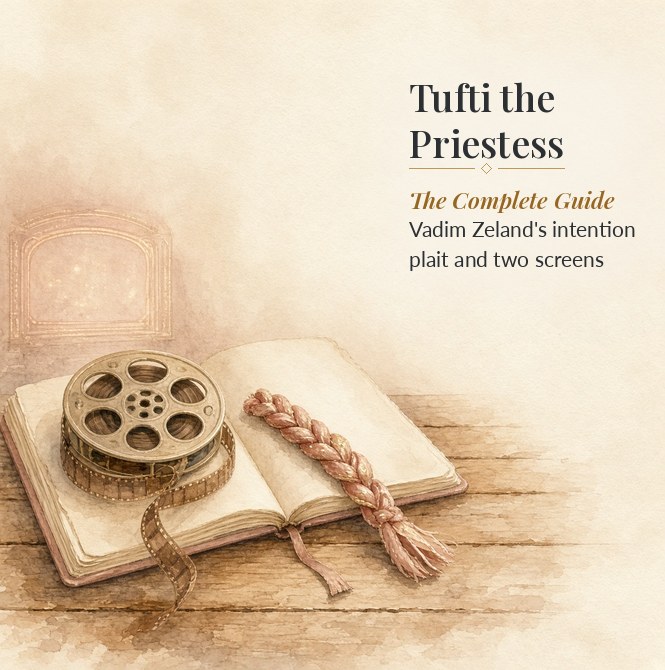
Tufti the Priestess is a book and method by Russian author Vadim Zeland, creator of Reality Transurfing. Told in the voice of Tufti, a playful priestess of ancient Egypt, it teaches you to “wake up” inside the film of your life by holding your attention in an awareness centre, and then to compose the next frames of reality ahead of time using an energetic “intention plait”.
Last updated: 30 October 2026
Reading time: about 16 minutes
How we wrote this guide: this guide was written by Saj Ali. Every research claim below links to the original study, its DOI or an official record.
Quick answer: what is Tufti the Priestess?
- It is a book and method by Vadim Zeland. Tufti the Priestess, translated from Russian by Joanna Dobson, builds on Zeland’s Reality Transurfing series (Zeland, official book page).
- Life is compared to frames on a film roll. Tufti teaches that reality “exists only for a single moment, like a frame on a film roll, which moves from the past into the future” (Zeland, Tufti the Priestess).
- You learn to wake up between two screens. Attention tends to get stuck on an inner screen of thoughts or an outer screen of events. Waking up means moving to the awareness centre: “I see myself and I see reality” (Zeland, Tufti the Priestess).
- You compose the future frame with the plait. From awareness, you focus on the tip of an energetic plait between your shoulder blades and picture the outcome you want (Zeland, Tufti the Priestess).
- It draws on proven principles. Research on mind wandering (Killingsworth & Gilbert, 2010), mental rehearsal (Driskell et al., 1994) and goal planning (Gollwitzer & Sheeran, 2006) shows the power of attention and clear intention.
Contents
- What Is Tufti the Priestess?
- Who Is Vadim Zeland?
- The Two Screens and the Awareness Centre
- Tracking Your Attention
- How to Use the Tufti Technique: A Step-by-Step Guide
- Composing Reality and the Intention Plait
- Other Tufti Techniques
- What the Research Shows
- What People Use Tufti For
- Tufti Compared with Similar Methods
- Tips for Practising Tufti
- Watch, Listen and Follow
- Frequently Asked Questions About Tufti the Priestess
- Key Takeaways
- Explore More on Self Help Supermarket
- Sources
What Is Tufti the Priestess?
Tufti the Priestess is a guide to taking control of your attention and your life. The book’s narrator is Tufti, who introduces herself in a cheeky, theatrical voice: “Three thousand years ago, I was a priestess of the Temple of Isis” (Zeland, Tufti the Priestess). She teases her readers, calls them her “little ones”, and promises to teach them how the world really works.
The book’s main idea is that most of us move through life on autopilot, following a script we did not choose. According to the official book page, things don’t work out “because you aren’t acting according to your own free will — you are being directed by a script”. Rather than “composing the reality of the upcoming film roll”, people “tend to battle with the reality they face in the current frame” (Zeland, official book page).
The remedy is to “wake up and come alive inside the movie” (Zeland, official book page). You do this first by training your attention, and then by using intention to shape what happens next.
Tufti the Priestess at a Glance
| Author | Vadim Zeland, creator of Reality Transurfing |
| English edition | Tufti the Priestess. Live Stroll Through a Movie, translated by Joanna Dobson |
| Core idea | Reality is like a film; wake up inside it and compose the next frames |
| Key tools | The two screens, the awareness centre, triggers and the intention plait |
| Time | A few minutes at a time, plus moments of awareness through the day |
| Related method | Reality Transurfing |
Who Is Vadim Zeland?
Vadim Zeland is a Russian author best known for the Reality Transurfing series, a popular collection of books about choosing your path through a field of possibilities. His official website carries a 2003 trademark and copyright notice for Reality Transurfing (Zeland, official book page).
Tufti the Priestess is one of his later works. It takes the ideas of Reality Transurfing in a fresh direction, focusing on practical techniques for attention and intention, and presents them through a lively fictional teacher rather than a formal manual.
The English translation by Joanna Dobson is listed on Zeland’s official site, which also publishes the opening chapters of the book online (Zeland, Tufti the Priestess). Readers who already know Reality Transurfing will recognise familiar themes, such as freeing yourself from outside influences and moving through life with ease.
The Two Screens and the Awareness Centre
Tufti explains that “you have two screens: an inner and an outer screen”. Your attention is “always directed either towards the inside or the outside — very rarely in-between” (Zeland, Tufti the Priestess).
- The inner screen is your thoughts. “When you are lost in thought, your attention is totally immersed in the inner screen,” and you may act “on autopilot” (Zeland, Tufti the Priestess).
- The outer screen is what is happening around you. When your attention is caught by something external, “you forget yourself and, again, act reflexively” (Zeland, Tufti the Priestess).
Tufti calls this state “sleep”: “a reflexive state, in which your attention is immersed either in the outer or the inner screen” (Zeland, Tufti the Priestess).
Waking up
The instruction is simple: “To wake up in a dream or waking reality, you must pull your attention away from the inner and outer screen and shift it to your awareness centre.” From this point, “you will be able to observe your thoughts and what is going on around you” (Zeland, Tufti the Priestess).
The key phrase is “I see myself and I see reality.” Tufti suggests asking yourself: “Where am I? What am I doing? Where is my attention?” (Zeland, Tufti the Priestess).
A stroll through a waking dream
Tufti’s first exercise is a walk in this state of awareness. She recommends doing it “in the morning after you have slept well and are feeling bright and happy”. Set the intention, “today I am going to stroll through a waking dream”, then go for a walk, perhaps to a shop or shopping centre. Before you speak, “direct your attention to the centre” (Zeland, Tufti the Priestess).
She describes the result warmly: people may “look at you with a certain curiosity” and be “especially responsive and well-disposed towards you” (Zeland, Tufti the Priestess).
Tracking Your Attention
At first, attention keeps slipping back into one screen or the other. Tufti says this is “quite normal”, and the answer is to build “the new habit of returning your attention to the centre” (Zeland, Tufti the Priestess).
She makes clear that you do not need to hold your attention in the centre all the time. “The meaning and value of this exercise lie in something else: your ability to respond to what is happening” (Zeland, Tufti the Priestess).
The two triggers
| Trigger | Rule | Examples |
|---|---|---|
| Outer trigger | “As soon as something happens, you wake up.” | Meeting someone, being asked a question, a sound or movement nearby |
| Inner trigger | “Before you do something, you wake up.” | Getting ready to go out, starting a task, beginning a conversation |
Quotes are from Zeland, Tufti the Priestess.
Tufti stresses that the inner trigger should come before the action, “because afterwards it will be too late”. All this “can only be learned through frequent repetition like in the martial arts” (Zeland, Tufti the Priestess).
She also adds a kind word of guidance: having woken up, “do not think this advantage makes you superior”, and approach others in a friendly, well-disposed way (Zeland, Tufti the Priestess).
How to Use the Tufti Technique: A Step-by-Step Guide
The steps below follow the core sequence taught in the book: wake up, activate the plait, then picture the future frame (Zeland, Tufti the Priestess). Start with something small and everyday so you can get used to the feeling.
- Choose a simple goal. Pick something small and specific, such as finding a good parking space, a pleasant conversation or a smooth journey. Simple goals help you learn the feel of the technique.
- Wake up into the awareness centre. Step out of your thoughts and out of whatever is happening around you. Tell yourself: “I see myself and I see reality.” Notice where your attention is and bring it to the middle point between the two screens.
- Activate the plait. Bring your attention to a spot a little behind your back, between your shoulder blades and slightly away from the spine. You may feel it as a gentle sensation, like a phantom limb. The exact position does not matter.
- Picture the future frame. Without letting go of the feeling of the plait, imagine the outcome you want as if it is already happening. Use thoughts, words and images together: see it, say it and feel it.
- Hold it briefly, then release. Keep the picture for a few seconds, then let it go. Return to normal awareness and carry on with your day.
- Repeat a few times. Repeat the sequence a few times, calmly and without strain. The book teaches that the plait works through gentle repetition rather than force.
- Act and stay awake. Take ordinary steps towards your goal while staying aware. Each time something happens, or before you do something, wake up again into the awareness centre.
Zeland reassures readers that “it is not essential to keep your attention totally focused on the tip of the plait”. What matters is that your thoughts, words and images are “in tandem with the plait” (Zeland, Tufti the Priestess).
Composing Reality and the Intention Plait
Once you can wake up, the next step is to shape what happens next. Tufti teaches: “You have to compose reality ahead of time, instead of fighting the current circumstances of your life” (Zeland, Tufti the Priestess).
She explains that “you have two control functions: attention and intention”. Attention governs your awareness, while intention governs your actions (Zeland, Tufti the Priestess).
Two intention centres
- The inner centre is “located in the frontal part of the skull”. This is the effort of wrinkling your forehead and tensing your muscles to push for results in the current frame (Zeland, Tufti the Priestess).
- The outer centre is at the tip of the intention plait. “It is a spot between the shoulders, only not flat to the spine, but a little away from it.” You can feel the plait “like a phantom limb” (Zeland, Tufti the Priestess).
The principle is simple: “You transfer your attention to the end of the plait and imagine the picture of any event you would like to attract into your life. This illuminates the future frame” (Zeland, Tufti the Priestess).
Finding the spot is easy. “You will find the precise spot intuitively. The exact distance is of no significance. It is enough to focus your attention on it, and you will feel where it is” (Zeland, Tufti the Priestess).
Other Tufti Techniques
The full book builds on these basics with further ideas that many readers enjoy. These include:
- Plait With Flow – a chapter Tufti recommends for anyone who cannot yet feel the plait (Zeland, Tufti the Priestess).
- Imitating action – a technique for going through the motions of your intended outcome in a playful, light way. It is one of the topics covered in Tufti-focused workshops and masterclasses.
- Turning setbacks into advantages – treating unexpected events as part of the film, rather than something to fight.
- Lucid dreaming – Tufti also teaches that, with time, you can learn to wake up inside your sleeping dreams as well (Zeland, Tufti the Priestess).
What the Research Shows
Tufti’s practices draw on themes that psychology has studied closely: where we place our attention, how mental rehearsal shapes performance and how clear intentions turn goals into action. This research offers a helpful lens on why the Tufti approach appeals to so many readers.
Waking up from autopilot
Tufti’s “two screens” closely mirror what researchers call mind wandering. A large Harvard study using a smartphone app found that “people are thinking about what is not happening almost as often as they are thinking about what is”, and that doing so “typically makes them unhappy” (Killingsworth & Gilbert, 2010). Bringing attention back to the present moment, as the awareness centre does, is the basis of mindfulness training. A major review found that mindfulness meditation programmes bring moderate improvements in anxiety and depression (Goyal et al., 2014).
Picturing the outcome
The plait technique asks you to picture an outcome clearly. Research on mental practice supports the power of imagery. A meta-analysis found that mental practice has a positive and significant effect on performance (Driskell et al., 1994). In one well-known study, people who mentally practised strong muscle contractions for 12 weeks increased their finger strength by 35% and elbow strength by 13.5% without physically training (Ranganathan et al., 2004).
Setting clear intentions
Tufti’s inner trigger (“before you do something, you wake up”) works like an if-then plan. A meta-analysis of 94 independent tests found that forming implementation intentions had “a positive effect of medium-to-large magnitude (d = .65) on goal attainment” (Gollwitzer & Sheeran, 2006).
Together, these findings show that attention, imagery and intention are powerful tools, which Tufti brings together in a single, memorable practice.
What People Use Tufti For
Readers apply the Tufti approach in many areas of life:
- Everyday awareness – stepping out of autopilot during the day. See mindfulness.
- Manifesting goals – using the plait to compose outcomes, from small daily wishes to larger plans. See the Law of Attraction.
- Overthinking – noticing when you are lost in the inner screen. See overthinking.
- Confidence – meeting people from a calm, aware state. See self-confidence.
- Motivation and action – pairing intention with steady action. See motivation and procrastination.
Tufti Compared with Similar Methods
| Method | Main approach | Key difference |
|---|---|---|
| Tufti the Priestess | Wake up, activate the plait, picture the future frame | Uses a specific body point (the plait) and a film metaphor |
| Reality Transurfing | Choosing life tracks in a space of variations | Zeland’s original, broader system |
| Law of Attraction | Like attracts like through thought and feeling | Focuses on emotions and vibration |
| Visualisation | Mentally rehearsing outcomes | No specific body point or awareness step |
| The Silva Method | Relaxed mind states and mental screen | Uses deep relaxation and counting down |
| Psycho-Cybernetics | Changing self-image through imagination | Focuses on the theatre of the mind and self-image |
Tips for Practising Tufti
- Start small. Practise the plait with simple, everyday goals before moving to bigger ones.
- Practise in a good mood. Tufti suggests trying the awareness walk when you feel “bright and happy” (Zeland, Tufti the Priestess).
- Use triggers. Link waking up to events and to the moment before each action.
- Keep it light. Tufti’s playful tone is part of the method. Approach it with curiosity and humour.
- Stay kind. Tufti asks readers to be well-disposed towards others (Zeland, Tufti the Priestess).
- Combine intention with action. Compose the frame, then take normal practical steps.
- Read the full book. The online chapters on Zeland’s site are a good starting point (Zeland, Tufti the Priestess).
Watch, Listen and Follow
Listen to the Tufti audiobook, follow guided plait meditations and see the two screens and the intention plait explained.
Videos
- Tufti the Priestess Live Stroll Through a Movie by Vadim Zeland Free Audiobook – Reality Transurfing – Reality Transurfing TV. The full Tufti the Priestess audiobook.
- The Intention Plait Tufti The Priestess Short Concept Breakdown Vadim Zeland Reality Transurfing – Reality Transurfing TV. A clear breakdown of how to use the intention plait.
- Tufti the Priestess Summary #Part 1 – Reality Transurfing by Vadim Zeland – Reality Transurfing TV. A summary of the first part of Tufti the Priestess.
- “Two Screens” Concept Tufti The Priestess Reality Transurfing Vadim Zeland Renée Garcia – Reality Transurfing TV. The two screens and how to wake up between them.
- Plait Activation Meditation (From Tufti the Priestess live stroll though a movie) – Brian Scott. A guided plait activation meditation.
- Activate the Plait from Vadim Zeland’s Tufti the Priestess – Bootsy Greenwood. How to activate the plait, with a practical walkthrough.
- “Imitating Action” Concept Tufti The Priestess Reality Transurfing Vadim Zeland Renée Garcia – Reality Transurfing TV. The imitating action technique explained.
- Plait With Flow Method Tufti The Priestess Short Concept Breakdown Vadim Zeland Reality Transurfing – Reality Transurfing TV. Plait With Flow: feeling and working with the plait.
- TUFTI: Techniques for A New Age | The Priestess Arrives | Lesson 1/40 – VLAD | REALITY TRANSURFING. A first lesson in Reality Transurfing and Tufti.
Books
- Tufti the Priestess. Live Stroll Through a Movie by Vadim Zeland, translated by Joanna Dobson (Zeland, official book page).
- Reality Transurfing by Vadim Zeland – the original series that Tufti builds on.
Online
- Zeland, Tufti the Priestess – the opening chapters of the book on Zeland’s official site.
- Our guide to Reality Transurfing.
Frequently Asked Questions About Tufti the Priestess
What is Tufti the Priestess?
Tufti the Priestess is a book and method by Vadim Zeland. It teaches you to wake up inside the “film” of your life by holding your attention in an awareness centre, and to compose future events using an energetic intention plait.
Who wrote Tufti the Priestess?
Vadim Zeland, the Russian author of the Reality Transurfing series, wrote it. The English edition was translated by Joanna Dobson.
What are the two screens in Tufti?
The inner screen is your thoughts and the outer screen is what is happening around you. Tufti teaches that attention usually gets stuck in one of them, and that you wake up by moving to the awareness centre between them.
Where is the intention plait?
Tufti describes it as a spot between the shoulder blades, a little away from the spine, that you feel rather than see, like a phantom limb. The exact position does not matter.
How do I use the plait?
Wake up into awareness, bring your attention to the tip of the plait and, while holding that feeling, picture the outcome you want in thoughts, words and images. Then let it go and carry on normally.
Is Tufti the same as Reality Transurfing?
Tufti builds on Reality Transurfing but focuses on practical techniques for attention and intention, told through the playful character of Tufti.
What research relates to Tufti?
It draws on research showing that mind wandering is linked to lower happiness, that mental rehearsal improves performance and that clear if-then intentions help people reach their goals.
Key Takeaways
- Tufti the Priestess is a book and method by Vadim Zeland.
- Life is compared to frames on a moving film roll.
- You wake up by moving attention between the inner and outer screens to the awareness centre.
- Outer and inner triggers help build the habit of waking up.
- The intention plait is used to compose the future frame ahead of time.
- Related research supports the power of attention, imagery and clear intentions.
Explore More on Self Help Supermarket
Use these guides alongside this one:
- Reality Transurfing – choose your life track
- Law of Attraction – attract what you want
- Visualisation – picture your goals
- The Silva Method – mind control
- The Secret – manifest your dreams
- Psycho-Cybernetics – change your self-image
- Mindfulness – present-moment awareness
- Abraham-Hicks – teachings of Abraham
- Overthinking – quiet the mind
- Motivation – find your drive
- Self-confidence – feel sure of yourself
- Procrastination – take action
- Browse all self-help techniques – compare every method on Self Help Supermarket.
Sources
- Zeland, V. Tufti the Priestess: Online book. https://zelands.com/tufti-the-priestess/
- Zeland, V. Tufti the Priestess. Live Stroll Through A Movie (J. Dobson, Trans.). Official book page. https://zelands.com/tufti-the-priestess-live-stroll-through-amovie/
- Killingsworth, M. A., & Gilbert, D. T. (2010). A wandering mind is an unhappy mind. Science, 330(6006), 932. https://doi.org/10.1126/science.1192439
- Driskell, J. E., Copper, C., & Moran, A. (1994). Does mental practice enhance performance? Journal of Applied Psychology, 79(4), 481–492. https://doi.org/10.1037/0021-9010.79.4.481
- Ranganathan, V. K., Siemionow, V., Liu, J. Z., Sahgal, V., & Yue, G. H. (2004). From mental power to muscle power. Neuropsychologia, 42(7), 944–956. https://doi.org/10.1016/j.neuropsychologia.2003.11.018
- Gollwitzer, P. M., & Sheeran, P. (2006). Implementation intentions and goal achievement: A meta-analysis of effects and processes. Advances in Experimental Social Psychology, 38, 69–119. https://doi.org/10.1016/S0065-2601(06)38002-1
- Goyal, M., Singh, S., Sibinga, E. M. S., et al. (2014). Meditation programs for psychological stress and well-being: A systematic review and meta-analysis. JAMA Internal Medicine, 174(3), 357–368. https://doi.org/10.1001/jamainternmed.2013.13018
Self Help Supermarket guides are for general information and are not a substitute for professional medical or psychological advice.