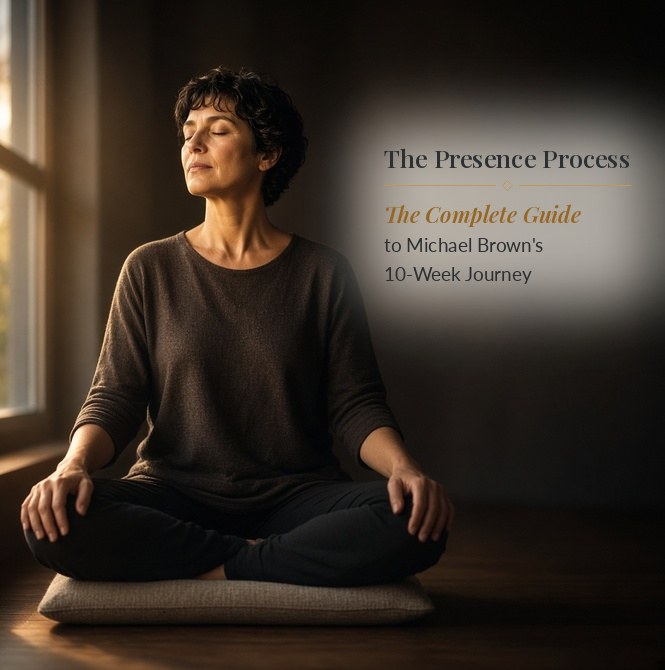
The Presence Process is a 10-week, self-guided programme from Michael Brown’s 2005 book of the same name. Each day you do two 15-minute sessions of connected breathing without pauses, repeat a short weekly phrase and read set chapters. The aim is to feel and “integrate” emotional charge left over from childhood.
Last updated: 23 October 2026
Reading time: about 35 minutes
How we wrote this guide
There are no published studies of the Presence Process itself, so we’ve been careful to separate what Michael Brown teaches from what research shows. For the method, we used both editions of the book, the Library of Congress record of its contents, his publisher’s pages, his own website and articles, and a 2009 question-and-answer blog where he replied to readers. For evidence and safety, we used peer-reviewed research on connected breathwork and breathwork in general, and NHS guidance. We checked every link, video, podcast, book and account in October 2026. We quote the book only briefly. This guide is general information, not medical advice.
⚠️ Before you start: who should be careful
- This isn’t a treatment for mental or physical illness. Keep taking any medicines and keep seeing your doctor or care team. Don’t use the process instead of treatment for depression, PTSD, an eating disorder, addiction or pain that hasn’t been diagnosed.
- The breathing can make you overbreathe. Breathing continuously without pauses can cause light-headedness, tingling and tight muscles. In research on connected breathwork, people with heart or lung conditions, epilepsy, pregnancy or a history of psychosis were excluded (Havenith et al., 2025). If any of these apply to you, talk to your doctor first.
- Expect it to stir things up. Brown warns that you may feel worse before you feel better. If you have a history of trauma or severe mental illness, do it alongside a qualified therapist, not alone.
- Feeling hopeless is a reason to get help, not to push on. If you feel you can’t go on or think about ending your life, stop and get support straight away.
- If you are in crisis, contact a crisis line now. USA: call or text 988 (988 Lifeline). Canada: call or text 9-8-8 (988.ca). UK and Ireland: Samaritans, free on 116 123 (Samaritans). Australia: Lifeline on 13 11 14 (Lifeline). India: Tele-MANAS on 14416 (Tele-MANAS). Elsewhere: find a free local line at findahelpline.com. In an emergency, call your local emergency number (for example 911, 999, 112 or 000).
Quick answer: what is the Presence Process and does it work?
- It’s a book-based course you do on your own. Over 10 weeks you read one session a week, do 15 minutes of “consciously connected breathing” twice a day and repeat a weekly phrase, such as “I choose to respond” (Brown, 2010).
- The idea: Brown says painful emotional patterns from early childhood keep pulling us out of the present. People and events that upset us are “messengers” for those old feelings. Feeling them fully, rather than reacting, is said to resolve them.
- It has a loyal following. Brown’s website says the book has sold over 100,000 copies in English and been published in 19 other languages (The Presence Process Portal, n.d.-b).
- There’s no direct evidence. No published trials have tested the Presence Process. Studies of breathwork in general show small benefits for stress, anxiety and low mood, but most are small (Fincham et al., 2023a).
- It’s demanding and not risk-free. It takes about 30 minutes a day for 10 weeks, the breathing can cause overbreathing symptoms, and difficult feelings are expected. It’s not a good fit if you’re in crisis.
Contents
- What is the Presence Process?
- Who is Michael Brown?
- The core ideas
- How the 10 weeks work
- Consciously connected breathing: how to do a session
- What people report
- How it compares with other approaches
- Does it work? The honest evidence
- Is the Presence Process safe?
- Doing it alone: communities and facilitators
- Books
- Watch, listen and follow
- Frequently asked questions
- Key takeaways
- Sources
What Is the Presence Process?
The Presence Process is a structured, self-guided programme set out in Michael Brown’s book The Presence Process. You work through it on your own, at home, using only the book. There is no teacher, group or app. Brown’s website describes it as “a self-facilitating procedure for gently integrating uncomfortable emotional conditions” (The Presence Process Portal, n.d.-a).
The book has two halves. The first explains Brown’s ideas about time, emotion and childhood. The second is the process itself: ten sessions, each lasting seven days (Brown, 2010). In week one you learn the breathing practice, which you then keep up for 15 minutes twice a day for the whole journey. Each week you also have:
- A short phrase to repeat. The first edition called these “Presence Activating Statements” and the revised edition calls them “conscious responses”. You repeat the week’s phrase silently whenever your mind isn’t busy.
- A chapter to read. It explains the theme of the week.
- Perceptual tools. These are ways of noticing and handling your reactions in daily life.
Later sessions add warm-water “water sessions” and more ways of working with difficult feelings.
The aim is what Brown calls present moment awareness: living with your attention in what is happening now, rather than in replays of the past or worries about the future. He argues that the main thing stopping us is unresolved emotional “charge” from childhood. The process is designed to bring that charge to the surface, so you can feel it without reacting and let it “integrate”.
Brown presents it as a way to “grow up” emotionally and take responsibility for your own experience, not as therapy (Namaste Publishing, n.d.-b). His publisher’s description says we “don’t need to be ‘healed'”. Instead, it says, childhood emotional imprints distract us from the present.
The two editions
The Presence Process: A Healing Journey into Present Moment Awareness was first published in 2005 by Beaufort Books in New York (Brown, 2005). A revised edition, The Presence Process: A Journey into Present Moment Awareness, was published in 2010 by Namaste Publishing in Vancouver (Brown, 2010). Namaste is also Eckhart Tolle’s publisher.
The two editions follow the same 10-week structure, but the revised edition differs in a few ways:
- The weekly statements have new names. “Presence Activating Statements” are now “conscious responses”.
- There are no formal assignments at the end of each chapter.
- The tone is warmer and less like a manual.
- The breathing guidance is clearer. In 2009 Brown said he planned to explain the breathing more clearly in the new edition, and to suggest a hot shower for people without a bath (Presence Process Q&A, 2009a; 2009b).
If you’re buying a copy now, get the revised edition. Most current online discussion refers to it.
Who Is Michael Brown?
Michael Brown is a South African author, born in 1962 according to library records (Library of Congress, n.d.). His publisher says that until 1989 he was a music journalist living what he called a “blissfully unconscious life”. He then developed a very painful neurological condition that conventional medicine could neither cure nor relieve (Namaste Publishing, n.d.-b).
In his own account, the condition was Horton’s syndrome, an old name for cluster headaches. Cluster headaches cause attacks of severe pain on one side of the head (NHS, n.d.-a). The search for relief led him through many alternative therapies. In the book, he says he trained as a Reiki Master and took part in a sweat lodge ceremony in Arizona in 1996 (Brown, 2010).
In interviews, Brown says that repeatedly entering present moment awareness, through ceremony and conscious breathing, eased his pain until it stopped completely (Merlian News, 2011). This is his personal story and hasn’t been independently checked.
In the late 1990s, Brown began to map out a step-by-step route into present moment awareness that “anyone, anywhere” could follow. He returned to South Africa in 2002 and began inviting others to try it (Namaste Publishing, n.d.-b). His other books are Alchemy of the Heart (2008) and Cat Tales for Mariette (2016). Both are published by Namaste.
His publisher says he lives in the Eastern Cape, South Africa, and his website gives a postal address there (The Presence Process Portal, n.d.-a). You may see claims online that Brown has died. We found no reliable source for this. His YouTube channel, The Presence Process Talks, posted a new video in May 2026, and a personal channel was posting in July 2026. He doesn’t appear to run courses, retreats or one-to-one sessions now. His website offers free articles, books, audio and recorded talks instead.
Brown’s website also has a page promoting magnesium supplements from a particular brand, with a discount code in his name (The Presence Process Portal, n.d.-c). This is a commercial interest, and those products are not part of the process.
The Core Ideas
The book uses a lot of its own vocabulary. These are the ideas you’ll meet most often.
Present moment awareness
For Brown, present moment awareness isn’t a technique but a state you gradually build up, or “accumulate”, through daily practice. In his account, most of us live “in time”. Our attention is pulled into replaying the past or worrying about the future, so we never fully experience what is happening now. His publisher’s page sums up the promise: “when we are present, we enjoy a life saturated with meaning” (Namaste Publishing, n.d.-b).
Emotional imprinting and the seven-year cycle
Brown’s central claim is that the emotional atmosphere we absorb in early childhood sets a pattern, or “imprint”, for the rest of our lives. He describes awareness as moving along a “Pathway of Awareness” from emotional to mental to physical. He links this to what he calls the “Seven Year Cycle” (Brown, n.d.):
- Birth to about 7: childhood is mainly emotional.
- About 7 to 14: school trains the mind.
- About 14 to 21: adolescence centres on the body.
In this model, unresolved emotional charge laid down in the first seven years drives the thoughts we have and the situations we keep ending up in as adults. So working on your thinking or circumstances first, he argues, misses the cause.
This is a spiritual and psychological framework, not established developmental science. Early relationships and experiences do shape emotional development. But the neat seven-year stages and the idea that adult life simply “replays” childhood imprints come from Brown, not from research.
Messengers and messages
In Brown’s language, the people and situations that upset us are messengers. The message is the old, unresolved feeling they stir up. A common way of putting this, quoted in the revised edition’s preface, is “Don’t kill the messenger. Receive the message” (Brown, 2010).
So when a partner’s tone of voice makes you furious or a boss’s email fills you with dread, the process asks you to stop blaming the person. Instead, notice that the strength of your reaction is probably about something older. In the 2005 edition, two whole sessions are titled “Identifying the Messenger” and “Getting the Message” (Library of Congress, n.d.).
Brown also talks about reflections and projections. What irritates us in others often mirrors something we haven’t accepted in ourselves. This overlaps with the idea of projection in psychotherapy and with shadow work.
Reacting versus responding
A reaction is automatic behaviour driven by unresolved charge: snapping, sulking, comfort eating, scrolling, drinking or keeping busy. A response means taking charge of the uncomfortable feeling yourself, by staying with it, rather than acting it out or trying to get rid of it. Brown’s website describes the process as moving us from “reactive” to “responsive” behaviour (The Presence Process Portal, n.d.-b). One week’s conscious response is simply “I choose to respond”.
Feeling it to heal it
The 2005 edition has a session called “Feel It to Heal It”, which sums up the method. Brown says it is the feeling of a memory that matters, not the story we tell about it. He argues you don’t need to relive or analyse painful events. Instead, you notice where the discomfort sits in your body and feel it “without condition”, meaning without trying to change it. In a 2009 answer to a reader, he wrote that the “stories we associate with these felt-imprints are irrelevant” (Presence Process Q&A, 2009c).
He calls this skill felt-perception. He also describes the process as “not-doing”. It doesn’t ask you to add anything new to your life. Instead, it brings awareness to things you already do: breathing, thinking, feeling and reading.
Responsibility and “no victims”
A strong theme in Brown’s writing is personal responsibility. He argues that blaming others keeps us stuck in what he calls “victim and victor mentality” (Brown, n.d.). Many readers find this empowering. But it can be harmful if it’s applied to abuse, discrimination or serious illness. We come back to this in the safety section.
How the 10 Weeks Work
The book asks you to read the first parts, which cover the theory and preparation, before starting. Some readers do this as a separate first read. Then you begin the experiential journey, one session per week.
Your daily routine during the 10 weeks:
- Two breathing sessions. Do 15 minutes of consciously connected breathing in the morning and again in the evening, every day from week one. The book calls this “the backbone of this process” (Brown, 2010).
- The weekly phrase. Repeat it silently during the day, whenever your mind isn’t busy.
- The reading. Read the week’s chapter, which explains the theme and the perceptual tools for that session.
- Noticing messengers. Watch your reactions in everyday life and practise responding rather than reacting.
The 10 sessions. The table below shows the 2005 session headings, taken from the Library of Congress record of the first edition’s contents (Library of Congress, n.d.). It also gives the revised edition’s weekly conscious responses, as reported by people who have recently worked through the book.
| Week | Focus in the 2005 edition | Conscious response (revised edition) |
|---|---|---|
| 1 | Our inner presence; consciously connected breathing | This moment matters |
| 2 | Identifying the messenger | I recognise my reflections and projections |
| 3 | Getting the message | I choose to respond |
| 4 | Feel it to heal it | I feel unconditionally |
| 5 | Activating inner compassion; rescuing our child self | I am innocent |
| 6 | Decreasing our negative emotional charge; the emotional cleansing process; into the water | I integrate charged emotions |
| 7 | Feeling our way through; embracing physical presence | I feel safe now |
| 8 | Activating peace of mind through forgiveness | I forgive myself |
| 9 | Restoring emotional balance | I love myself unconditionally |
| 10 | Living on purpose; gratitude | I appreciate what I am |
Water sessions. Around the middle of the process (session six in the first edition), the book adds “water sessions”. These involve lying in a warm bath before a breathing session, as a way of feeling your emotional state more directly. If you don’t have a bath, Brown suggests a 10- to 15-minute hot shower before you breathe (Presence Process Q&A, 2009b). Take care with very hot water if you have a heart condition, low blood pressure or are pregnant, or if the breathing tends to make you light-headed.
Missed days and stopping. The book stresses gentle persistence over perfection. Brown has said many people stop around sessions five to seven, which is when deeper material tends to surface. If you take a break of more than two weeks, he recommends starting again from the beginning (Presence Process Q&A, 2009f). After you finish, he recommends a break of at least three weeks before going through the book again (Presence Process Q&A, 2009d). Between rounds, he suggests continuing the twice-daily breathing with the phrase “I am here now”, one word per breath.
After the 10 weeks. Many people go through the book more than once. Brown frames the process as the start of a lifelong practice of responding, not a one-off fix.
Consciously Connected Breathing: How to Do a Session
This is the core daily practice of the Presence Process, based on Brown’s book and the guidance on his website. Brown’s website now stresses that “it is the connectedness between breaths” that matters, “NOT the intensity of our breathing” (The Presence Process Portal, n.d.-d). If you have any of the health conditions listed in the safety section, check with your doctor first.
▶ Michael Brown – Introduction to the Presence Process – ThePresencePortal. Brown introduces the process in his own words.
- Pick your times. The first edition asks you to breathe soon after waking and again before bed. Brown later said this needn’t be literally the first thing you do, and that you shouldn’t do it straight after a large meal (Presence Process Q&A, 2009g). Choose two slots when you won’t be disturbed for about 20 minutes, and set a gentle timer for 15 minutes.
- Sit comfortably. We suggest sitting upright on a chair or cushion, with your back supported if you need it. Lying down makes it easier to fall asleep.
- Start breathing gently. Close your eyes and breathe in and out at a comfortable pace. Breathing through your nose, if you can, tends to keep the breath slower and makes overbreathing less likely.
- Connect the breaths. Let each in-breath flow into the out-breath, and the out-breath into the next in-breath, without holding your breath at either end. Brown says a tiny natural gap as the breath turns is fine. What you avoid is a long, breathless pause (Presence Process Q&A, 2009h).
- Keep it natural. Don’t force big or fast breaths. Brown’s current advice is to “breathe naturally” and “find your own comfortable rhythm” (The Presence Process Portal, n.d.-d). If you start to feel dizzy or tingly, slow down and breathe more gently.
- Add the phrase if you like. Some people silently repeat a short phrase in time with the breath, one word per in-breath or out-breath, such as “I am here now”.
- Let feelings come and go. Emotions, memories, body sensations, yawning, tiredness or restlessness may come up, and your body may want to move. Brown says movement is fine and shouldn’t be forced to stop. Don’t try to work out what the feelings mean. Just notice where you feel them in your body and keep the breath connected.
- Keep going for the full 15 minutes. If your mind wanders, gently come back to the connected breath. If you fall asleep, Brown suggests splashing your face with cold water and carrying on (Presence Process Q&A, 2009e).
- Sit quietly afterwards. When the timer goes, let your breathing return to normal. Sit for a few minutes, feeling what’s in your body and listening to the sounds around you (Presence Process Q&A, 2009d).
- Return to your day gently. Get up slowly, especially if you feel light-headed. Then go on with the week’s phrase and your reading.
How fast should you breathe?
Advice has changed over time, so it’s worth knowing the difference. In a 2009 reply, Brown said the practice needed “alert breathing”, loud enough to hear and at a “brisk” pace. He also said it was different from deep, relaxed breathing in rebirthing or yoga (Presence Process Q&A, 2009a). His current website instead puts the emphasis on connection rather than intensity and on a natural, comfortable rhythm.
In an article, Brown also says the practice “only calls for natural breathing” and that 15-minute sessions are “not long enough” for intensive processing (Brown, 2009). From a safety point of view, the gentler version is the better choice. Any continuous breathing that’s faster or deeper than your body needs can lead to overbreathing.
What People Report
There’s no systematic data on what happens to people who do the Presence Process. Below is what readers say in reviews, blogs, videos and the questions they sent Brown. Treat it as anecdote, not evidence.
Positive experiences
The most common positive reports are:
- Reacting less. People say they’re less reactive in relationships and notice their triggers sooner.
- Feeling calmer. They describe more calm and less background anxiety.
- Releasing feelings. Crying or anger can surface and pass during the breathing.
- Feeling more present in ordinary moments.
- Taking more responsibility for their moods.
Several long-term reviewers on YouTube describe it as one of the most useful things they’ve done. Some people with chronic pain, especially in the “TMS” (tension myositis syndrome) community, use it alongside other mind–body pain approaches (TMS Wiki, n.d.).
Difficult experiences
Readers’ questions to Brown in 2009 give a frank picture of the harder side. People described:
- Tiredness and weakness that got in the way of work and family life (Presence Process Q&A, 2009i).
- Body sensations: shaking, involuntary movement, headaches and falling asleep during sessions.
- Strong emotions: waves of fear, grief and shame, and intense emotion weeks after finishing.
- Feeling trapped and wanting “it to end” (Presence Process Q&A, 2009j).
- Worsening physical symptoms, such as stomach pain (Presence Process Q&A, 2009k).
Other common complaints in online discussions are:
- The language. The book’s own vocabulary and long, repetitive explanations put some readers off.
- The time it takes. Two 15-minute sessions a day for 10 weeks is hard to keep up.
- No end point. Some people finish without noticing much change.
“Feeling worse before feeling better”
Brown is open that the process can feel uncomfortable. In an article on his website, he says we may “feel poorly before feeling enriched”, and he treats discomfort as a sign of progress (The Presence Process Portal, n.d.-e). When a reader asked whether the process could make their symptoms worse, he replied that it “cannot worsen what already is”. He said it only makes you more aware of what is already there (Presence Process Q&A, 2009k).
That framing can help people stay with ordinary discomfort. But it also has a downside: it can make it harder to tell normal unease apart from a real problem that needs medical or psychological help. See the safety section for guidance on when to stop.
How It Compares With Other Approaches
| Presence Process | Connected breathwork (rebirthing, holotropic) | Mindfulness | Sedona Method | Eckhart Tolle’s teaching | |
|---|---|---|---|---|---|
| Format | Book, done alone over 10 weeks | Facilitated sessions, often 1–3 hours | Courses, apps or self-practice | Book, audio or courses | Books, talks, retreats |
| Main practice | 15 minutes of connected breathing twice a day, plus weekly phrases | Long sessions of continuous, often faster breathing | Paying attention to the present without judging it | Asking “release questions” to let go of feelings | Watching thoughts and “being present” |
| View of emotions | Feel old childhood charge fully to integrate it | Release through intense experience | Notice feelings with acceptance | Let go of feelings, often quickly | Watch the emotional “pain-body” |
| Research | None | A few small studies | Large body of trials | Very little | None directly |
Versus connected breathwork, rebirthing and holotropic breathwork
The breathing in the Presence Process looks a lot like conscious connected breathing, which is used in rebirthing, and holotropic breathwork. All of them involve breathing in a continuous circle without pauses. Brown says the Presence Process “is not aligned with them”. In his account, those methods use powerful breath control and need a facilitator, while his uses natural breathing for shorter periods (Brown, 2009).
In practice, the main differences are:
- Session length. Presence Process sessions last 15 minutes, while breathwork sessions often run for an hour or more.
- Intensity. Brown tells you to breathe at a comfortable rhythm rather than deliberately overbreathing.
- Format. You work alone with a book.
The physiology is related, though. Any continuous breathing that is faster or deeper than you need lowers carbon dioxide in the blood. That drop is what produces many of the dramatic effects of longer breathwork sessions (Havenith et al., 2025).
Versus the Wim Hof Method
Wim Hof’s breathing uses rounds of deliberately deep, fast breaths followed by long breath holds, along with cold exposure. Its aims are mainly physical: energy, resilience and stress tolerance. The Presence Process has no breath holds and no cold exposure, and its aims are emotional and spiritual. In a large, well-blinded trial of a similar fast-breathing-with-holds technique, people improved, but no more than a placebo breathing group (Fincham et al., 2024).
Versus mindfulness
Both aim at present-moment awareness, and both ask you to notice experience without fighting it. But their approaches differ:
- Mindfulness usually trains attention by gently returning to an anchor, such as the breath, and treats feelings as passing events.
- The Presence Process asks you to breathe in a particular way, and to go looking for emotional charge from childhood so you can feel it fully.
Brown has been dismissive of Buddhism and meditation, calling Buddhism too “mental” (Presence Process Q&A, 2009l). Mindfulness has far more research behind it, including courses recommended in UK guidelines.
Versus the Sedona Method
The Sedona Method also deals with stuck feelings, but its approach is almost the opposite. It uses simple questions to help you let go of a feeling in the moment, without needing to dig into the past. When a reader asked about combining the two, Brown said he knew nothing about the Sedona Method. He added that looking for “an easier way” was a form of avoidance (Presence Process Q&A, 2009c). Some people find the Sedona Method gentler and quicker. Others prefer the structure of the Presence Process.
Versus Eckhart Tolle
The Presence Process is often recommended to readers of Eckhart Tolle. Namaste Publishing published both Tolle’s The Power of Now and Brown’s revised edition, and markets Brown’s book “from the publishers of Eckhart Tolle”. The TMS Wiki describes it as following the same principles as The Power of Now, but as a “how-to manual” (TMS Wiki, n.d.).
There is a big overlap. Tolle’s “pain-body”, the build-up of old emotional pain, is close to Brown’s “emotional imprinting”. But Tolle offers no fixed programme, while Brown gives you a daily routine for 10 weeks. Readers who love Tolle’s ideas but struggle to put them into practice often say this is what drew them to the Presence Process. Brown and Tolle are not otherwise connected.
Does It Work? The Honest Evidence
There are no studies of the Presence Process itself
We searched two large research databases, Europe PMC and Crossref, in October 2026. We found no published trials, observational studies or case series of the Presence Process. Everything we know about its effects comes from Brown’s own writing and from personal accounts. These are naturally biased towards people who finished the process and liked it.
That doesn’t mean it can’t help. It means we can’t say how often it helps, for whom, or how often it causes problems.
What research on related practices shows
- Breathwork in general. A 2023 meta-analysis of 12 randomised trials found breathwork was linked with lower self-reported stress than control conditions. It found a small-to-medium effect, with similar effects for anxiety and low mood. But most studies had a moderate risk of bias, and the authors warned against “hype” (Fincham et al., 2023a). The studies covered many different breathing techniques, not connected breathing in particular.
- Fast breathing with breath holds. A large, blinded trial of 200 healthy young adults compared 20 minutes a day of fast breathing with breath holds against a slower placebo version for three weeks. Both groups’ stress improved, with no difference between them (Fincham et al., 2024). This suggests that expectation, routine and taking time out may account for much of the benefit.
- Connected and holotropic breathwork. A 2025 study compared holotropic and conscious connected breathwork in experienced practitioners. The deeper people overbreathed, and the lower their carbon dioxide fell, the more likely they were to enter altered states of consciousness. These states resembled some psychedelic experiences and were linked with better well-being afterwards, though some participants reported feeling worse (Havenith et al., 2025). This was not a randomised trial of benefits.
- Reviews of fast-breathing practices say they can have strong effects on the nervous system and that more rigorous clinical testing is needed (Fincham et al., 2023b; Rhinewine & Williams, 2007).
Why it might help some people
Even without direct evidence, some parts of the process match ideas that are well supported in psychology:
- Time each day spent noticing feelings, rather than suppressing or distracting yourself from them.
- Pausing between a trigger and your reaction.
- Kinder self-talk, such as “I am innocent” and “I forgive myself”.
- Seeing current reactions in the light of past experience.
Similar elements appear in acceptance-based therapies, inner child work and mindfulness. The 10-week structure and twice-daily routine may also help simply by giving people a regular habit and a sense of commitment.
Chronic pain
The Presence Process is popular with people who see their chronic pain as partly driven by stress and emotion, often following the late Dr John Sarno. According to a radio transcript on the TMS Wiki, Sarno said he sometimes did the breathing himself but didn’t use it with patients (TMS Wiki, n.d.). If you’re interested in this route, the best-tested related approach is pain reprocessing therapy. In a randomised trial, it greatly reduced chronic back pain for many participants (Ashar et al., 2022). Always get new or changing pain checked by a doctor first.
Is the Presence Process Safe?
For most healthy adults, 15 minutes of gentle connected breathing is unlikely to be dangerous. But the process isn’t risk-free, and it’s done alone, so you need to be your own safety net.
Overbreathing
Breathing continuously, especially faster or deeper than you need, lowers the carbon dioxide in your blood. This can cause:
- light-headedness or dizziness
- tingling in your hands, feet or around your mouth
- tight or cramping hands
- a racing heart
- feelings of panic or unreality
Researchers deliberately use this effect in longer breathwork sessions (Havenith et al., 2025). If it happens, slow down, breathe more gently through your nose and let the connected pattern go for a few breaths. If you get chest pain or severe breathlessness, or the symptoms don’t settle, stop and seek medical help (NHS, n.d.-d).
Who should check with a doctor first
Studies of connected breathwork have excluded people with:
- cardiovascular disease, such as poorly controlled high blood pressure or heart rhythm problems
- chronic lung disease, such as asthma or COPD
- pregnancy
- epilepsy or other long-term brain conditions
- a history of psychosis
- some personality disorders
- recent substance misuse (Havenith et al., 2025)
The Presence Process breathing is gentler and shorter, but if any of these apply to you, get medical advice first. The same goes for panic disorder, because overbreathing can trigger panic attacks.
Emotional risks
The process is designed to bring up difficult feelings, and it does so without a therapist. Take extra care if you have:
- Trauma or PTSD. Deliberately going looking for childhood pain can be overwhelming. Trauma-focused therapies recommended by the NHS are delivered by trained therapists who pace the work carefully (NHS, n.d.-c).
- Depression or suicidal thoughts. Feeling hopeless is not “part of the process”. It’s a reason to get help now.
- Bipolar disorder, psychosis or dissociation. Intense emotional or altered states may destabilise you.
Even in standard mindfulness courses, some participants have lasting negative effects linked to hyperarousal or dissociation (Britton et al., 2021). A more intense, self-run process is unlikely to be safer.
Concerns about the framing
Some parts of Brown’s teaching deserve caution:
- He treats discomfort as progress. Brown tends to describe uncomfortable experiences as signs that the process is working. To a reader who described feeling trapped and wanting “it to end”, he replied that these feelings were “the medicine” (Presence Process Q&A, 2009j). We think anyone feeling this way should talk to a doctor, a crisis line or a therapist.
- Responsibility can tip into self-blame. Brown’s answer to a reader with PTSD after sexual assault framed past events as “required” and drew on beliefs about past lives (Presence Process Q&A, 2009m). You don’t have to accept that view to benefit from the breathing or the idea of responding rather than reacting.
- Physical symptoms need medical attention. Brown has said the work doesn’t address specific symptoms, and he encouraged a reader with cancer to look after their body. Never treat the process as a substitute for diagnosis or treatment.
When to stop
Stop, or pause the process, if you have:
- persistent panic, dizziness or chest symptoms
- feelings of unreality that don’t pass
- thoughts of harming yourself
- sleep or daily life falling apart for more than a few days
Get support from your doctor or a licensed therapist (in England, NHS Talking Therapies; NHS, n.d.-b). In a crisis, use a crisis line such as 988 (US), 9-8-8 (Canada), Samaritans on 116 123 (UK and Ireland) or Lifeline on 13 11 14 (Australia), or call your local emergency number.
Doing It Alone: Communities and Facilitators
Brown’s view: no groups, no gurus
Unusually, Brown actively discourages support groups. When a chronic pain forum invited him to join its Presence Process group, he replied that a support group “only supports ego, drama” (Presence Process Q&A, 2009n). He argued that our real support group is the family and colleagues we meet every day. An article on his website, “Lets Not Form Another Group”, makes the same case (The Presence Process Portal, n.d.-e).
There are no accredited facilitators
Brown says there is no programme to accredit teachers: “This heart-work is self-facilitation” (Presence Process Q&A, 2009o). So anyone offering “certified Presence Process facilitation” is not endorsed by the process itself. Some coaches offer guided sessions or 10-week groups based on the book. If you join one:
- Ask about their training. Find out what they’re trained in, for example as a counsellor or therapist.
- Ask what they do if someone becomes distressed.
- Check whether they ask about your health before you start.
Online spaces
- Reddit. r/PresenceProcess is a small community where people share their experiences of the process.
- TMS Wiki. The TMS Wiki has a page and forum thread on the Presence Process for people with mind–body pain (TMS Wiki, n.d.).
- Brown’s own website. The Presence Process Portal offers free articles, short books, breathing audio, recorded talks and 10 recorded one-to-one sessions.
Online groups vary in quality and aren’t moderated by professionals. Use them for encouragement, not for advice on mental health crises.
Books
We checked all of these titles on Open Library.
By Michael Brown
- The Presence Process: A Journey into Present Moment Awareness (revised edition, Namaste Publishing, 2010). This is the edition to buy. It includes the full 10-week process, with the background theory in the opening parts.
- The Presence Process: A Healing Journey into Present Moment Awareness (Beaufort Books, 2005). The original edition, with Presence Activating Statements and weekly assignments.
- Alchemy of the Heart (Namaste Publishing, 2008). A shorter book about how childhood shapes our reactions and how to take responsibility for them. His publisher calls it “a weekend read” (Namaste Publishing, n.d.-a).
- Cat Tales for Mariette (Namaste Publishing, 2016). Brown’s website calls it “a book about intimacy” and the “emotional completion” of his three books (The Presence Process Portal, n.d.-f).
- Free short books. The Art of Integration, The Essence and The Flow are free on Brown’s website.
Related reading
- The Power of Now by Eckhart Tolle. The best-known book on present moment awareness, from the same publisher.
- The Untethered Soul by Michael A. Singer. On letting stored emotional energy pass through rather than resisting it.
- When the Body Says No by Gabor Maté. On how stress and suppressed emotion may affect health.
- Healing Back Pain by John E. Sarno. The book behind the TMS approach to chronic pain.
- Holotropic Breathwork by Stanislav and Christina Grof. The theory and practice of the best-known connected breathwork method.
Watch, Listen and Follow
We checked all of these links in October 2026. Some of the creators below sell coaching, courses or products.
Videos
- Michael Brown – Introduction to the Presence Process – ThePresencePortal.
- Michael Brown – Emotional Processing – ThePresencePortal.
- A Walk Through the Presence Process 1 – Namaste Publishing. Brown introduces the process, in two parts.
- A Walk Through the Presence Process 2 – Namaste Publishing.
- Michael Brown, The Presence Process: interview on felt perception and intimacy – unevisual films.
- The Pathway of Awareness (1 of 10) – Jordan Shafer.
- The Presence Process Long Term Review – Ole Stories. A personal account of doing the process over years.
- Notes from The Presence Process – Nithya Shanti.
- The Presence Process and Chronic Pain – TMS RoundTable.
▶ A Walk Through the Presence Process 1 – Namaste Publishing. Brown explains what the process involves, from his publisher’s channel.
Podcasts and interviews
- Interview with Michael Brown – Merlian News, with Merryn Jose (2011). About his illness, conscious breathing and the book.
- Michael Brown, author of The Presence Process and Alchemy of the Heart, part 1 – tributaries radio.
- Michael Brown, author of The Presence Process and Alchemy of the Heart, part 2 – tributaries radio.
- Michael Brown, author of The Presence Process – Intuitive Soul radio (2008).
- ‘The Presence Process’ by Michael Brown: Takeaways – LUAN Emotional Museum (December 2022).
- Dieser Augenblick ist bedeutsam: weeks one to five – atmen_plus, in German (February 2024).
- Die Momente dazwischen: weeks six to ten – atmen_plus, in German (February 2024).
Accounts to Follow
- The Presence Process Talks (Michael Brown): YouTube
- ThePresencePortal: YouTube
- Namaste Publishing: YouTube · Facebook · Instagram
- r/PresenceProcess: Reddit
- Eckhart Tolle: X
Frequently Asked Questions About the Presence Process
What is the Presence Process in simple terms?
It’s a 10-week, do-it-yourself programme from Michael Brown’s book of the same name. Every day you breathe in a continuous, connected way for 15 minutes twice, repeat a short weekly phrase and read that week’s chapter. The aim is to feel and resolve old emotional patterns from childhood so you can live more in the present.
Who created the Presence Process?
Michael Brown, a South African author and former music journalist. He developed it after years of looking for relief from a severe pain condition, and first published it in 2005. A revised edition followed in 2010 from Namaste Publishing, which also publishes Eckhart Tolle.
Is Michael Brown still alive?
We found no reliable report of his death. His publisher says he lives in the Eastern Cape, South Africa, and his YouTube channel was still posting new videos in 2026.
How long does each breathing session take?
Fifteen minutes, twice a day, for the whole 10 weeks. Afterwards, sit quietly for a few minutes. With the reading, expect to spend 30 to 45 minutes a day on the process.
How is the breathing done?
Breathe in and out at a comfortable pace without holding your breath at the top or bottom, so the breaths join in a continuous circle. Brown’s current advice is that the connection matters, not how hard you breathe. If you feel dizzy or tingly, slow down.
Is the Presence Process the same as breathwork or rebirthing?
The breathing is similar to conscious connected breathing used in rebirthing, but the sessions are much shorter and gentler. You do it alone with a book rather than with a facilitator. Brown says his process isn’t aligned with those methods.
What are “messengers” in the Presence Process?
They’re the people and situations that upset you. In Brown’s view, they’re bringing a “message”: an unresolved feeling from your past. The process asks you to stop blaming the messenger and to feel the old feeling instead.
Does the Presence Process work?
There’s no research on the process itself, so no one can say how well it works. Breathwork in general has small benefits for stress, anxiety and mood in studies, though many are low quality. Many readers say it helped them react less and feel more present, while others found it hard going or noticed little change.
Can it make you feel worse?
Yes, at least for a while. Brown expects discomfort, and readers report tiredness, strong emotions, poor sleep and physical symptoms. Feeling hopeless or unsafe is not a sign of progress. Stop and get support if that happens.
Is the Presence Process safe if I have anxiety, PTSD or depression?
It’s not designed for or tested on people with mental health conditions. If you have one, talk to your doctor or therapist first and don’t do it in place of treatment. Overbreathing can trigger panic, and digging into childhood pain without support can be overwhelming.
Do I need a teacher or group?
No. It’s designed to be done alone, and Brown discourages support groups and says there is no accreditation for teachers. Some people still find a friend or online community encouraging.
What if I miss days or stop partway?
Brown says many people stop around sessions five to seven. If you take a break of more than two weeks, he suggests starting again from the beginning.
Which edition should I buy?
The 2010 revised edition from Namaste Publishing, The Presence Process: A Journey into Present Moment Awareness. It’s clearer and most current discussion refers to it.
How does it relate to Eckhart Tolle?
Both teach present moment awareness and share a publisher, but they aren’t otherwise connected. Readers often see the Presence Process as a practical, step-by-step way into ideas similar to those in The Power of Now.
Key Takeaways
- The Presence Process is a 10-week, self-guided book programme by South African author Michael Brown, first published in 2005 and revised in 2010.
- The daily practice is 15 minutes of connected breathing twice a day, plus a weekly phrase and reading.
- The core idea is that emotional charge from early childhood drives adult reactions, and that feeling it fully, rather than reacting, integrates it.
- People and events that upset you are “messengers” pointing to old, unresolved feelings.
- There are no studies of the process itself. Related breathwork research shows modest benefits and a lot of placebo-like improvement.
- It isn’t risk-free: overbreathing symptoms and difficult emotions are common, and it’s not suitable as a replacement for treatment.
- Brown says there are no accredited teachers and discourages support groups. The book is designed to be enough.
- We found no reliable evidence that Brown has died; his channels were active in 2026.
Explore More on Self Help Supermarket
- Eckhart Tolle: official site and teachings
- Michael Singer: official site (The Untethered Soul)
- Gabor Maté: official site (trauma, addiction and healing)
- Wim Hof: the official Wim Hof Method site
- Anthony de Mello: the official archive (external)
- Inner child healing
- Shadow work: the complete guide
- The Emotion Code
- EFT tapping: the complete guide
- Havening
- Map of Consciousness
- Depression: WHO fact sheet (external)
- Mental health: WHO fact sheet (external)
- Browse all techniques
Sources
- Ashar, Y. K., Gordon, A., Schubiner, H., Uipi, C., Knight, K., Anderson, Z., Carlisle, J., Polisky, L., Geuter, S., Flood, T. F., Kragel, P. A., Dimidjian, S., Lumley, M. A., & Wager, T. D. (2022). Effect of pain reprocessing therapy vs placebo and usual care for patients with chronic back pain: A randomized clinical trial. JAMA Psychiatry, 79(1), 13-23. https://doi.org/10.1001/jamapsychiatry.2021.2669
- Britton, W. B., Lindahl, J. R., Cooper, D. J., Canby, N. K., & Palitsky, R. (2021). Defining and measuring meditation-related adverse effects in mindfulness-based programs. Clinical Psychological Science, 9(6), 1185-1204. https://doi.org/10.1177/2167702621996340
- Brown, M. (n.d.). Navigating our experiences. The Presence Process Portal. https://www.thepresenceprocessportal.com/resources/Navigating%20Our%20Experiences.htm
- Brown, M. (2005). The presence process: A healing journey into present moment awareness. Beaufort Books. https://openlibrary.org/works/OL4271640W
- Brown, M. (2009, November 27). A brief discussion about The Presence Process. Merlian News. https://www.merliannews.com/a_brief_discussion_about_the_presence_process_629/
- Brown, M. (2010). The presence process: A journey into present moment awareness (Rev. ed.). Namaste Publishing. https://openlibrary.org/works/OL19947407W
- Fincham, G. W., Strauss, C., Montero-Marin, J., & Cavanagh, K. (2023a). Effect of breathwork on stress and mental health: A meta-analysis of randomised-controlled trials. Scientific Reports, 13, 432. https://doi.org/10.1038/s41598-022-27247-y
- Fincham, G. W., Kartar, A., Uthaug, M. V., Anderson, B., Hall, L., Nagai, Y., Critchley, H., & Colasanti, A. (2023b). High ventilation breathwork practices: An overview of their effects, mechanisms, and considerations for clinical applications. Neuroscience & Biobehavioral Reviews, 155, 105453. https://doi.org/10.1016/j.neubiorev.2023.105453
- Fincham, G. W., Epel, E., Colasanti, A., Strauss, C., & Cavanagh, K. (2024). Effects of brief remote high ventilation breathwork with retention on mental health and wellbeing: A randomised placebo-controlled trial. Scientific Reports, 14, 16893. https://doi.org/10.1038/s41598-024-64254-7
- Havenith, M. N., Leidenberger, M., Brasanac, J., Corvacho, M., Carmo Figueiredo, I., Schwarz, L., Uthaug, M., Rakusa, S., Bernardic, M., Vasquez-Mock, L., Pérez Rosal, S., Carhart-Harris, R., Gold, S. M., Jungaberle, H., & Jungaberle, A. (2025). Decreased CO2 saturation during circular breathwork supports emergence of altered states of consciousness. Communications Psychology, 3, 59. https://doi.org/10.1038/s44271-025-00247-0
- Library of Congress. (n.d.). Table of contents for The presence process: A healing journey into present moment awareness. https://catdir.loc.gov/catdir/toc/ecip0515/2005019805.html
- Merlian News. (2011, July 12). Merlian News podcast interview with Michael Brown. https://www.merliannews.com/merlian_news_podcast_interview_with_michael_brown_1053/
- Namaste Publishing. (n.d.-a). Alchemy of the Heart. https://www.namastepublishing.com/alchemy-of-the-heart
- Namaste Publishing. (n.d.-b). The Presence Process. https://www.namastepublishing.com/the-presence-process
- NHS. (n.d.-a). Cluster headaches. https://www.nhs.uk/conditions/cluster-headaches/
- NHS. (n.d.-b). NHS Talking Therapies, for anxiety and depression. https://www.nhs.uk/mental-health/talking-therapies-medicine-treatments/talking-therapies-and-counselling/nhs-talking-therapies/
- NHS. (n.d.-c). Post-traumatic stress disorder: Treatment. https://www.nhs.uk/mental-health/conditions/post-traumatic-stress-disorder-ptsd/treatment/
- NHS. (n.d.-d). Shortness of breath. https://www.nhs.uk/symptoms/shortness-of-breath/
- Presence Process Q&A. (2009a, July 7). How to breathe for The Presence Process. https://presenceprocessquestions.blogspot.com/2009/07/is-deep-relaxation-breathing-suitable.html
- Presence Process Q&A. (2009b, July 5). What happens if I do not have a bath tub for the water sessions? https://presenceprocessquestions.blogspot.com/2009/07/what-happens-if-i-do-not-have-bath-tub.html
- Presence Process Q&A. (2009c, July 22). Do I need more than The Presence Process while doing it? https://presenceprocessquestions.blogspot.com/2009/07/do-i-need-more-than-presence-process.html
- Presence Process Q&A. (2009d, June 16). What Presence Activating Statement do I use in between experiential journeys through TPP? https://presenceprocessquestions.blogspot.com/2009/06/what-presence-activating-statement-do-i.html
- Presence Process Q&A. (2009e, June 7). Why do I fall asleep during my breathing? https://presenceprocessquestions.blogspot.com/2009/06/why-do-i-fall-asleep-during-my.html
- Presence Process Q&A. (2009f, June 23). If we stop at some point in the procedure, do we restart from the beginning? https://presenceprocessquestions.blogspot.com/2009/06/if-we-stop-at-some-point-in-procedure.html
- Presence Process Q&A. (2009g, June 13). Do I have to attend to the breathing practice on an empty stomach? https://presenceprocessquestions.blogspot.com/2009/06/do-i-have-to-attend-to-breathing.html
- Presence Process Q&A. (2009h, June 9). Am I doing the breathing properly? https://presenceprocessquestions.blogspot.com/2009/06/am-i-doing-breathing-properly.html
- Presence Process Q&A. (2009i, August 27). I cannot get through the tiredness, what do I do? https://presenceprocessquestions.blogspot.com/2009/08/i-cannot-get-through-tiredness-what-do.html
- Presence Process Q&A. (2009j, June 9). What do I do about feeling stuck and wanting it all to end? https://presenceprocessquestions.blogspot.com/2009/06/what-do-i-do-about-feeling-stuck-and.html
- Presence Process Q&A. (2009k, July 20). Does The Presence Process make my symptoms worse? https://presenceprocessquestions.blogspot.com/2009/07/does-presence-process-make-my-symptoms.html
- Presence Process Q&A. (2009l, June 20). What is the difference between The Presence Process, Buddhism, and meditation? https://presenceprocessquestions.blogspot.com/2009/06/what-is-difference-between-presence.html
- Presence Process Q&A. (2009m, August 25). How do I integrate the experience of being gang raped and having been a heroin addict? https://presenceprocessquestions.blogspot.com/2009/08/how-do-i-integrate-experience-of-being.html
- Presence Process Q&A. (2009n, July 31). Would you like to join our TMS, Presence Process support group? https://presenceprocessquestions.blogspot.com/2009/07/would-you-like-to-join-our-tms-presence.html
- Presence Process Q&A. (2009o, October 27). How can I become accredited to teach The Presence Process? https://presenceprocessquestions.blogspot.com/2009/10/how-can-i-become-accredited-to-teach.html
- Rhinewine, J. P., & Williams, O. J. (2007). Holotropic Breathwork: The potential role of a prolonged, voluntary hyperventilation procedure as an adjunct to psychotherapy. The Journal of Alternative and Complementary Medicine, 13(7), 771-776. https://doi.org/10.1089/acm.2006.6203
- Samaritans. (n.d.). Samaritans: Here to listen. https://www.samaritans.org/
- The Presence Process Portal. (n.d.-a). Welcome to The Presence Process portal. https://www.thepresenceprocessportal.com/
- The Presence Process Portal. (n.d.-b). Books. https://www.thepresenceprocessportal.com/books.php
- The Presence Process Portal. (n.d.-c). Wellbeing is currency. https://www.thepresenceprocessportal.com/wellness.php
- The Presence Process Portal. (n.d.-d). How we breathe for The Presence Process. https://www.thepresenceprocessportal.com/how-we-breathe.php
- The Presence Process Portal. (n.d.-e). Articles to support the journey. https://www.thepresenceprocessportal.com/articles.php
- The Presence Process Portal. (n.d.-f). That cat book. https://www.thepresenceprocessportal.com/new-book.php
- TMS Wiki. (n.d.). The Presence Process. https://www.tmswiki.org/ppd/The_Presence_Process