
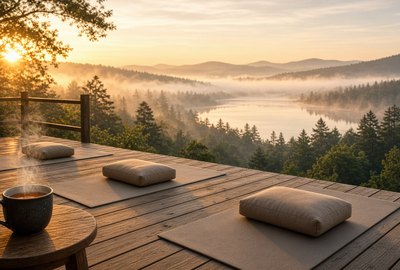
A self-help retreat is a stay of a few days to several weeks away from daily life, focused on personal growth, healing or wellbeing. Retreats range from silent meditation courses and yoga stays to structured personal development programmes and wellness resorts. Most combine teaching, practice, rest and time in nature.
Last updated: 10 November 2026
Reading time: about 7 minutes
How we wrote this article: this article was written by Saj Ali. It lists retreat centres checked on their official websites, explains how costs work, and links research on meditation retreats and time away to the original studies.
Self-help retreats in brief
- What they are. Time away from daily life focused on growth, healing or rest.
- Main types. Meditation, yoga, personal development, wellness and spiritual retreats.
- Cost. From free (donation-based Vipassana courses) to luxury resort prices.
- Research. Meditation retreats showed moderate benefits for anxiety, depression and stress.
- Choosing. Match the retreat’s style, length and structure to your goal.
Contents
- Types of Self-Help Retreat
- Well-Known Retreat Centres in the United States
- Well-Known Retreat Centres Around the World
- How Retreat Costs Work
- What Research Shows
- How to Choose the Right Retreat
- How to Prepare and Make It Last
- A DIY Retreat at Home
- Frequently Asked Questions
- Key Takeaways
- Explore More on Self Help Supermarket
- Sources
Types of Self-Help Retreat
| Type | What happens | Good for |
|---|---|---|
| Silent meditation | Days of meditation in silence, with teachings | Deep calm, mindfulness, insight |
| Yoga | Daily yoga, breathwork and meditation | Body and mind balance |
| Personal development | Structured workshops on beliefs, emotions and goals | Breaking patterns, clarity |
| Wellness | Spa treatments, nutrition, fitness and rest | Recovery from stress and burnout |
| Spiritual | Practice within a tradition, such as Zen or Buddhist | Spiritual growth |
| Creative and nature | Writing, art, hiking or wilderness time | Inspiration and reconnection |
Many centres offer a mix, with a programme of workshops you can choose from.
Well-Known Retreat Centres in the United States
| Centre | Location | Known for |
|---|---|---|
| Esalen Institute | Big Sur, California | Founded in 1962; a birthplace of the human potential movement; workshops, hot springs, massage |
| Kripalu Center for Yoga & Health | Stockbridge, Massachusetts | One of the largest yoga and wellness retreat centres in North America |
| Omega Institute | Rhinebeck, New York | Hundreds of workshops on health, creativity, relationships and leadership |
| Spirit Rock Meditation Center | Woodacre, California | Insight meditation; co-founded by teacher Jack Kornfield |
| Insight Meditation Society | Barre, Massachusetts | Silent insight meditation retreats, from weekends to three months |
| 1440 Multiversity | Scotts Valley, California | Learning retreats in a redwood forest |
| Art of Living Retreat Center | Boone, North Carolina | Meditation, breathwork, yoga and Ayurveda in the Blue Ridge Mountains |
| Drala Mountain Center | Red Feather Lakes, Colorado | Meditation and contemplative retreats in the Rocky Mountains |
Well-Known Retreat Centres Around the World
| Centre | Location | Known for |
|---|---|---|
| Vipassana (Dhamma.org) | Centres worldwide | Ten-day silent residential courses in the tradition of S. N. Goenka; no charge for teaching or room and board |
| Plum Village | Near Bordeaux, France | Mindfulness practice centre founded by Zen master Thich Nhat Hanh |
| Gaia House | Devon, UK | Silent insight meditation retreats |
| Hollyhock | Cortes Island, British Columbia, Canada | Learning retreats on leadership, creativity and healing |
| Kamalaya | Koh Samui, Thailand | Wellness sanctuary with programmes for stress, burnout and detox |
| Sivananda Yoga Centers | Ashrams worldwide | Traditional yoga retreats and teacher training |
Personal development programmes also run residential courses. The Hoffman Process, a week-long residential course on family patterns and emotional healing, has run since 1967 and reports over 150,000 participants.
How Retreat Costs Work
Retreat prices vary widely. These are the main pricing models:
| Pricing model | How it works | Example |
|---|---|---|
| Donation-based | No set fee; students give what they can at the end | Vipassana courses; dana-based meditation retreats |
| Sliding scale | Several price levels by income | Many Buddhist meditation centres |
| Tuition plus lodging | A workshop fee plus a separate room and meals charge, from shared dorms to private rooms | Esalen, Omega, Kripalu |
| All-inclusive programme | One price for teaching, room, meals and treatments | Wellness resorts such as Kamalaya |
| Course fee | A fixed fee for a structured programme | Personal development courses |
Ways to save:
- Choose shared rooms or camping where offered.
- Look for scholarships, work-study or volunteer programmes; many centres, including Omega, offer them.
- Try a weekend before committing to a longer stay.
- Consider donation-based meditation retreats.
- Check prices directly on the centre’s website, as they change by season and room type.
What Research Shows
| Study | Finding |
|---|---|
| Khoury et al., 2017 | A meta-analysis of 21 studies with 2,912 participants found traditional meditation retreats were moderately effective overall, with large effects on anxiety, depression and stress, and benefits maintained at follow-up |
| de Bloom et al., 2009 | Vacations improved health and wellbeing, but the effects faded soon after returning to work |
Together these findings suggest that retreats with a practice you can continue at home, such as meditation, may give longer-lasting benefits than rest alone. Planning how you will keep up what you learn is part of a good retreat.
How to Choose the Right Retreat
Ask yourself these questions:
- What do I want? Rest, healing, skills, spiritual growth or a breakthrough?
- How much structure? Silent retreats have strict schedules. Wellness resorts are flexible.
- How long? A weekend suits a first try. Ten days or more gives time for deeper change.
- Who teaches? Look up the teachers’ training and experience. Our guide to finding a qualified practitioner has questions to ask.
- What is the setting? Mountains, sea, forest or city?
- What is included? Check rooms, meals, dietary options and what costs extra.
- What support is there? For emotionally intense programmes, ask what support is available during and after.
- What do past guests say? Read reviews from several sources.
| If your goal is… | Consider |
|---|---|
| Calm and mindfulness | A silent meditation retreat |
| Stress and burnout recovery | A wellness or yoga retreat |
| Breaking old patterns | A structured personal development programme |
| Spiritual growth | A retreat within a tradition you connect with |
| Inspiration | A creative or nature retreat |
How to Prepare and Make It Last
Before you go:
- Set one clear intention for the retreat.
- Clear your diary and set an out-of-office message.
- Start a short daily practice beforehand, such as 10 minutes of meditation.
- Pack comfortable clothes, a journal and any medication you need.
While you are there:
- Follow the schedule, even when it feels hard.
- Limit phone use. Many retreats ask you to hand phones in.
- Journal each evening.
When you return:
- Ease back in. Plan a quiet day before going back to work.
- Keep one practice going daily, even for five minutes.
- Join a local or online group to keep up the practice.
- Write down three changes you want to keep.
Our journaling guide and meditation guide can help you keep the benefits going.
A DIY Retreat at Home
If travel isn’t possible, you can create a short retreat at home:
| Time | Activity |
|---|---|
| 7:00 | Wake without a phone; gentle stretching |
| 7:30 | 20 minutes of meditation |
| 8:00 | Mindful breakfast in silence |
| 9:00 | Walk in nature |
| 10:30 | Read a self-help book; journal |
| 12:30 | Simple lunch |
| 14:00 | Rest or yoga |
| 15:30 | Reflective writing on your intention |
| 17:00 | 20 minutes of meditation |
| 19:00 | Early dinner; no screens in the evening |
Switch off notifications, tell others you are unavailable, and keep the day simple. Our list of the best self-help books has reading ideas.
Frequently Asked Questions
What is a self-help retreat?
A self-help retreat is time away from daily life, from a weekend to several weeks, focused on personal growth, healing or wellbeing through teaching, practice and rest.
How much do retreats cost?
Costs range from free, as with donation-based Vipassana courses, to luxury wellness resort prices. Many centres charge a workshop fee plus lodging, with shared rooms costing less.
Are meditation retreats effective?
A 2017 meta-analysis of 21 studies found traditional meditation retreats were moderately effective, with large effects on anxiety, depression and stress.
What is the best retreat for beginners?
A weekend programme at a centre with a mix of workshops, yoga and meditation is a gentle first step before a longer or silent retreat.
Are Vipassana courses free?
Yes. Courses at Dhamma.org centres charge nothing for teaching or room and board; they run on donations from past students.
How do I keep the benefits after a retreat?
Keep one daily practice, such as short meditation or journaling, join a group, and plan a gentle return to work.
Key Takeaways
- Self-help retreats range from silent meditation to wellness resorts and personal development courses.
- Well-known centres include Esalen, Kripalu, Omega, Spirit Rock and Plum Village.
- Costs range from donation-based to luxury; shared rooms and scholarships lower the price.
- Meditation retreats show moderate benefits for anxiety, depression and stress.
- Keeping a daily practice afterwards helps the benefits last.
Explore More on Self Help Supermarket
Use these pages alongside this one:
- Meditation – techniques for every level
- Burnout – recovering from exhaustion
- Stress Management – practical ways to manage stress
- Samadhi – deep meditative absorption explained
- How to Find a Qualified Practitioner – questions to ask before you book
- Best Self-Help Books – reading for your retreat
- Best Self-Help Podcasts – shows on psychology, habits and meaning
- The German Guide to Self-Help – rest, nature and routine from Germany
- Browse all self-help techniques – compare every method on Self Help Supermarket.
Sources
- Esalen Institute. https://www.esalen.org/
- Kripalu Center for Yoga & Health. https://kripalu.org/
- Omega Institute. https://www.eomega.org/
- Spirit Rock Meditation Center. https://www.spiritrock.org/
- Insight Meditation Society. https://www.dharma.org/
- 1440 Multiversity. https://www.1440.org/
- Art of Living Retreat Center. https://artoflivingretreatcenter.org/
- Drala Mountain Center. https://www.dralamountain.org/
- Vipassana Meditation (Dhamma.org). Questions and Answers. https://www.dhamma.org/en-US/about/qanda
- Plum Village. https://plumvillage.org/
- Gaia House. https://gaiahouse.co.uk/
- Hollyhock. https://hollyhock.ca/
- Kamalaya Koh Samui. https://kamalaya.com/
- Sivananda Yoga Vedanta Centers. https://sivananda.org/
- Hoffman Institute. https://www.hoffmaninstitute.org/
- Khoury, B., Knäuper, B., Schlosser, M., Carrière, K., and Chiesa, A. (2017). Effectiveness of traditional meditation retreats: A systematic review and meta-analysis. Journal of Psychosomatic Research, 92, 16–25. https://doi.org/10.1016/j.jpsychores.2016.11.006
- de Bloom, J., Kompier, M., Geurts, S., de Weerth, C., Taris, T., and Sonnentag, S. (2009). Do we recover from vacation? Meta-analysis of vacation effects on health and well-being. Journal of Occupational Health, 51(1), 13–25. https://doi.org/10.1539/joh.K8004
Self Help Supermarket guides are for general information and are not a substitute for professional medical or psychological advice.