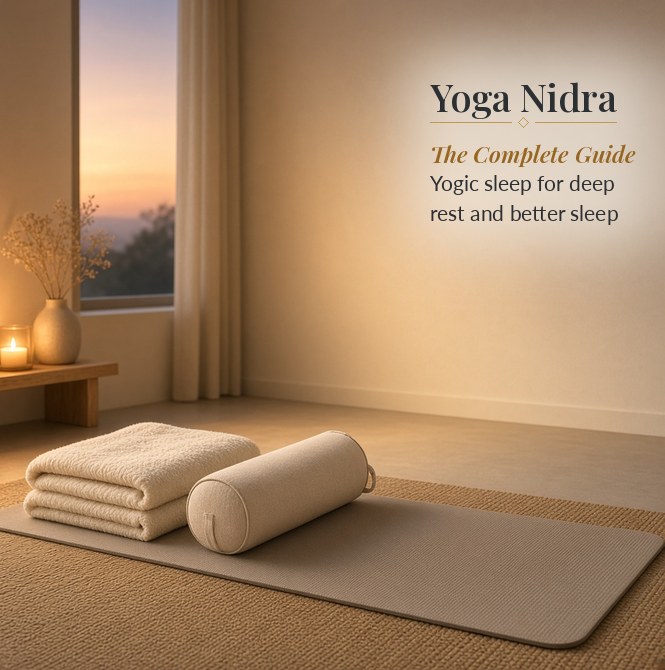
Yoga nidra, often called “yogic sleep”, is a guided meditation practised lying down. A teacher or recording leads you through a body scan, breath awareness, opposite sensations and visualisation, so that your body relaxes deeply while your mind stays gently aware. Many people use it to unwind, ease stress and fall asleep more easily, and it is one of the practices behind the modern idea of Non-Sleep Deep Rest (NSDR).
Last updated: 5 November 2026
Reading time: about 8 minutes
How we wrote this guide: this guide was written by Saj Ali. It brings together the yoga nidra tradition with published research, and every research claim links to its source.
Yoga nidra in brief
- What it is. A guided, lying-down meditation that brings deep relaxation while you stay aware.
- Where it comes from. Ancient yoga traditions, systematised by Swami Satyananda Saraswati in the 1960s.
- How long. Anything from 10 to 45 minutes; many people start with 10 to 20.
- What helps. Studies link yoga nidra with better sleep and lower stress.
- Cost. Free recordings are widely available, and classes are offered in many yoga studios.
Contents
- What Is Yoga Nidra?
- Where Yoga Nidra Comes From
- Yoga Nidra and NSDR
- How to Practise Yoga Nidra
- What the Research Says
- What People Use It For
- Yoga Nidra vs Other Practices
- Getting Started
- Frequently Asked Questions
- Key Takeaways
- Explore More on Self Help Supermarket
- Sources
What Is Yoga Nidra?
Yoga nidra means “yogic sleep”. It is a guided practice in which you lie still while a voice leads you through your body, breath, feelings and images. The aim is to reach a state between waking and sleeping, where the body is deeply relaxed and the mind is quiet but aware (Pandi-Perumal et al., 2022).
Unlike many forms of meditation, you do not need to sit upright or concentrate hard. You simply listen and follow along, which makes yoga nidra very approachable for beginners.
Where Yoga Nidra Comes From
The idea of yogic sleep appears in older yoga and tantric texts. The modern practice was systematised and introduced to the public in the 1960s through the writings of Swami Satyananda Saraswati of the Bihar School of Yoga in India (Pandi-Perumal et al., 2022) (Bihar School of Yoga). His method combines guided imagery with Shavasana, the relaxation pose at the end of many yoga classes (Pandi-Perumal et al., 2022).
Many teachers have since created their own versions. One well-known adaptation is iRest (Integrative Restoration), developed by Dr Richard Miller, which has been used in military and veteran communities and endorsed by the US Army Surgeon General (iRest Institute).
Yoga Nidra and NSDR
Neuroscientist Dr Andrew Huberman coined the term Non-Sleep Deep Rest (NSDR) to describe practices such as yoga nidra that bring deep relaxation without sleep. He shares NSDR protocols of about 10, 20 and 30 minutes (Huberman Lab). NSDR is often a shorter, secular take on yoga nidra, without the intention-setting or spiritual language. Our NSDR guide explains it in detail.
How to Practise Yoga Nidra
Most people practise with a recording or a teacher. A typical session follows these stages (Pandi-Perumal et al., 2022):
1. Lie down and settle
Lie on your back in Shavasana, arms by your sides, palms up, with a pillow under your knees if you like. Cover yourself with a light blanket and close your eyes.
2. Set an intention (sankalpa)
Silently repeat a short, positive statement in the present tense, such as “I am calm and at ease”. Say it three times.
3. Rotate your awareness through the body
Move your attention slowly from one body part to the next: right thumb, each finger, palm, wrist, up the arm, and so on around the whole body. Just notice each part, without moving.
4. Notice your breath
Watch your natural breath, perhaps counting breaths backwards from 27 to 1. If you lose count, simply start again.
5. Feel opposite sensations
Notice pairs of feelings, such as heaviness then lightness, or warmth then coolness, one after the other.
6. Visualise
Picture a series of calming images, such as a quiet beach, a candle flame or a starry sky, letting each one come and go.
7. Return to your intention
Repeat your sankalpa three more times.
8. Come back slowly
Become aware of the room and your breathing again. Move your fingers and toes, roll to one side and sit up when you are ready.
What the Research Says
Research on yoga nidra is growing and encouraging.
- Sleep. In a study of 41 people with chronic insomnia, both yoga nidra and cognitive behavioural therapy for insomnia (CBT-I) improved sleep. The yoga nidra group also showed more deep (N3) sleep and lower salivary cortisol (Datta et al., 2021).
- Stress and wellbeing. In a 2022 study, 30 days of a short 11-minute yoga nidra practice lowered stress and improved sleep quality and wellbeing (Moszeik et al., 2022).
- Brain chemistry. A brain-imaging study found increased dopamine release during yoga nidra, along with a reduced desire for action (Kjaer et al., 2002).
- Clinical interest. Reviews describe growing clinical interest in yoga nidra for sleep, stress and wellbeing (Pandi-Perumal et al., 2022).
What People Use It For
- Falling asleep. Many people play a recording in bed.
- A midday reset. A 10 to 20 minute session can feel refreshing after a poor night.
- Easing stress. The slow body scan helps the body shift into rest mode; see how to lower cortisol.
- Supporting a yoga practice. It fits naturally at the end of a yoga class.
- Creative rest. Some people use the calm, dreamy state for reflection and ideas.
Yoga Nidra vs Other Practices
| Yoga nidra | Sitting meditation | Sleep | |
|---|---|---|---|
| Position | Lying down | Usually sitting | Lying down |
| Awareness | Relaxed but aware | Alert and focused | Not aware |
| Guidance | Usually guided | Guided or silent | None |
| Typical length | 10 to 45 minutes | 5 to 30 minutes | 7 or more hours |
Getting Started
- Choose a quiet time, such as early afternoon or bedtime.
- Start with a 10 to 20 minute recording; our Yoga Nidra hub lists good options.
- Use a blanket, as body temperature drops as you relax.
- If you fall asleep, that is fine; with practice, staying aware becomes easier.
- Keep the same intention for several weeks before changing it.
For more ways to rest well, see our Sleep and Nervous System Regulation guides.
Frequently Asked Questions
What is yoga nidra?
A guided, lying-down meditation, often called yogic sleep, that brings deep relaxation while you stay gently aware.
Who created yoga nidra?
It draws on ancient yoga traditions and was systematised for the public in the 1960s by Swami Satyananda Saraswati of the Bihar School of Yoga.
Is yoga nidra the same as NSDR?
They are closely related. NSDR, a term coined by Andrew Huberman, describes deep-rest practices such as yoga nidra, usually in a shorter, secular form.
How long should a yoga nidra session be?
Anywhere from 10 to 45 minutes. A 2022 study found benefits from just 11 minutes a day for 30 days.
Can yoga nidra help with sleep?
Studies suggest it can. In people with insomnia, yoga nidra improved sleep and increased deep sleep.
Is it okay to fall asleep during yoga nidra?
Yes. Many people do at first, and staying aware becomes easier with practice.
What is a sankalpa?
A short, positive intention repeated at the start and end of a yoga nidra session.
Do I need yoga experience?
No. You simply lie down and follow the guidance.
Key Takeaways
- Yoga nidra is a guided, lying-down meditation that brings deep relaxation with gentle awareness.
- It was systematised in the 1960s by Swami Satyananda Saraswati.
- A session moves through intention, body scan, breath, sensations and visualisation.
- Research links yoga nidra with better sleep and lower stress.
- NSDR is a shorter, secular take on the same idea.
- Start with a 10 to 20 minute recording.
Explore More on Self Help Supermarket
Use these pages alongside this one:
- Yoga Nidra hub – recordings, videos and books
- NSDR – Non-Sleep Deep Rest explained
- Andrew Huberman – the neuroscientist who coined NSDR
- Yoga: The Complete Guide – styles and getting started
- Sleep – better sleep, step by step
- Browse all self-help techniques – compare every method on Self Help Supermarket.
Sources
- Pandi-Perumal, S. R., Spence, D. W., Srivastava, N., et al. (2022). The origin and clinical relevance of Yoga Nidra. Sleep and Vigilance, 6(1), 61–84. https://doi.org/10.1007/s41782-022-00202-7
- Bihar School of Yoga. Official website. https://www.biharyoga.net/
- iRest Institute. About iRest. https://www.irest.org/about-irest
- Huberman Lab. NSDR (Non-Sleep Deep Rest). https://www.hubermanlab.com/nsdr
- Datta, K., Tripathi, M., Verma, M., Masiwal, D., and Mallick, H. N. (2021). Yoga nidra practice shows improvement in sleep in patients with chronic insomnia: A randomized controlled trial. National Medical Journal of India, 34(3), 143–150. https://doi.org/10.25259/NMJI_63_19
- Moszeik, E. N., von Oertzen, T., and Renner, K.-H. (2022). Effectiveness of a short Yoga Nidra meditation on stress, sleep, and well-being in a large and diverse sample. Current Psychology, 41, 5272–5286. https://doi.org/10.1007/s12144-020-01042-2
- Kjaer, T. W., Bertelsen, C., Piccini, P., Brooks, D., Alving, J., and Lou, H. C. (2002). Increased dopamine tone during meditation-induced change of consciousness. Cognitive Brain Research, 13(2), 255–259. https://doi.org/10.1016/S0926-6410(01)00106-9
Self Help Supermarket guides are for general information and are not a substitute for professional medical or psychological advice.