
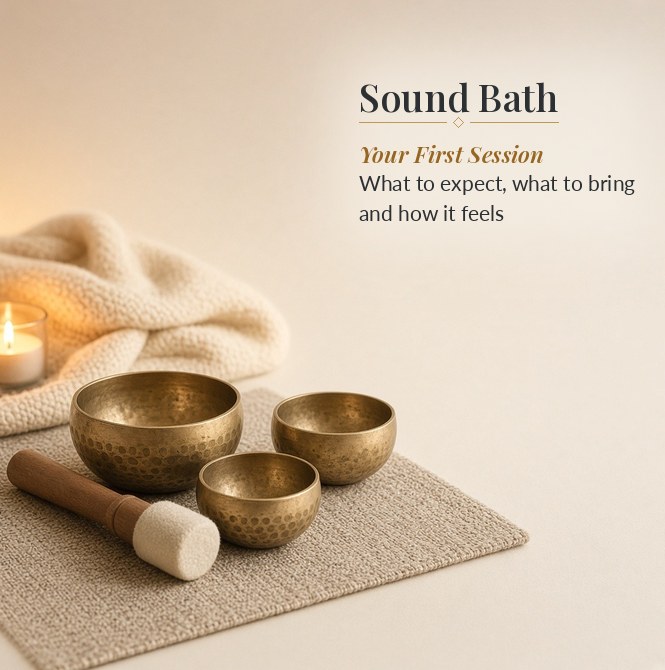
A sound bath is a relaxing group or one-to-one session in which you lie down comfortably while a practitioner plays instruments such as singing bowls, gongs and chimes. You are “bathed” in sound and simply listen, which many people find a gentle, easy way into deep relaxation and meditation. A typical session lasts 45 to 90 minutes.
Last updated: 5 November 2026
Reading time: about 5 minutes
How we wrote this guide: this guide was written by Saj Ali. It explains what happens at a sound bath and summarises published research, and every research claim links to its source.
Sound baths in brief
- What it is. You lie down and listen while instruments are played around you.
- Length. Usually 45 to 90 minutes.
- Instruments. Singing bowls, gongs, chimes, drums and voice.
- What you do. Nothing but rest and listen.
- Our guide. See Sound Healing: The Complete Guide for history and styles.
Contents
- What Is a Sound Bath?
- Instruments You May Hear
- What Happens at Your First Session
- What to Wear and Bring
- How You Might Feel
- What the Research Says
- Trying a Sound Bath at Home
- Finding a Session
- Frequently Asked Questions
- Key Takeaways
- Explore More on Self Help Supermarket
- Sources
What Is a Sound Bath?
A sound bath is a form of sound healing in which a practitioner plays resonant instruments while you lie still and listen. The word “bath” refers to the way the sound seems to wash over you. There is nothing to learn and no right way to feel, which makes it one of the most accessible forms of meditation.
Instruments You May Hear
| Instrument | Sound |
|---|---|
| Metal singing bowls | Warm, layered tones that hum and fade slowly |
| Crystal singing bowls | Pure, clear tones that ring for a long time |
| Gongs | Deep, rolling waves of sound (a “gong bath”) |
| Chimes and bells | Light, bright accents |
| Drums, rain sticks and ocean drums | Soft rhythms and natural sounds |
| Voice | Humming, chanting or gentle singing |
What Happens at Your First Session
- Arrival. You find a space, usually on a mat, and settle with blankets and a cushion.
- Introduction. The practitioner explains the session and may guide a few slow breaths.
- The sound. Instruments are played for most of the session, often building and softening in waves.
- Rest. You simply listen. Many people drift in and out of a dreamy, deeply relaxed state.
- Closing. The sound fades into silence, and you take a few minutes before slowly sitting up.
What to Wear and Bring
- Loose, comfortable clothes and warm socks.
- A yoga mat, blanket and pillow if the venue does not provide them.
- An eye mask, if you like to rest in darkness.
- A bottle of water for afterwards.
- Arrive a few minutes early so you can settle in.
How You Might Feel
Experiences vary. Many people feel calm, light and rested, some notice tingling or warmth, and some drift into sleep, which is perfectly fine. It can be helpful to move slowly afterwards, drink some water and give yourself a quiet half-hour before going back to a busy day.
What the Research Says
In an observational study of 62 adults, a Tibetan singing bowl meditation was followed by significantly less tension, anger, fatigue and depressed mood, and an increase in spiritual well-being. People who were new to this kind of meditation reported a greater reduction in tension than experienced participants (Goldsby et al., 2016). The researchers concluded that singing bowl meditation may be a feasible, low-cost way to reduce feelings of tension and increase well-being (Goldsby et al., 2016).
Trying a Sound Bath at Home
If there is no class near you, you can lie down with headphones and a recorded sound bath. Our Sound Healing hub collects videos to start with, and binaural beats are another way to relax with sound. Pairing a session with yoga nidra or meditation works well.
Finding a Session
Sound baths are offered at yoga studios, wellness centres and online. Look for a practitioner who has trained in sound healing and who explains how they run their sessions. Ask about their training and how long they have been practising.
Frequently Asked Questions
What is a sound bath?
A relaxing session where you lie down and listen while a practitioner plays singing bowls, gongs and other instruments.
How long is a sound bath?
Usually 45 to 90 minutes.
What should I wear to a sound bath?
Loose, comfortable clothes and warm socks. Bring a blanket if the venue does not provide one.
Is it OK to fall asleep in a sound bath?
Yes. Many people drift off, and that is perfectly fine.
What is the difference between a sound bath and a gong bath?
A gong bath is a sound bath played mainly on gongs.
Can I do a sound bath at home?
Yes. Lie down with headphones and a recorded sound bath.
How often should I go?
Whatever suits you. Many people enjoy a session weekly or monthly.
Key Takeaways
- A sound bath is a lying-down listening meditation.
- Singing bowls, gongs and chimes are the most common instruments.
- There is nothing to do but rest and listen.
- Bring comfortable clothes, warm socks and a blanket.
- A study of singing bowl meditation found reduced tension and improved mood.
- You can try a recorded sound bath at home.
Explore More on Self Help Supermarket
Use these pages alongside this one:
- Sound Healing: The Complete Guide – history and styles
- Sound Healing hub – videos and resources
- Binaural Beats – relaxing with sound
- Yoga Nidra – guided deep rest
- Stress Management – everyday calm
- Browse all self-help techniques – compare every method on Self Help Supermarket.
- How to Find a Qualified Practitioner – registers by country
Sources
- Goldsby, T. L., Goldsby, M. E., McWalters, M., and Mills, P. J. (2016). Effects of singing bowl sound meditation on mood, tension, and well-being: an observational study. Journal of Evidence-Based Complementary and Alternative Medicine, 22(3), 401-406. https://doi.org/10.1177/2156587216668109
Self Help Supermarket guides are for general information and are not a substitute for professional medical or psychological advice.

