
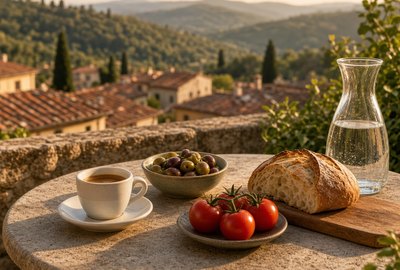
Italian self-help draws on everyday habits and a long intellectual history: unhurried meals, evening walks, time with family and friends, the Mediterranean way of eating, and ideas from Roman Stoics, Renaissance writers and modern Italian thinkers such as Maria Montessori, Roberto Assagioli and Francesco Cirillo.
Last updated: 10 November 2026
Reading time: about 8 minutes
How we wrote this article: this article was written by Saj Ali. It covers Italian words, habits, methods and thinkers, explains where each comes from, and links research where studies exist. Quotes come from published texts and official sources.
Italian self-help at a glance
- Dolce far niente. The sweetness of doing nothing: enjoying rest without guilt.
- Passeggiata. The relaxed evening stroll through town.
- Mediterranean diet. Recognised by UNESCO and linked in trials with heart health.
- Pomodoro Technique. Francesco Cirillo’s 25-minute focus method.
- Thinkers. Marcus Aurelius, Seneca, Montessori and Assagioli.
Contents
- Six Italian Words for a Better Life
- Dolce Far Niente: The Art of Doing Nothing
- La Passeggiata: The Evening Walk
- The Mediterranean Diet and Slow Food
- Sardinia and Long Life
- Italian Thinkers and Methods
- The Pomodoro Technique: Italy’s Focus Method
- How to Bring Italian Habits Into Your Life
- Frequently Asked Questions
- Key Takeaways
- Explore More on Self Help Supermarket
- Sources
Six Italian Words for a Better Life
| Word or phrase | Meaning | How to use it |
|---|---|---|
| Dolce far niente | The sweetness of doing nothing | Schedule guilt-free time to simply rest |
| Passeggiata | An unhurried evening stroll | Walk after dinner with family or friends |
| La bella figura | Making a good impression through care and presentation | Take pride in how you show up |
| Sprezzatura | Effortless grace; making hard things look easy | Practise until skills feel natural |
| Convivialità | The joy of sharing food and company | Eat at least one meal a day with others |
| Piano piano | Slowly, slowly; step by step | Make progress in small, steady steps |
The word *sprezzatura* comes from Baldassare Castiglione’s *The Book of the Courtier* (1528), which described an ideal of grace that hides the effort behind it.
Dolce Far Niente: The Art of Doing Nothing
*Dolce far niente* celebrates enjoying a moment without needing to be productive: sitting in the sun, watching a street, lingering over coffee. In a culture of constant busyness, it offers a useful reminder that rest is valuable in its own right.
Research on short breaks supports this. A meta-analysis of 22 study samples, involving more than 2,300 people, found that micro-breaks of up to ten minutes boosted vigour and reduced fatigue (Albulescu et al., 2022).
Try it: set aside 15 minutes today with no phone, no task and no goal. Sit somewhere pleasant and let your mind wander. See our stress management guide for more ways to unwind.
La Passeggiata: The Evening Walk
In many Italian towns, people stroll through the main street or square in the early evening, greeting neighbours, chatting and enjoying the air. The *passeggiata* combines gentle movement with social connection.
Both parts are good for you. In experiments at Stanford University, walking boosted creative thinking compared with sitting, and the effect lasted for a short time after the walk (Oppezzo and Schwartz, 2014). Social connection matters even more: a meta-analysis of 148 studies involving more than 300,000 people found that people with stronger social relationships had a 50% greater likelihood of survival over the study periods (Holt-Lunstad et al., 2010).
Try it: take a 20-minute walk after dinner, ideally with someone you live with or a neighbour.
The Mediterranean Diet and Slow Food
The Mediterranean diet is on UNESCO’s Representative List of the Intangible Cultural Heritage of Humanity, shared by Italy and six other countries. UNESCO describes it as more than food: it includes skills, knowledge, rituals and the practice of sharing meals at the table (UNESCO).
What research says: in the PREDIMED trial in Spain, involving 7,447 people at high cardiovascular risk, those following a Mediterranean diet supplemented with extra-virgin olive oil or nuts had about 30% fewer major cardiovascular events, such as heart attack and stroke, than those advised to follow a reduced-fat diet (Estruch et al., 2018).
Italy is also home to Slow Food, founded in 1986 as a response to fast food. According to Slow Food, the movement now works in more than 160 countries to promote “good, clean and fair food”.
| Mediterranean habit | Simple step |
|---|---|
| Plenty of vegetables, fruit and legumes | Add a bean or lentil dish twice a week |
| Olive oil as the main fat | Cook and dress salads with olive oil |
| Fish and nuts | Swap one meat meal for fish each week |
| Shared meals | Eat together and put phones away |
| Seasonal, local food | Shop at a local market |
Sardinia and Long Life
Italy’s island of Sardinia includes one of the world’s best-known areas of exceptional longevity. Researchers identified a mountainous area in central-eastern Sardinia with an unusually high number of people living to 100, especially men (Poulain et al., 2004). This finding helped inspire the later “Blue Zones” research.
Researchers point to a mix of factors in such communities, including daily physical work and walking on hilly ground, a plant-rich diet, and strong family and community ties.
The self-help lesson: long-term wellbeing often comes from ordinary daily habits rather than special programmes.
Italian Thinkers and Methods
| Thinker | Key work or idea | Self-help theme |
|---|---|---|
| Marcus Aurelius (121–180) | *Meditations* | Inner calm through Stoic reflection |
| Seneca (c. 4 BC–AD 65) | *Letters to Lucilius*, *On the Shortness of Life* | Using time wisely |
| Baldassare Castiglione (1478–1529) | *The Book of the Courtier* | Grace and self-presentation |
| Maria Montessori (1870–1952) | The Montessori method | Independence and self-directed learning |
| Roberto Assagioli (1888–1974) | Psychosynthesis | Integrating the whole self |
| Francesco Cirillo | The Pomodoro Technique | Focus in short intervals |
Marcus Aurelius, the Roman emperor and Stoic, wrote private notes on how to stay calm and act well. In the Casaubon translation of *Meditations*, he says: “it is in thy power to retire into thyself, and to be at rest” (Project Gutenberg). The idea is that peace comes from within rather than from a holiday or a change of scene.
Seneca, another Roman Stoic, wrote about using time well and treating each day with care. His letters remain widely read in modern self-help.
Maria Montessori was an Italian physician and educator, and one of the first women to graduate in medicine in Italy, in 1896. Her method, now used in schools worldwide, encourages children to learn through independent, hands-on activity. Adults can borrow the idea by learning through doing.
Roberto Assagioli was an Italian psychiatrist who founded psychosynthesis, an approach in humanistic and transpersonal psychology that aims to bring the different parts of a person into a balanced whole.
Francesco Cirillo developed the Pomodoro Technique in the late 1980s while a university student. It is named after the tomato-shaped kitchen timer he used.
The Pomodoro Technique: Italy’s Focus Method
The Pomodoro Technique breaks work into focused intervals, usually 25 minutes, separated by short breaks.
How to use it:
- Choose one task.
- Set a timer for 25 minutes and work only on that task.
- When the timer rings, take a five-minute break.
- After four rounds, take a longer break of 15 to 30 minutes.
The method pairs well with the micro-break research above, which links short breaks with less fatigue. It can also help with procrastination, because 25 minutes feels manageable. For more ideas, see our productivity guide.
How to Bring Italian Habits Into Your Life
| Habit | Start this week |
|---|---|
| Dolce far niente | Take 15 minutes of guilt-free rest each day |
| Passeggiata | Walk for 20 minutes after dinner |
| Mediterranean meals | Cook two plant-rich meals with olive oil |
| Convivialità | Share one meal with friends or family |
| Pomodoro | Use four 25-minute focus rounds on your main task |
| Stoic reflection | Write a short evening note on what went well |
For a German perspective on rest and routine, read The German Guide to Self-Help.
Frequently Asked Questions
What does dolce far niente mean?
Dolce far niente means “the sweetness of doing nothing”. It describes enjoying rest and simple pleasures without guilt.
What is the passeggiata?
The passeggiata is the Italian tradition of an unhurried evening stroll through town, often with family and friends.
Is the Mediterranean diet healthy?
In the PREDIMED trial, a Mediterranean diet with extra-virgin olive oil or nuts was linked with about 30% fewer major cardiovascular events than a reduced-fat diet.
Who invented the Pomodoro Technique?
Italian Francesco Cirillo developed the Pomodoro Technique in the late 1980s, naming it after his tomato-shaped kitchen timer.
What is psychosynthesis?
Psychosynthesis is an approach to psychology founded by Italian psychiatrist Roberto Assagioli. It aims to integrate the different parts of a person into a whole.
Which Italian thinkers are useful for self-help?
Roman Stoics Marcus Aurelius and Seneca, Renaissance writer Castiglione, educator Maria Montessori, psychiatrist Roberto Assagioli and Francesco Cirillo are widely read.
Key Takeaways
- Italian culture values rest, shared meals and evening walks.
- Short breaks reduce fatigue, and walking boosts creative thinking.
- Strong social ties are linked with longer life.
- The Mediterranean diet was linked with fewer cardiovascular events in the PREDIMED trial.
- Italian methods such as Pomodoro, Montessori and psychosynthesis are used worldwide.
Explore More on Self Help Supermarket
Use these pages alongside this one:
- Productivity – ways to focus and get more done
- Procrastination – getting started on tasks you avoid
- Stress Management – practical ways to unwind
- Journaling for Mental Health – reflective writing for wellbeing
- The German Guide to Self-Help – rest, nature and routine from Germany
- Hofstede’s Cultural Dimensions – how national cultures differ
- Browse all self-help techniques – compare every method on Self Help Supermarket.
Sources
- Albulescu, P., et al. (2022). “Give me a break!” A systematic review and meta-analysis on the efficacy of micro-breaks for increasing well-being and performance. PLOS ONE, 17(8), e0272460. https://doi.org/10.1371/journal.pone.0272460
- Oppezzo, M., and Schwartz, D. L. (2014). Give your ideas some legs: The positive effect of walking on creative thinking. Journal of Experimental Psychology: Learning, Memory, and Cognition, 40(4), 1142–1152. https://doi.org/10.1037/a0036577
- Holt-Lunstad, J., Smith, T. B., and Layton, J. B. (2010). Social relationships and mortality risk: A meta-analytic review. PLoS Medicine, 7(7), e1000316. https://doi.org/10.1371/journal.pmed.1000316
- Estruch, R., et al. (2018). Primary prevention of cardiovascular disease with a Mediterranean diet supplemented with extra-virgin olive oil or nuts. New England Journal of Medicine, 378, e34. https://doi.org/10.1056/NEJMoa1800389
- Poulain, M., et al. (2004). Identification of a geographic area characterized by extreme longevity in the Sardinia island: The AKEA study. Experimental Gerontology, 39(9), 1423–1429. https://doi.org/10.1016/j.exger.2004.06.016
- UNESCO. Mediterranean diet. Intangible Cultural Heritage. https://ich.unesco.org/en/RL/mediterranean-diet-00884
- Slow Food. About us. https://www.slowfood.com/about-us/
- Marcus Aurelius. Meditations (M. Casaubon, trans.). Project Gutenberg. https://www.gutenberg.org/ebooks/2680
Self Help Supermarket guides are for general information and are not a substitute for professional medical or psychological advice.