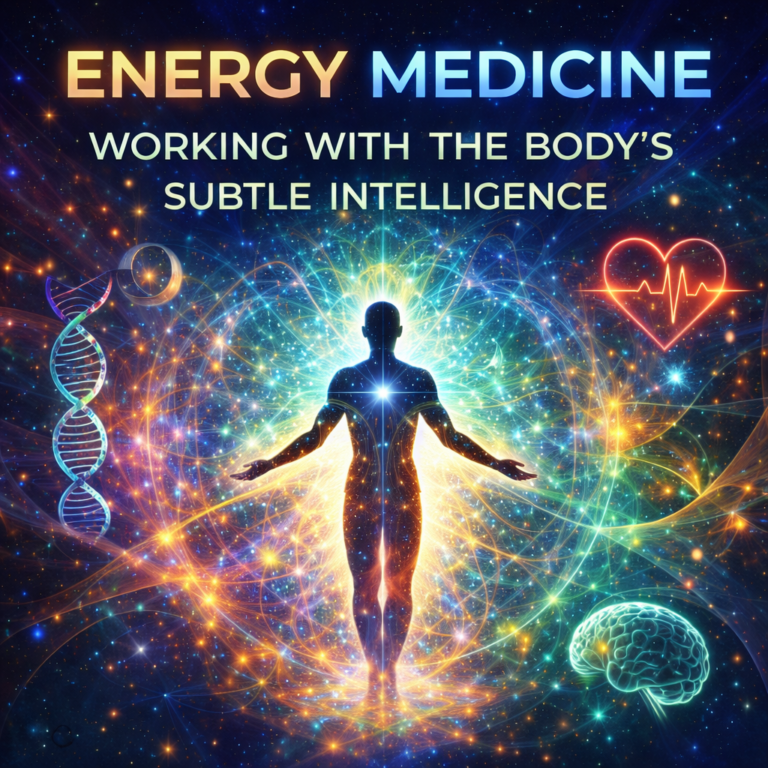
Energy Medicine: Working With the Body’s Subtle Intelligence
Modern medicine excels at structure: organs, systems, chemistry, diagnostics. Energy medicine addresses something different—but no less real—the body’s regulatory intelligence. It operates on the premise that before dysfunction appears in tissue, it first appears in the body’s energetic and informational systems.
In simple terms, energy medicine focuses on how the body communicates with itself.
Every biological process—heartbeat, nerve transmission, immune response—is driven by electrical and electromagnetic activity. Energy medicine works with these underlying patterns, rather than only intervening once breakdown has occurred.
The Body as an Energy System
Long before symptoms arise, the body sends signals: fatigue, tension, mood shifts, disrupted sleep, low resilience to stress. These are not random inconveniences; they are early indicators of imbalance.
Energy medicine views health as coherence—a state where systems are communicating efficiently and without distortion. Stress, trauma, emotional suppression, and chronic overload interfere with this communication. Over time, this interference can express itself physically.
Rather than asking “What’s broken?”, energy medicine asks:
“Where is flow restricted, misaligned, or overloaded?”
This shift in perspective is subtle—but powerful.
Regulation, Not Force
One of the defining features of energy medicine is that it does not rely on force. There is no attempt to overpower the body or aggressively correct it. Instead, the aim is regulation—supporting the body so it can recalibrate itself.
Practices such as breathwork, acupuncture, biofield therapies, somatic awareness, sound, and intention-based techniques all fall under this umbrella. While their methods differ, the objective is the same: restore balance, reduce noise in the system, and allow innate healing processes to function more effectively.
From a nervous system standpoint, this often means shifting the body out of chronic “fight or flight” and back into repair mode.
Stress as an Energetic Load
Stress is not only psychological—it is energetic. When the system is constantly overstimulated, it burns through resources meant for repair, immunity, and regeneration.
Energy medicine works upstream of symptoms by reducing this load. As the system settles, people often report clearer thinking, improved sleep, emotional stability, and increased vitality—sometimes before any visible physical changes occur.
This is not placebo. It is physiology responding to improved regulation.
Complementary, Not Alternative
Crucially, energy medicine is not positioned as a replacement for medical care. It functions best as a complement—working alongside conventional treatment to support resilience, recovery, and long-term wellbeing.
Where medicine treats the condition, energy medicine supports the terrain in which healing occurs.
This integrative approach is increasingly reflected in progressive healthcare models, high-performance coaching, and trauma-informed therapy.
A Shift in Relationship With the Body
Perhaps the most valuable contribution of energy medicine is relational. It teaches people to listen to their bodies rather than override them, to respond rather than react, and to treat symptoms as information—not enemies.
Health, in this framework, becomes less about constant intervention and more about intelligent maintenance.
When the system is coherent, the body does what it has always known how to do: regulate, adapt, and heal.