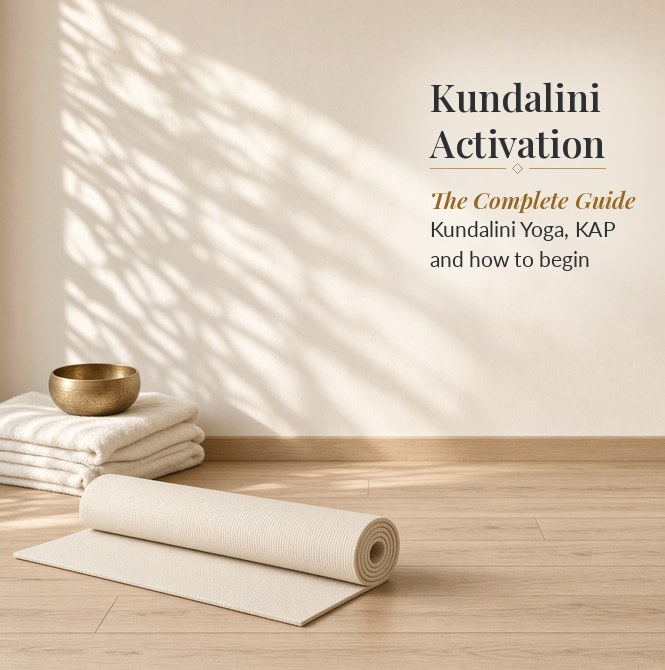
Kundalini activation is the process of awakening kundalini, the vital life-force energy that yogic tradition describes as resting at the base of the spine. People work with it in two main ways: actively, through kundalini yoga, breathwork, mantra and meditation, or receptively, through the Kundalini Activation Process (KAP), where you lie down and receive an energy transmission from a facilitator.
Last updated: 30 October 2026
Reading time: about 16 minutes
How we wrote this guide: this guide was written by Saj Ali. Every research claim below links to the original study, its DOI or an official record.
Quick answer: what is kundalini activation and how do you do it?
- Kundalini is described as dormant life-force energy. In yogic tradition it rests at the base of the spine and rises through the chakras as it awakens, bringing greater energy, awareness and a sense of connection.
- There are two main routes. Kundalini yoga uses effort: breath, posture, mantra and meditation. The Kundalini Activation Process (KAP) is receptive: you lie on a mat while a facilitator transmits energy and gently touches energy points (a KAP facilitator FAQ).
- Kundalini yoga has strong research. Randomised trials have found benefits for anxiety (Simon et al., 2021), insomnia (Khalsa & Goldstein, 2021), memory and mood in older adults (Eyre et al., 2017) and obsessive-compulsive symptoms (Shannahoff-Khalsa et al., 2019).
- A 12-minute practice is a great start. Kirtan Kriya, a kundalini meditation using the sounds Saa Taa Naa Maa, improved mood and cognition in caregivers who practised it daily for eight weeks (Lavretsky et al., 2013).
- KAP is open to beginners. No experience is needed: the KAP Academy says all you have to do is relax and keep an open mind (KAP Academy FAQ).
Contents
- What Is Kundalini?
- Kundalini Yoga: The Active Path
- The Kundalini Activation Process (KAP): The Receptive Path
- How to Practise Kirtan Kriya: A 12-Minute Kundalini Meditation
- Kundalini Yoga vs KAP
- Benefits of Kundalini Practice
- What the Research Shows
- A Simple Daily Kundalini Routine
- Getting the Most from Kundalini Activation
- Finding a Teacher or Facilitator
- Watch, Listen and Follow
- Frequently Asked Questions About Kundalini activation
- Key Takeaways
- Explore More on Self Help Supermarket
- Sources
What Is Kundalini?
Kundalini is a Sanskrit word often translated as “coiled”. In yogic and tantric tradition it describes a vital energy pictured as a serpent coiled at the base of the spine. As kundalini awakens, it is said to rise up the central channel of the body, called sushumna, through each of the seven chakras to the crown of the head.
A kundalini awakening is described as a profound shift in energy and consciousness. People report experiences such as warmth or tingling along the spine, waves of energy, spontaneous movement, emotional release, deep stillness, heightened awareness and a feeling of connection to something greater.
Kundalini activation is the practice of encouraging this energy to awaken. Some approaches do this gradually through daily yoga and meditation; others, like KAP, focus on direct energy transmission.
Kundalini Activation at a Glance
| Origins | Yogic and tantric traditions of India |
| Main approaches | Kundalini yoga, breathwork, mantra and meditation, and the Kundalini Activation Process (KAP) |
| Experience needed | None |
| Home practice | Yes: kundalini yoga and meditations such as Kirtan Kriya |
| Best-researched form | Kundalini yoga, studied in randomised trials |
Kundalini Yoga: The Active Path
Kundalini yoga is a dynamic style of yoga that combines movement, breath, mantra, hand positions (mudras) and meditation. Classes are built from kriyas, sets of exercises performed in a specific order to create a particular effect, such as energising, calming or balancing the nervous system.
Key elements
- Breathwork (pranayama). Techniques such as long, deep breathing and rapid, rhythmic “breath of fire” through the nose.
- Movement. Repetitive movements such as spinal flexes and twists, often done in rhythm with the breath.
- Mantra. Chanted or silent sounds, such as Sat Nam (“truth is my identity”) or Saa Taa Naa Maa.
- Mudras. Hand positions used to focus attention and energy.
- Meditation and relaxation. Classes usually end with a deep relaxation and a meditation.
Because it works with breath and the nervous system, kundalini yoga has become one of the most studied forms of yoga in clinical research, led by researchers such as Dr Sat Bir Singh Khalsa, director of research at the Kundalini Research Institute. See our yoga guide for other styles.
The Kundalini Activation Process (KAP): The Receptive Path
The Kundalini Activation Process, or KAP, was founded by Venant Wong. The KAP Academy describes it as a direct energy transmission that activates the process of kundalini awakening.
What happens in a KAP class
In a typical open class, participants lie comfortably on yoga mats while music plays. There is no breathwork or technique to follow; you simply relax and receive. The facilitator may gently touch specific energy points on the body. Each person’s experience is different: some people experience spontaneous movement, emotional release such as tears or laughter, deep stillness or heightened awareness, while others notice tingling, heat or cool sensations (a KAP facilitator FAQ).
KAP is often called the “path of surrender”, because the focus is on allowing rather than doing. Afterwards there is usually time for grounding and questions (a KAP facilitator FAQ).
Online or in person
KAP is offered both in groups and privately, in person and online. The KAP Academy says online classes are not much different from in-person ones, though some beginners may need one or a few more classes to activate online (KAP Academy FAQ).
Who KAP suits
No experience is needed (KAP Academy FAQ). The KAP Academy notes that it is not recommended for people prone to mania, delusion or psychosis, and that pregnant people in their third trimester should wait until after the birth (KAP Academy FAQ).
How to Practise Kirtan Kriya: A 12-Minute Kundalini Meditation
Kirtan Kriya is one of the best-studied kundalini practices. It combines a mantra, finger movements (mudras) and visualisation, and the Alzheimer’s Research & Prevention Foundation has funded and shared much of the research on it. This is the version used in studies such as Lavretsky et al., 2013.
- Sit comfortably. Sit on a chair with your feet flat on the floor, or cross-legged on a cushion. Keep your spine straight, rest your hands on your knees with palms up and close your eyes.
- Learn the four sounds. The mantra is Saa Taa Naa Maa. Each sound is said in turn, and the cycle repeats.
- Add the finger movements. On Saa, touch your thumb to your index finger. On Taa, thumb to middle finger. On Naa, thumb to ring finger. On Maa, thumb to little finger. Use both hands at the same time.
- Visualise the “L”. As you say each sound, imagine it flowing in through the top of your head, down to the centre of your head and out through the point between your eyebrows, like the shape of a letter L.
- Chant aloud for 2 minutes. Begin by chanting the sounds aloud in your normal voice, keeping a steady rhythm.
- Whisper for 2 minutes. Continue in a whisper.
- Silent for 4 minutes. Say the sounds silently in your mind, keeping the finger movements going.
- Whisper, then aloud. Whisper for 2 minutes, then chant aloud for the final 2 minutes.
- Close the practice. Take a deep breath in, stretch your arms above your head, then bring them slowly down to your sides as you exhale. Sit quietly for a moment before opening your eyes.
In the caregiver study, participants practised for 12 minutes a day for eight weeks (Lavretsky et al., 2013). A daily slot, such as first thing in the morning, makes it easier to keep going.
Kundalini Yoga vs KAP
| Kundalini yoga | KAP | |
|---|---|---|
| Approach | Active: you practise breath, movement, mantra and meditation | Receptive: you lie down and receive a transmission |
| Effort | Moderate physical and mental effort | None; you relax and surrender |
| Setting | Classes, online or at home | Group or private sessions with a facilitator, in person or online |
| Home practice | Yes, daily | Mostly in sessions |
| Research | Randomised trials for anxiety, sleep, mood and memory | Mainly practitioner and participant reports |
Many people enjoy both: a daily kundalini yoga or meditation practice, with occasional KAP sessions for a deeper experience.
Benefits of Kundalini Practice
- Calmer anxiety. In a large trial, kundalini yoga helped many adults with generalised anxiety (Simon et al., 2021). See our anxiety guide.
- Better sleep. Kundalini yoga improved total sleep time and sleep efficiency in people with insomnia (Khalsa & Goldstein, 2021). See sleep.
- Lower stress. Breathwork, mantra and deep relaxation calm the nervous system. See stress management and burnout.
- Brighter mood. Kirtan Kriya reduced depressive symptoms in caregivers (Lavretsky et al., 2013), and kundalini yoga improved mood in older adults with memory concerns (Eyre et al., 2017). See depression.
- Sharper thinking. Both Kirtan Kriya and kundalini yoga improved aspects of memory and cognition in older adults (Lavretsky et al., 2013; Eyre et al., 2017).
- More energy. Many practitioners describe feeling energised and alive. See energy and fatigue.
- Emotional release and growth. KAP participants often describe emotional clearing, clarity and a sense of “coming home” to themselves (a KAP facilitator FAQ).
- Calmer, clearer thoughts. Kundalini meditation gives a busy mind something to focus on. See overthinking.
What the Research Shows
Kundalini yoga has been studied in a growing number of randomised controlled trials.
Anxiety
In a trial published in JAMA Psychiatry, 226 adults with generalised anxiety disorder were randomly assigned to cognitive behavioural therapy (CBT), kundalini yoga or stress education. After 12 weeks, 54.2% of the kundalini yoga group responded, compared with 33.0% for stress education. CBT had the highest response rate (70.8%) and remains the first choice, while the authors noted that yoga can still be helpful for some people (Simon et al., 2021).
Insomnia
Khalsa and Goldstein compared kundalini yoga with sleep hygiene education for sleep-onset insomnia. Kundalini yoga produced larger improvements, including total sleep time (effect size 0.95) and sleep efficiency (1.36), and at six months more than 80% of the yoga group met remission criteria (Khalsa & Goldstein, 2021). An earlier preliminary study found that a simple daily yoga practice improved sleep in people with chronic insomnia (Khalsa, 2004).
Memory and mood in older adults
Eyre and colleagues compared kundalini yoga with memory enhancement training, the gold-standard approach, in older adults with mild cognitive impairment. Both groups improved memory, and only the kundalini yoga group also improved executive function, depressive symptoms and resilience (Eyre et al., 2017).
Kirtan Kriya for caregivers
Lavretsky and colleagues asked 39 family dementia caregivers to practise either Kirtan Kriya or listen to relaxation music for 12 minutes a day for eight weeks. 65.2% of the meditation group achieved at least a 50% improvement in depressive symptoms, compared with 31.2% of the relaxation group. The meditation group also showed improved mental health, cognition and telomerase activity (Lavretsky et al., 2013).
Obsessive-compulsive symptoms
In a randomised trial for obsessive-compulsive disorder, kundalini yoga improved scores on the standard Y-BOCS scale by 40.4%, compared with 17.9% for Relaxation Response meditation (Shannahoff-Khalsa et al., 2019).
The studies at a glance
| Study | Who | Main finding |
|---|---|---|
| Simon et al., 2021 | 226 adults with generalised anxiety | 54.2% responded to kundalini yoga vs 33.0% to stress education |
| Khalsa & Goldstein, 2021 | Adults with insomnia | Large gains in sleep time and efficiency |
| Eyre et al., 2017 | Older adults with mild cognitive impairment | Improved memory, executive function, mood and resilience |
| Lavretsky et al., 2013 | 39 family caregivers | 65.2% vs 31.2% saw a 50% improvement in depressive symptoms |
| Shannahoff-Khalsa et al., 2019 | Adults with OCD | 40.4% vs 17.9% improvement in Y-BOCS scores |
Most published research is on kundalini yoga and meditation. KAP is newer and is mainly described through the experiences of facilitators and participants.
A Simple Daily Kundalini Routine
If you would like to begin gently at home, this 20-minute routine draws on common kundalini yoga practices.
- Tune in (1 minute). Sit tall, bring your palms together at your chest and take a few slow breaths, setting an intention for your practice.
- Long deep breathing (3 minutes). Breathe slowly through the nose, filling the belly, then the ribs, then the chest, and exhale fully.
- Spinal flexes (3 minutes). Sitting cross-legged or on a chair, hold your shins or knees. Inhale as you arch the spine forward and lift the chest; exhale as you round back. Move steadily with the breath.
- Shoulder shrugs (1 minute). Inhale and lift the shoulders, exhale and drop them.
- Kirtan Kriya (12 minutes). Follow the step-by-step guide above.
- Relax (2 to 5 minutes). Lie on your back, let go and rest.
Go at your own pace and rest whenever you need to. Gentle, regular practice is more valuable than intense effort. For more calming practices, see our guides to meditation, mindfulness and the Wim Hof Method for another breath-based approach.
Getting the Most from Kundalini Activation
- Start small and steady. A daily 12-minute meditation is a powerful foundation.
- Ground yourself. After practice or a KAP session, drink water, eat a nourishing meal, walk outdoors or put your bare feet on the ground.
- Allow, don’t force. Both traditions encourage you to let energy move at its own pace. KAP facilitators describe the process as unfolding only to the degree your body is ready for (a KAP facilitator FAQ).
- Integrate between sessions. Journalling, rest and time in nature help you absorb insights and emotional releases.
- Combine with other energy practices. Many people enjoy chakra healing, Reiki or sound healing alongside kundalini work.
- Find community. Group classes, whether kundalini yoga or KAP, add support and shared energy.
If you have epilepsy, a history of psychosis or mania, or are pregnant, talk to your doctor before trying intense breathwork or KAP, and let your teacher or facilitator know.
Finding a Teacher or Facilitator
Kundalini yoga teachers
Kundalini yoga is taught in yoga studios, community centres and online. Look for a teacher who has completed a recognised kundalini yoga teacher training and who offers modifications for beginners. The Kundalini Research Institute and 3HO share classes, events and free resources.
KAP facilitators
The KAP Academy trains facilitators through several levels of training. Choose a facilitator who has completed KAP Academy training, explains clearly what to expect and offers time for grounding and questions after each class.
Costs
Prices vary by country, city and teacher. Drop-in yoga classes and group KAP sessions are usually the most affordable options, while private sessions cost more. Many free kundalini yoga classes and meditations are available online, including the videos below.
Watch, Listen and Follow
Learn what kundalini is, see what a KAP session looks like and follow along with kundalini yoga and Kirtan Kriya at home.
Videos
- What Is Kundalini? // Spiritual Intelligence 014 – Aaron Abke. A clear introduction to kundalini.
- The Science of Kundalini Awakening // Spiritual Intelligence 015 – Aaron Abke. How kundalini awakening is understood.
- KAP Kundalini Activation Process – Behind the Scenes – Venant Wong. Behind the scenes of a KAP class with founder Venant Wong.
- Kundalini Activation Process KAP is The Path of Surrender – Kundalini Activation Process By Tracey. A facilitator on KAP as the path of surrender.
- Easy Kundalini Yoga Practice for Beginners (30-min) Kriya, Poses, Breath of Fire, & Meditation – BrettLarkinYoga. A 30-minute beginner class with kriya, breath of fire and meditation.
- 20 Min Kundalini Yoga for the Entire Body | KUNDALINI YOGA FOR HEALTH – BrettLarkinYoga. A 20-minute whole-body practice.
- Quick Start to Kundalini: Perfect for Beginners 20 Minutes – YogaVision Online. A 20-minute quick start for beginners.
- Heal Your Nervous System: Kundalini Yoga for Spinal Health – YogaVision Online. Kundalini yoga for spinal health.
- Kirtan Kriya – 12 Minute Meditation for Memory (See Ad-Free Version Below) with Mahanraj Kaur – Yoga Vista. Follow along with the 12-minute Kirtan Kriya.
Books
- Kundalini: The Evolutionary Energy in Man – Gopi Krishna (1967). A classic first-person account of kundalini awakening.
- The Principles and Practice of Yoga in Health Care – edited by Sat Bir Singh Khalsa and colleagues (Handspring, 2016). A research-based overview of yoga in health care.
Organisations and free resources
- KAP Academy – the official home of the Kundalini Activation Process, classes and facilitator training.
- Kundalini Research Institute – kundalini yoga research and teacher training.
- Alzheimer’s Research & Prevention Foundation – research on Kirtan Kriya and brain health.
- 3HO – kundalini yoga classes, events and resources.
Frequently Asked Questions About Kundalini activation
What is kundalini activation?
Kundalini activation is the process of awakening kundalini, the life-force energy that yogic tradition describes as resting at the base of the spine. It can be done actively through kundalini yoga, breathwork and meditation, or receptively through the Kundalini Activation Process (KAP).
What is KAP?
KAP, or the Kundalini Activation Process, was founded by Venant Wong. You lie on a mat while music plays and a facilitator transmits energy and may gently touch energy points. Many people experience spontaneous movement, emotional release, tingling or deep stillness.
What does a kundalini awakening feel like?
People describe warmth or tingling along the spine, waves of energy, spontaneous movement, emotional release, deep peace, heightened awareness and a sense of connection. Every person’s experience is different.
Does kundalini yoga work?
Randomised trials have found benefits for generalised anxiety, insomnia, mood and memory in older adults, and obsessive-compulsive symptoms. For anxiety, 54.2% of people responded to kundalini yoga compared with 33.0% for stress education.
How do I activate kundalini at home?
A simple start is a daily kundalini yoga routine with breathing, spinal flexes and the 12-minute Kirtan Kriya meditation. Go gently and allow the energy to develop at its own pace.
Can I do KAP online?
Yes. The KAP Academy says online classes are not much different from in-person classes, although some beginners may need a few more sessions to activate online.
Who should not do KAP?
The KAP Academy says KAP is not recommended for people prone to mania, delusion or psychosis, and suggests waiting until after birth if you are in your third trimester of pregnancy.
Key Takeaways
- Kundalini is described as life-force energy resting at the base of the spine.
- You can activate it actively through kundalini yoga or receptively through KAP.
- KAP was founded by Venant Wong; you simply lie down and receive.
- Kundalini yoga has randomised-trial support for anxiety, sleep, mood and memory.
- Kirtan Kriya is a well-researched 12-minute daily meditation anyone can learn.
- Ground yourself after practice and let the energy unfold at its own pace.
Explore More on Self Help Supermarket
Use these guides alongside this one:
- Yoga – other yoga styles
- Chakra healing – balance your energy centres
- Meditation – daily calm
- Mindfulness – present-moment awareness
- Reiki – gentle energy healing
- Sound healing – healing with sound
- Wim Hof Method – breath and cold
- Spiritual healing – connect to something greater
- Anxiety – calming tools that work
- Stress management – ways to relax
- Sleep – sleep better
- Energy and fatigue – feel recharged
- Burnout – recover and restore
- Overthinking – quiet a busy mind
- Browse all self-help techniques – compare every method on Self Help Supermarket.
Sources
- Simon, N. M., Hofmann, S. G., Rosenfield, D., et al. (2021). Efficacy of yoga vs cognitive behavioral therapy vs stress education for the treatment of generalized anxiety disorder: A randomized clinical trial. JAMA Psychiatry, 78(1), 13–20. https://doi.org/10.1001/jamapsychiatry.2020.2496
- Khalsa, S. B. S., & Goldstein, M. R. (2021). Treatment of chronic primary sleep onset insomnia with Kundalini yoga: A randomized controlled trial with active sleep hygiene comparison. Journal of Clinical Sleep Medicine, 17(9), 1841–1852. https://doi.org/10.5664/jcsm.9320
- Khalsa, S. B. S. (2004). Treatment of chronic insomnia with yoga: A preliminary study with sleep–wake diaries. Applied Psychophysiology and Biofeedback, 29(4), 269–278. https://doi.org/10.1007/s10484-004-0387-0
- Eyre, H. A., Siddarth, P., Acevedo, B., et al. (2017). A randomized controlled trial of Kundalini yoga in mild cognitive impairment. International Psychogeriatrics, 29(4), 557–567. https://doi.org/10.1017/S1041610216002155
- Lavretsky, H., Epel, E. S., Siddarth, P., et al. (2013). A pilot study of yogic meditation for family dementia caregivers with depressive symptoms: Effects on mental health, cognition, and telomerase activity. International Journal of Geriatric Psychiatry, 28(1), 57–65. https://doi.org/10.1002/gps.3790
- Shannahoff-Khalsa, D., Fernandes, R. Y., Pereira, C. A. B., et al. (2019). Kundalini yoga meditation versus the Relaxation Response meditation for treating adults with obsessive-compulsive disorder: A randomized clinical trial. Frontiers in Psychiatry, 10, 793. https://doi.org/10.3389/fpsyt.2019.00793
- KAP Academy. FAQ. https://www.kapacademy.com/faq/
- Berenika Alexandre. FAQ about Kundalini Activation Process (KAP). https://www.berenikaalexandre.com/kundalini-faq
- Alzheimer’s Research & Prevention Foundation. Kirtan Kriya research publications. https://alzheimersprevention.org/alzheimers/kirtan-kriya-research-publications/
- Kundalini Research Institute. https://kundaliniresearchinstitute.org/
Self Help Supermarket guides are for general information and are not a substitute for professional medical or psychological advice.