
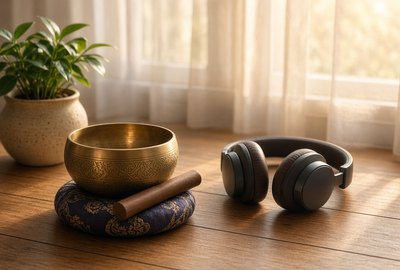
Meditation music is music or sound used to support relaxation, focus and meditation. It is usually slow, steady and free of sudden changes, and includes ambient music, nature sounds, singing bowls, devotional chanting and mantra, drones and binaural beats. Research shows that listening to music can reduce stress and improve sleep quality.
Last updated: 10 November 2026
Reading time: about 7 minutes
How we wrote this article: this article was written by Saj Ali. It explains the main types of meditation music, links research on music, binaural beats and singing bowls to the original studies, and lists albums, artists and apps checked on their official sites.
Meditation music in brief
- What it is. Slow, steady music or sound that supports relaxation and meditation.
- Main types. Ambient, nature sounds, singing bowls, mantra and chant, binaural beats.
- Stress. A meta-analysis of 104 trials found music interventions reduced stress.
- Sleep. A Cochrane review found music improved sleep quality in adults with insomnia.
- Start with. 10 minutes of slow music with your eyes closed, following your breath.
Contents
- Why Music Helps Meditation
- Types of Meditation Music
- What Research Shows
- Well-Known Meditation and Ambient Albums
- Apps and Libraries for Meditation Music
- How to Meditate With Music
- Matching Music to Your Goal
- Frequently Asked Questions
- Key Takeaways
- Explore More on Self Help Supermarket
- Sources
Why Music Helps Meditation
Music can make meditation easier, especially for beginners. It gives the mind something gentle to rest on, masks distracting noise, and can slow breathing and heart rate.
Music suited to meditation usually has:
| Feature | Why it helps |
|---|---|
| Slow tempo, around 60 beats per minute or less | Encourages slower breathing and heart rate |
| Few sudden changes | Avoids pulling attention away |
| Little or no lyrics | Lyrics engage the thinking mind |
| Long, sustained tones | Help the body settle |
| Gentle volume | Relaxing rather than stimulating |
Some traditions prefer silence for meditation, and others, such as kirtan and mantra practice, place sound at the centre. Both approaches can be valuable.
Types of Meditation Music
| Type | What it is | Good for |
|---|---|---|
| Ambient | Slow, atmospheric electronic or acoustic music | Relaxation, focus, sleep |
| Nature sounds | Rain, ocean, forest, streams | Masking noise, calm |
| Singing bowls and gongs | Resonant metal bowls and gongs, often in sound baths | Deep relaxation |
| Mantra and chant | Repeated sacred words or songs, such as Om or Sanskrit and Gurmukhi mantras | Devotional and focus practice |
| Drones | A single sustained note or chord | Concentration |
| Binaural beats | Two slightly different tones, one in each ear, heard as a beat | Relaxation, focus (headphones needed) |
| Solfeggio and tuned frequencies | Music tuned to specific frequencies such as 432 Hz or 528 Hz | Personal preference |
| Guided meditation with music | A voice guides you over soft music | Beginners |
What Research Shows
| Study | Finding |
|---|---|
| de Witte et al., 2020 | Two meta-analyses of 104 randomised trials with 9,617 participants found music interventions reduced both physical stress (such as heart rate) and psychological stress |
| Jespersen et al., 2022 (Cochrane) | In 13 studies of adults with insomnia, listening to music for 25 to 60 minutes a day improved sleep quality, with moderate-certainty evidence |
| Garcia-Argibay et al., 2019 | A meta-analysis of 22 studies found binaural beats had a medium effect on memory, attention, anxiety and pain perception, with longer listening giving better results |
| Goldsby et al., 2017 | After a singing bowl sound meditation, 62 adults reported less tension, anger, fatigue and low mood, and greater spiritual wellbeing |
These results suggest that music is a simple, low-cost way to support relaxation, sleep and meditation practice.
Well-Known Meditation and Ambient Albums
| Album or artist | Year | Why it’s popular |
|---|---|---|
| blank” rel=”noopener”>_Sleep by Max Richter | 2015 | An eight-and-a-half-hour piece composed to be listened to while sleeping |
| “Weightless” by Marconi Union | 2011 | An eight-minute track made with sound therapists to help listeners relax |
| blank” rel=”noopener”>_Ambient 1: Music for Airports by Brian Eno | 1978 | The album that gave ambient music its name |
| Liquid Mind (Chuck Wild) | 1994 onwards | Very slow, spacious albums made for relaxation and sleep |
| Deuter | 1970s onwards | A pioneer of new age and meditation music |
| blank” rel=”noopener”>_Music for Psychedelic Therapy by Jon Hopkins | 2021 | Immersive ambient music inspired by guided therapy sessions |
Mantra and devotional music:
| Artist | Style |
|---|---|
| Deva Premal and Miten | Sanskrit mantras set to gentle music; their recording of the Gayatri mantra is widely used in yoga classes |
| Snatam Kaur | Sikh devotional chanting and kirtan |
Apps and Libraries for Meditation Music
| App | What it offers | Price model |
|---|---|---|
| Insight Timer | A very large free library of music, guided meditations and a meditation timer | Free, with an optional paid tier |
| Endel | Personalised soundscapes for focus, relaxation and sleep | Subscription, with a free trial |
| Headspace | Guided meditations plus focus and sleep music | Subscription, with a free trial |
| Calm | Sleep stories, music and soundscapes | Subscription, with a free trial |
Streaming services such as Spotify, Apple Music and YouTube also have large collections of meditation and sleep playlists. Our guide to meditation apps compares the main options.
How to Meditate With Music
A simple 10-minute music meditation:
- Choose a piece without lyrics, around 10 minutes long.
- Sit or lie comfortably. Close your eyes.
- Take three slow breaths, longer on the out-breath.
- Let the music be the object of your attention. Notice one instrument or tone and follow it.
- When your mind wanders, gently return to the sound.
- As the music ends, stay still for a minute and notice how you feel.
Tips:
- Use headphones for binaural beats; they need a different tone in each ear.
- Keep volume low. Soft sound relaxes; loud sound stimulates.
- Use the same track for a few weeks. Familiar music becomes a cue for your body to relax.
- Set a sleep timer if using music at bedtime.
- Don’t listen while driving to music designed for deep relaxation or sleep.
Our meditation guide covers other techniques, and our comparison of breathing techniques pairs well with music.
Matching Music to Your Goal
| Goal | Try |
|---|---|
| Falling asleep | Very slow ambient, such as Max Richter’s Sleep or Liquid Mind; rain sounds |
| Calming anxiety | “Weightless”; slow nature sounds; singing bowls |
| Focus while working | Steady ambient or drones without lyrics; Endel focus mode |
| Devotional practice | Mantra and kirtan, such as Deva Premal or Snatam Kaur |
| Deep relaxation | A singing bowl or gong sound bath |
| Morning meditation | Gentle ambient with nature sounds |
For more support, see our guides to stress management, anxiety and how to lower cortisol.
Frequently Asked Questions
What is meditation music?
Meditation music is slow, steady music or sound, such as ambient music, nature sounds, singing bowls, mantra or binaural beats, used to support relaxation and meditation.
Does music help with stress?
Yes. A meta-analysis of 104 randomised trials found music interventions reduced both physical and psychological stress.
Is music good for sleep?
A 2022 Cochrane review found that listening to music for 25 to 60 minutes a day improved sleep quality in adults with insomnia.
Do binaural beats work?
A meta-analysis of 22 studies found binaural beats had a medium effect on memory, attention, anxiety and pain perception. You need headphones to hear them.
What is the most relaxing song?
“Weightless” by Marconi Union, released in 2011, was made with sound therapists to help listeners relax and is often described as one of the most relaxing tracks.
Should I meditate with music or in silence?
Both work. Music can help beginners settle and focus, while silence lets you work with the breath and thoughts directly. Many people use both.
Key Takeaways
- Meditation music is slow, steady and usually without lyrics.
- Main types include ambient, nature sounds, singing bowls, mantra and binaural beats.
- Music interventions reduce stress, and music can improve sleep quality.
- Well-known choices include Max Richter’s Sleep, Marconi Union’s Weightless and Brian Eno’s Music for Airports.
- Using the same track regularly can become a cue for your body to relax.
Explore More on Self Help Supermarket
Use these pages alongside this one:
- Meditation – techniques for every level
- Meditation Apps – the main apps compared
- Breathing Techniques Compared – breathwork for calm
- Stress Management – practical ways to manage stress
- How to Lower Cortisol – calming the stress response
- Samadhi – deep meditative absorption explained
- Best Self-Help YouTube Channels – channels for growth, habits and mindset
- Meditation on TikTok – short guided practices and teachers
- Flow State Podcasts and Videos – listening and watching to understand flow
- Browse all self-help techniques – compare every method on Self Help Supermarket.
Sources
- de Witte, M., Spruit, A., van Hooren, S., Moonen, X., and Stams, G. J. (2020). Effects of music interventions on stress-related outcomes: A systematic review and two meta-analyses. Health Psychology Review, 14(2), 294–324. https://doi.org/10.1080/17437199.2019.1627897
- Jespersen, K. V., Pando-Naude, V., Koenig, J., Jennum, P., and Vuust, P. (2022). Listening to music for insomnia in adults. Cochrane Database of Systematic Reviews, 8, CD010459. https://doi.org/10.1002/14651858.CD010459.pub3
- Garcia-Argibay, M., Santed, M. A., and Reales, J. M. (2019). Efficacy of binaural auditory beats in cognition, anxiety, and pain perception: A meta-analysis. Psychological Research, 83(2), 357–372. https://doi.org/10.1007/s00426-018-1066-8
- Goldsby, T. L., Goldsby, M. E., McWalters, M., and Mills, P. J. (2017). Effects of singing bowl sound meditation on mood, tension, and well-being: An observational study. Journal of Evidence-Based Complementary and Alternative Medicine, 22(3), 401–406. https://doi.org/10.1177/2156587216668109
- Max Richter. Official website. https://maxrichtermusic.com/
- Marconi Union. Official website. https://marconiunion.com/
- Brian Eno. Official website. https://www.brian-eno.net/
- Liquid Mind. Official website. https://www.liquidmindmusic.com/
- Insight Timer. https://insighttimer.com/
- Endel. https://endel.io/
Self Help Supermarket guides are for general information and are not a substitute for professional medical or psychological advice.